Superficial Spreading Melanoma: A Comprehensive Guide
The most common melanoma subtype: Understand its radial growth, risk factors, diagnosis, and evolving management strategies for early detection.
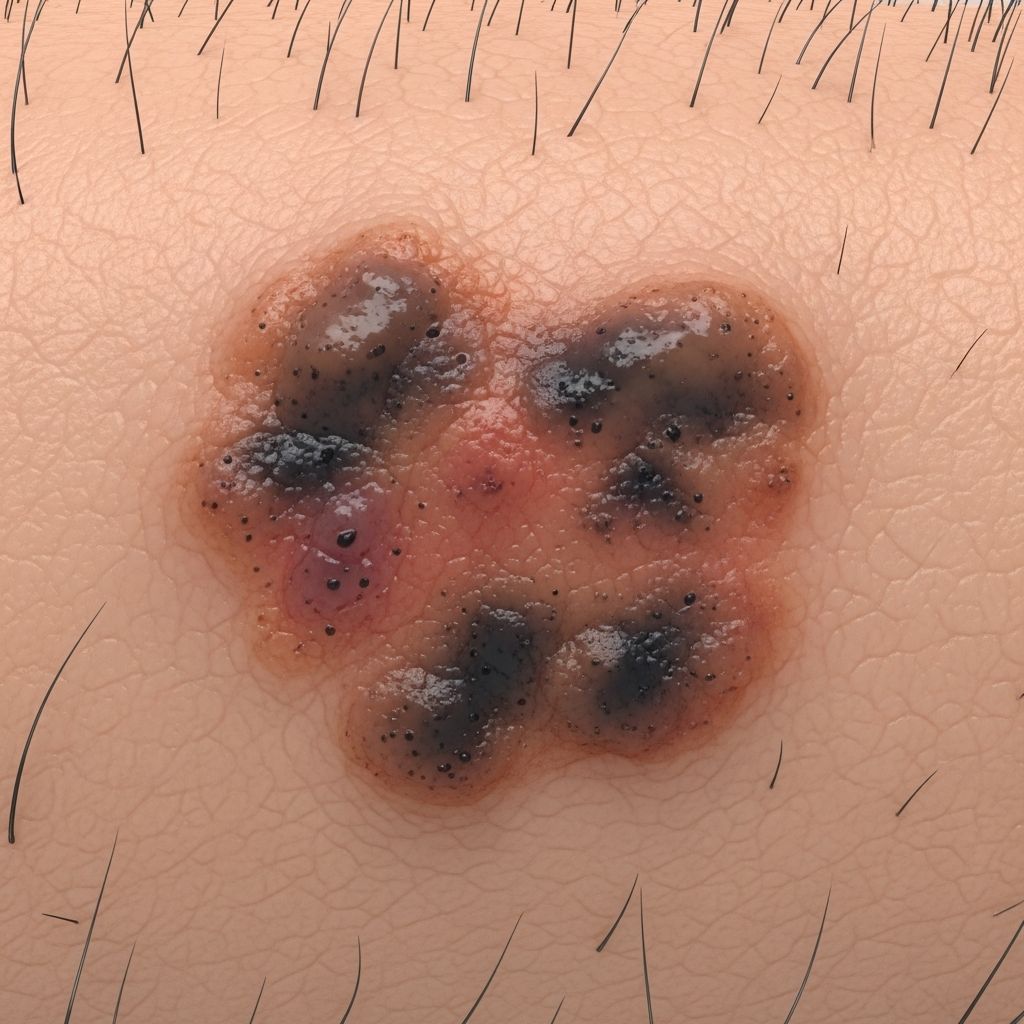
**Superficial spreading melanoma (SSM)** is the most common subtype of melanoma, accounting for approximately two-thirds of cases in high-incidence regions like Australia and New Zealand. It originates from melanocytes in the basal layer of the epidermis and is characterized by a prolonged radial growth phase before potential vertical invasion.
What is superficial spreading melanoma?
Superficial spreading melanoma arises from malignant transformation of melanocytes, the pigment-producing cells in the skin. Unlike more aggressive forms, SSM initially remains confined to the epidermis in an ‘in situ’ phase, spreading horizontally across the skin surface for months to years or even decades. This radial growth phase manifests as a slowly enlarging, flat, discolored patch.
Eventually, an unknown proportion progresses to invasive disease when melanoma cells breach the basement membrane into the dermis. A rapidly growing nodular component may emerge within the lesion, leading to deeper proliferation and increased metastatic potential. Management guidelines continue to evolve; for the latest protocols, consult resources like the Australian Cancer Council Clinical Practice Guidelines for Melanoma.
Who gets superficial spreading melanoma?
SSM predominantly affects individuals with fair skin (phototypes I-II), though it can occur in those who tan moderately (phototype III). It is rare in darker skin tones (phototypes IV-VI). The condition is equally prevalent in males and females, with most diagnoses occurring after age 40; fewer than 15% of cases arise before 40, and it is exceedingly rare under 20 (<1% of cases).
In geographical hotspots like Australia and New Zealand, SSM constitutes about two-thirds of all melanomas, nearly always in white-skinned populations.
What causes superficial spreading melanoma?
The precise trigger for melanocyte malignancy remains unclear, but genetic mutations play a central role. The BRAF V600E mutation is frequently identified in SSM and may evolve as the tumor advances. Ultraviolet (UV) radiation is a key environmental culprit, inducing DNA damage and immune tolerance that permits unchecked growth of abnormal cells. This damage stems from natural sunlight—especially intermittent intense exposure with sunburn—and artificial UV sources like sunbeds.
About 25% of SSM develop within pre-existing melanocytic nevi, which may be common, atypical/dysplastic, or congenital. The majority, however, arise de novo in normal-appearing skin. Childhood sunburns and lifelong intermittent sun exposure heighten risk, particularly on intermittently exposed sites.
What are the risk factors for superficial spreading melanoma?
The primary risk factors for SSM include:
- **Fair skin** that burns easily and does not tan well (phototypes I-II)
- **Previous melanoma** or non-melanoma skin cancer
- **Multiple dysplastic or atypical nevi** (more than 5)
- **Many common moles** (more than 100)
- **Immunosuppression**, such as organ transplant recipients or those on long-term corticosteroids
Secondary factors encompass blue/green eyes, red/blond hair, indoor occupations with outdoor leisure, and clinical signs of chronic sun damage like solar elastosis or keratoses. A history of severe sunburns, especially in youth, significantly elevates risk.
What does superficial spreading melanoma look like?
SSM typically presents as a slowly evolving flat patch of discolored skin, initially mimicking a mole, freckle, or lentigo. Over time—spanning months to decades—it develops distinctive features recognizable by the
ABCDE rule
:Related Stories



- Asymmetry: One half unlike the other
- Border irregularity: Notched, scalloped, or fuzzy edges
- Colour variation: Shades of brown, black, red, white, or blue within the lesion
- Diameter: Larger than 6 mm (pencil eraser size), though smaller lesions occur
- Evolving: Changes in size, shape, color, or symptoms like itching/bleeding
Common sites include the trunk (40%) in males and legs (40%) in females, reflecting intermittent sun exposure patterns. Lesions may itch, bleed, crust, or develop a raised nodule signaling vertical growth. Dermoscopic features often reveal irregular pigmentation, blue-grey veils, atypical networks, and notched borders.
How is superficial spreading melanoma diagnosed?
Suspicious lesions warrant prompt excision biopsy. Pathological confirmation is challenging in early in situ stages but reveals hallmark features:
- Buckshot (pagetoid) scatter of atypical melanocytes in the epidermis—enlarged cells with hyperchromatic nuclei ascending upward
- Nests of melanocytes along the dermo-epidermal junction
- Lack of maturation (no progressive deepening/pigmentation loss toward dermis, unlike nevi)
- Mitotic figures and pleomorphism in advanced cases
Dermal invasion prompts measurement of Breslow thickness (depth in mm) and assessment of Clark level (anatomic invasion plane). Ulceration, mitotic rate, and regression are prognostic indicators.
What are the Clark levels of melanoma?
| Level | Characteristics |
|---|---|
| Level 1 | In situ melanoma (epidermis only) |
| Level 2 | Invaded papillary dermis |
| Level 3 | Filled papillary dermis |
| Level 4 | Invaded reticular dermis |
| Level 5 | Invaded subcutaneous fat |
Clark levels provide anatomical context but are largely supplanted by Breslow thickness for prognostication.
What is the staging of melanoma?
TNM staging integrates tumor thickness, ulceration, nodal involvement, and metastases:
| Stage | Characteristics |
|---|---|
| Stage 0 | Melanoma in situ |
| Stage I | Thin invasive melanoma (<2 mm, no ulceration) |
| Stage II | Thick melanoma (>2 mm) or ulcerated thin melanoma, no nodes |
| Stage III | Regional lymph node metastases |
| Stage IV | Distant metastases |
Early-stage SSM (in situ or thin invasive) carries excellent prognosis with >95% 5-year survival.
What is the treatment for superficial spreading melanoma?
Treatment hinges on stage:
- In situ/early invasive: Wide local excision with 5-10 mm margins suffices.
- Thicker tumors (>1-2 mm): Wider margins (1-2 cm); sentinel lymph node biopsy (SLNB) often recommended for staging, especially in younger patients, though it lacks proven survival benefit.
- Node-positive (Stage III): Complete lymphadenectomy ± adjuvant immunotherapy (e.g., checkpoint inhibitors).
- Metastatic (Stage IV): Systemic therapies including targeted BRAF/MEK inhibitors, immunotherapy, or clinical trials.
In New Zealand, SLNB is favored for melanomas >1 mm. Follow-up entails regular skin checks and self-exams.
What is the outcome for superficial spreading melanoma?
Prognosis excels for early detection: in situ lesions approach 100% cure rate post-excision. Thin invasives (<1 mm) yield >95% 5-year survival. Thicker tumors or nodal spread worsen outlook, though immunotherapies have improved Stage III/IV outcomes dramatically. Regular surveillance and sun protection mitigate recurrence risk.
How can superficial spreading melanoma be prevented?
Primary prevention targets UV exposure:
- Avoid midday sun (10 AM-4 PM); seek shade.
- Wear protective clothing, broad-brim hats, UV sunglasses.
- Apply SPF 50+ broad-spectrum sunscreen daily, reapplying every 2 hours.
- Avoid sunbeds entirely.
- Perform monthly skin self-exams using ABCDE; see dermatologist for changes.
- High-risk individuals: Annual full-body exams.
Frequently Asked Questions (FAQs)
Q: Is superficial spreading melanoma the most common melanoma type?
A: Yes, it accounts for 60-70% of melanomas, especially in fair-skinned populations in sunny regions.
Q: Can SSM arise from a mole?
A: About 25% develop within existing nevi; most arise de novo. Monitor changing moles closely.
Q: What does ABCDE stand for in melanoma detection?
A: Asymmetry, Border irregularity, Colour variation, Diameter >6 mm, Evolving changes.
Q: Is sentinel node biopsy always necessary?
A: Controversial; recommended for thicker melanomas (>1 mm) for staging, but no survival benefit proven.
Q: How does UV exposure contribute to SSM?
A: UV induces mutations (e.g., BRAF) and immune suppression, promoting radial growth on intermittently exposed skin.
References
- Superficial Spreading Melanoma — DermNet NZ. 2023. https://dermnetnz.org/topics/superficial-spreading-melanoma
- Superficial Spreading Melanoma — Wikipedia (citing primary sources). 2023. https://en.wikipedia.org/wiki/Superficial_spreading_melanoma
- Melanoma — DermNet NZ (StatPearls/NCBI). 2023. https://www.ncbi.nlm.nih.gov/books/NBK470409/
Similar Articles








Read full bio of medha deb