Supernumerary Nipple Images: 7 Kajava Categories Explained
Explore detailed images and clinical insights into supernumerary nipples, accessory mammary tissue malformations present from birth.
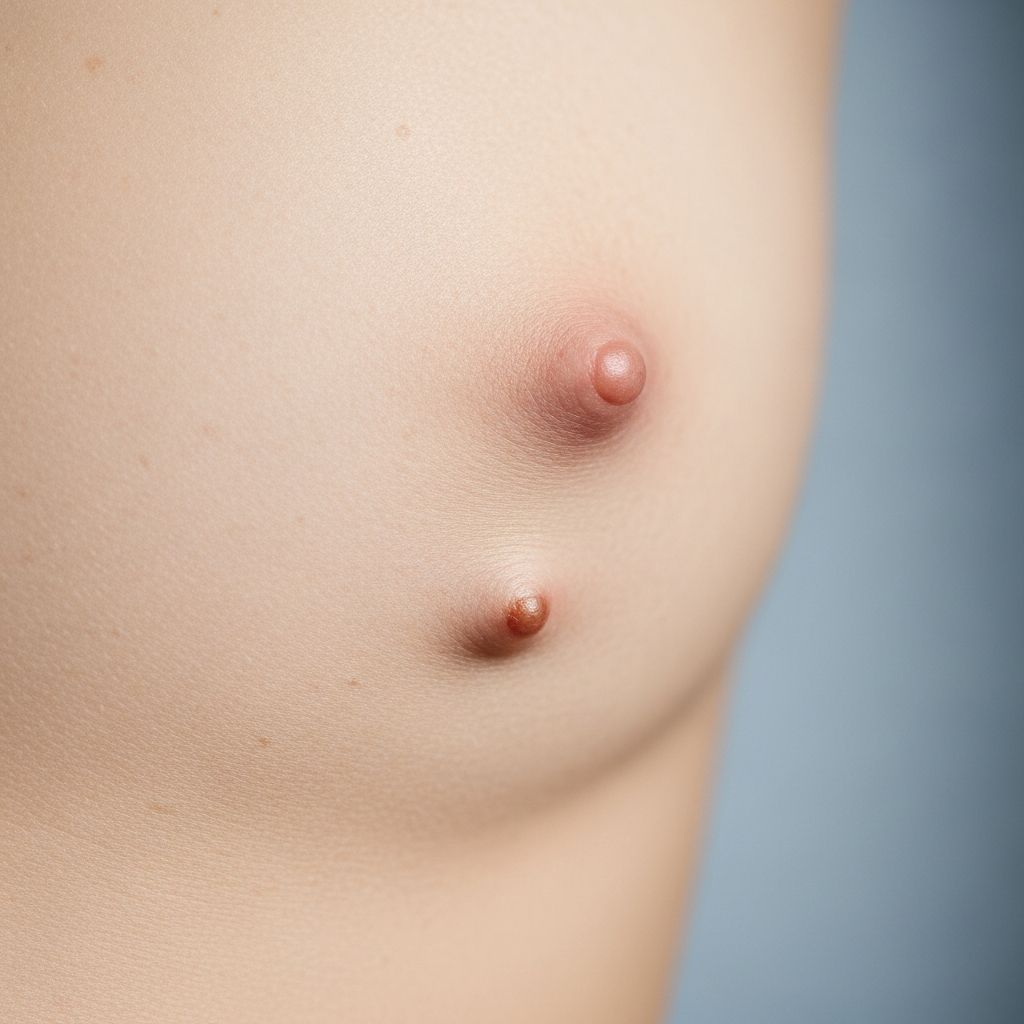
A supernumerary nipple, also known as an accessory nipple, third nipple, ectopic nipple, or polythelia, represents a congenital minor malformation of mammary tissue resulting in extra nipple(s) and/or associated glandular structures. These are typically harmless but can mimic skin lesions like naevi. This image gallery provides clinical, dermoscopic, and histological visuals to aid diagnosis.
What is a Supernumerary Nipple?
Supernumerary nipples arise from incomplete regression of embryonic milk lines (mammary ridges), which form as thickened ectodermal strips extending from the axilla to the groin. Normally, only the pectoral ridges persist to form the breasts, but vestigial remnants elsewhere lead to extra nipples. They occur in up to 6% of the population, more commonly in males, and follow an autosomal dominant inheritance in about 6% of familial cases.
These lesions are present at birth, often resembling small brown or pink papules with a central projection. They may enlarge at puberty due to hormonal influence, develop hair, or rarely lactate if glandular tissue is present. Prevalence varies globally: up to 6% in the US, lower in Hungary at 0.22%.
Clinical Features
Supernumerary nipples appear along the milk lines bilaterally, from axilla to groin, though 5% occur ectopically on the neck, back, vulva, or thighs. They are usually smaller than normal nipples, measuring 2-5 mm, with a central nipple elevation and possible dimple. Colors range from pink to brown, and they may be solitary or multiple.
- Solitary or multiple: Often one per side but can be numerous.
- Location: 67% below normal breast, 21% above, along vertical lines.
- Appearance at birth: Flat or raised papule, mole-like.
- Pubertal changes: Enlargement, tenderness, hair growth, premenstrual swelling.
- Rare complications: Lactation, pain, or diseases like carcinoma.
Images typically show a small, elevated central nipple within a faintly pigmented areola-like area on the trunk, abdomen, or thigh. For example, one common presentation is a 3 mm brown papule with central dimple on the left mid-axillary line.
Kajava Classification
The 1915 Kajava system categorizes supernumerary nipples by tissue components, aiding clinical assessment. Category I (polymastia) includes full breast tissue, while Category VI (polythelia) is nipple only.
| Category | Description | Features | Image Characteristics |
|---|---|---|---|
| I (Polymastia) | Complete breast with nipple + areola + gland | May lactate fully | Miniature breast mound |
| II | Nipple + areola + gland, no fat | Glandular swelling | Areola with central nipple |
| III | Areola + gland, no nipple | Patches of breast tissue | Pigmented patch |
| IV | Gland only, no nipple/areola | Subcutaneous lump | Non-descript swelling |
| V (Pseudomamma) | Nipple + areola + fat, no gland | Soft mound | Areola with fatty base |
| VI (Polythelia) | Nipple only | Most common | Small projecting papule |
| VII | Areola only (polythelia areolaris) | Pigmented macule | Flat brown spot |
This classification is crucial as higher categories with glandular tissue can develop breast pathologies.
Dermoscopic Features
Dermoscopy reveals distinctive patterns distinguishing supernumerary nipples from melanoma or naevi. Key features include a peripheral network-like structure and central white scar-like area.
Related Stories



| Dermoscopic Feature | Description |
|---|---|
| Peripheral network | Brownish interconnected lines on tan background at edges |
| Central network-like structures | Similar network centrally |
| Central white scar-like area | Sharply circumscribed white patch in center |
| Cleft-like appearance | Rim splitting nipple tip symmetrically |
| White cobblestone globules | Aggregated whitish angulated structures |
| Central dimpling with plug | Round dimple with dark plug |
| Fisheye-like (comedo-mimic) | Dark dots resembling comedo openings |
Images under dermoscopy show these hallmarks: e.g., a lesion with peripheral pigment network, central white fibrosis, and nipple cleft.
Differential Diagnoses
- Melanocytic naevus: Lacks elevation/dimple; irregular network on dermoscopy.
- Sebaceous naevus: Yellowish, hairless plaque.
- Organoid naevus: Verrucous surface, epidermal features.
- Basal cell carcinoma: Pearly border, arborizing vessels.
- Clear cell acanthoma: Vascular globules.
- Neurofibroma: Buttonhole sign.
Definitive differentiation requires biopsy if atypical.
Associated Conditions
Though usually isolated, supernumerary nipples feature in syndromes like Simpson-Golabi-Behmel, Beckwith-Wiedemann, or urogenital malformations. A disputed link exists to urinary tract anomalies; one study found higher prevalence in urologic malignancies (32/203 vs. 4/203 controls). Monitor for rare breast cancer in glandular types.
Histology
Microscopically, epidermis is papillomatous with elongated rete ridges. Dermis shows smooth muscle bundles, ductal structures, and lobules akin to normal nipple-areola complex. No atypia unless diseased.
Images: H&E stains reveal stratified squamous epithelium, subepithelial fibrosis, and mammary glands.
Diagnosis and Treatment
Diagnosis is clinical/dermoscopic; biopsy confirms. No treatment needed unless cosmetic concern, pain, or lactation. Excision is simple outpatient procedure.
Frequently Asked Questions (FAQs)
Q: Are supernumerary nipples cancerous?
A: Extremely rare; glandular types can develop carcinoma like normal breast tissue, but risk is low.
Q: Can supernumerary nipples lactate?
A: Yes, if containing glandular tissue; reported in pregnancy/postpartum.
Q: Should I remove a third nipple?
A: Only for cosmetics or symptoms; otherwise benign.
Q: Do they indicate kidney problems?
A: Association disputed; screen if syndromic features present.
Q: How common are multiple extra nipples?
A: Up to 8 reported; usually solitary.
Image Gallery Highlights
- Infant axilla: Tiny pink papule.
- Adult abdomen: Brown nipple with areola, hairy.
- Dermoscopy: Network + central scar.
- Rare ectopic: Thigh lesion.
(Note: Actual images depict these variations; consult dermatologist for personal cases.)
References
- Supernumerary nipple dermoscopy — DermNet NZ. 2023. https://dermnetnz.org/topics/supernumerary-nipple-dermoscopy
- Supernumerary Nipple — DermNet NZ. 2023. https://dermnetnz.org/topics/supernumerary-nipple
- Third (supernumerary) nipple: Types, causes, and removal — Medical News Today. 2023-05-23. https://www.medicalnewstoday.com/articles/320710
- Supernumerary nipples and urologic malignancies — PubMed (Urol Int). 1986. https://pubmed.ncbi.nlm.nih.gov/3791170/
- Supernumerary nipple image — DermNet NZ. 2023. https://dermnetnz.org/imagedetail/9198-supernumerary-nipple
- Third Nipple (Supernumerary Nipple): Causes, Types & Removal — Cleveland Clinic. 2023-08-01. https://my.clevelandclinic.org/health/diseases/25167-third-nipple
Similar Articles








Read full bio of medha deb