Suture Materials: Essential Guide For Choosing The Right Type
Comprehensive guide to suture materials, types, properties, and selection for optimal wound closure in dermatological surgery.
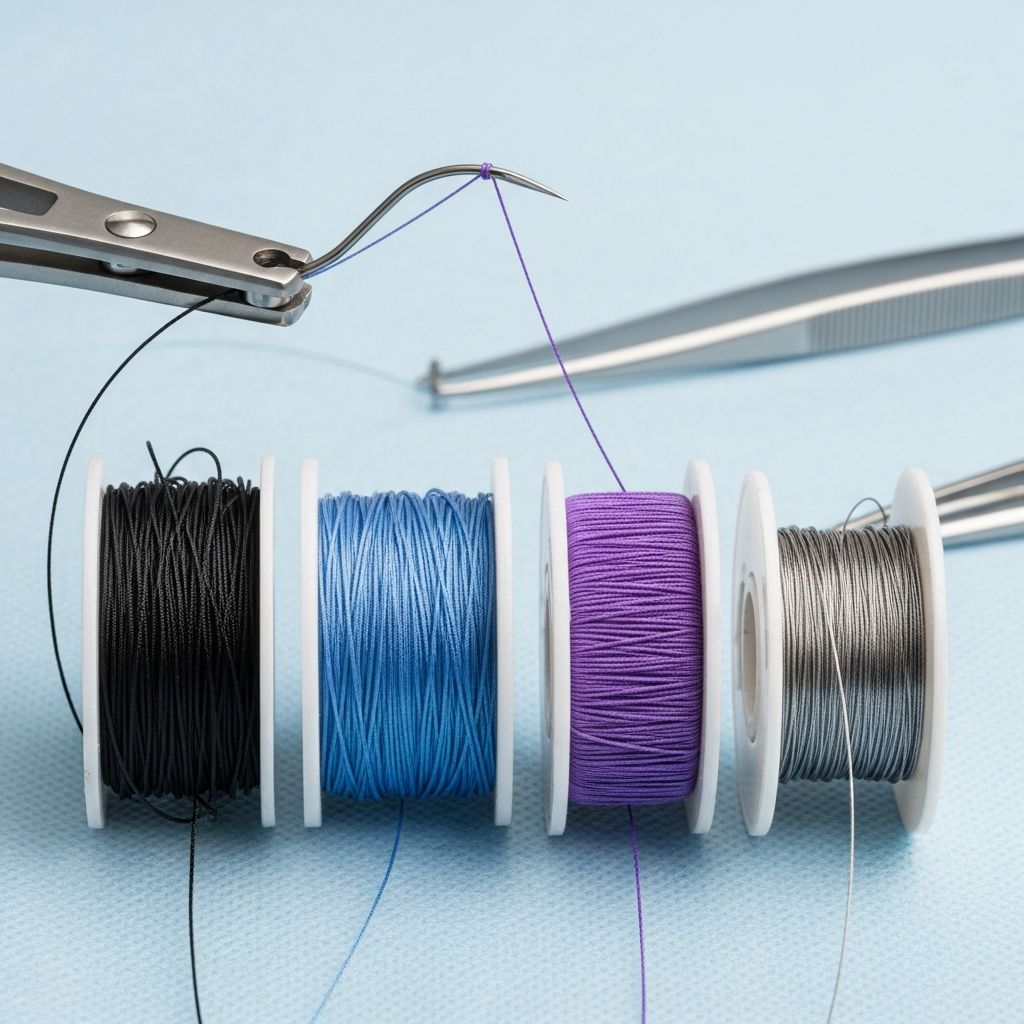
Suture materials are essential tools in surgical wound closure, providing mechanical support during the healing process while minimizing tissue reaction and infection risk. The choice of suture depends on wound location, tension, tissue type, and healing characteristics to achieve optimal cosmetic and functional results.
What are sutures?
Sutures, also known as stitches, are sterile surgical threads used to approximate wound edges, reduce dead space, and promote healing. They hold tissues together until natural fibrosis or collagen deposition provides sufficient strength. Ideal sutures balance tensile strength, knot security, handling properties, and biocompatibility, with minimal inflammatory response.
Key properties of suture materials include:
- Tensile strength: Ability to withstand pulling forces without breaking.
- Knot security: Resistance to slippage under tension.
- Handling: Ease of manipulation, tying, and passage through tissue.
- Tissue reactivity: Degree of inflammation induced, affecting healing speed and scarring.
- Absorption profile: For absorbable types, time to lose strength and complete degradation.
Sutures are classified as absorbable or non-absorbable, monofilament or multifilament, based on origin (natural or synthetic), and size (denoted by USP standards, e.g., 2-0 for thicker, 6-0 for finer).
Absorbable sutures
Absorbable sutures lose most of their tensile strength within 60 days and are degraded by hydrolysis or enzymatic proteolysis. They are ideal for deep, buried layers where removal is impractical, such as subcutaneous or fascial closures. Common uses include ligatures, approximation of internal tissues, and in contaminated wounds where monofilament types reduce infection risk.
Advantages: No need for removal, reducing patient discomfort and follow-up visits. Disadvantages: Potential for unpredictable absorption rates influenced by infection, hematoma, or patient factors like diabetes.
| Material | Trade Names | Origin | Absorption Time | Uses |
|---|---|---|---|---|
| Surgical Gut | – | Natural (collagen) | 70-90 days | Subcuticular, mucosal |
| Polyglactin 910 | Vicryl®, Polysorb® | Synthetic braided | 56-90 days | Deep dermal, subcutaneous |
| Poliglecaprone 25 | Monocryl® | Synthetic monofilament | 90-120 days | Subcuticular, low-reaction sites |
| Polydioxanone | PDS II® | Synthetic monofilament | 180 days | High-tension, slow-healing |
| Polytrimethylene carbonate | Maxon® | Synthetic monofilament | 180-210 days | High-tension wounds |
| Glycomer 631 | Biosyn® | Synthetic monofilament | 90-110 days | General subcutaneous |
Polyglactin 910 (Vicryl) is versatile for most deep sutures due to its predictable absorption and handling. Monocryl is preferred for minimal tissue reaction, while PDS suits high-tension areas like abdominal fascia. Monofilament absorbables like PDS or Maxon are favored in contaminated wounds for lower infection rates.
Non-absorbable sutures
Non-absorbable sutures retain tensile strength beyond 60 days and require removal, typically 5-14 days post-placement depending on site (face: 5 days; extremities: 10-14 days). They are used for skin surface closure, tendons, or vascular anastomoses where prolonged support is needed.
Advantages: Predictable strength, low reactivity for synthetics. Disadvantages: Require removal, potential for ‘track marks’ if left too long.
| Material | Trade Names | Structure | Uses |
|---|---|---|---|
| Nylon | Ethilon®, Dermalon® | Monofilament/multifilament | Skin closure, standard epidermal |
| Polybutester | Novafil® | Monofilament | Skin, elastic tissues |
| Polypropylene | Prolene® | Monofilament | Running subcuticular, vascular |
| Silk | Dysilk® | Braided | Mucosal, ligatures (not skin) |
| Polyester | Dacron®, Ethibond® | Braided | Orthopedics, cardiovascular |
Nylon or polybutester are standards for epidermal sutures. Polypropylene excels in running subcuticular for fine cosmetics. Silk, though braided for handling, induces more reaction and suits mucosa. Polyester is strong for high-tension but poor handling.
Related Stories



Suture size
Suture size is standardized by United States Pharmacopeia (USP) numbers: higher numbers (e.g., 5-0, 6-0) indicate finer diameters for delicate areas like face/eyelids; lower (e.g., 0, 2-0) for thicker tissues like trunk. Size selection matches tissue thickness and required strength—oversized causes excess reaction, undersized risks breakage.
- Face/scalp: 5-0 to 6-0
- Extremities: 4-0 to 5-0
- Trunk: 3-0 to 4-0
Actual diameter and strength vary by material; consult manufacturer charts.
Suture needles
Surgical needles have three parts: tip (cutting/taper), body (curved/straight), and shank (attached to suture). Dermatologic surgery favors 3/8 or 1/2 circle taper-cut or reverse-cutting needles for precise skin passage.
- Cutting needles: Tri-faceted tip for tough skin/keratinized tissue.
- Taper needles: Smooth round for soft tissue like bowel.
- Shapes: 1/4 circle for mouth; 1/2 circle for general; straight for deep.
Needle size matches suture; swaged (pressed-on) design minimizes tissue trauma.
Choosing suture material
Selection considers wound tension/location, infection risk, healing speed, cosmetic needs, and patient factors (e.g., allergies, steroids). High-tension: non-absorbable or long-absorption. Contaminated: monofilament absorbable. Facial: fine non-absorbable for eversion.
- Deep dermal/buried: Polyglactin 910 or Monocryl.
- Skin surface: Nylon/polypropylene.
- Mucosal: Silk/polyester.
- **High tension: PDS/Maxon.
Patient comorbidities like diabetes delay healing, favoring longer-strength sutures. Surgeon preference and cost influence, but evidence prioritizes low-reactivity synthetics.
Alternatives to sutures
For select wounds, alternatives reduce foreign body reaction:
- Skin staples: Quick for scalp/trunk linear lacerations; remove 7-14 days.
- Tissue adhesives (cyanoacrylate): Superficial, low-tension; no removal.
- Tape closures: Steri-Strips for tiny wounds.
Staples suit hairy areas; adhesives for pediatrics.
Related topics
- Suturing techniques
- Basic suturing kit
- Wound closure principles
Frequently Asked Questions
What is the difference between absorbable and non-absorbable sutures?
Absorbable sutures degrade naturally within 60-180 days, used internally; non-absorbable persist and need removal, ideal for skin.
Which suture is best for facial wounds?
Fine (6-0) nylon or polypropylene for optimal cosmesis and eversion.
How long do absorbable sutures last?
Varies: Vicryl 56-90 days; PDS 180 days; influenced by wound conditions.
Are monofilament sutures better in infected wounds?
Yes, less bacterial harboring than braided.
When to remove skin sutures?
Face: 3-5 days; scalp: 7-10; limbs: 10-14; trunk: 7-10.
References
- Suture Materials: Conventional and Stimulatory-Responsive Sutures — National Library of Medicine (PMC). 2024. https://pmc.ncbi.nlm.nih.gov/articles/PMC12467860/
- Suture materials – DermNet — DermNet NZ. 2023-10-01. https://dermnetnz.org/topics/suture-materials
- Suturing techniques – DermNet — DermNet NZ. 2023-10-01. https://dermnetnz.org/topics/suturing-techniques
- Suturing – Dermnetnz (Scribd extract) — DermNet NZ via Scribd. 2013. https://www.scribd.com/document/148018115/Suturing-Dermnetnz
Similar Articles








Read full bio of Sneha Tete