Suturing Techniques: Essential Guide To Wound Closure
Master essential suturing methods for optimal wound closure and superior cosmetic outcomes in cutaneous surgery.
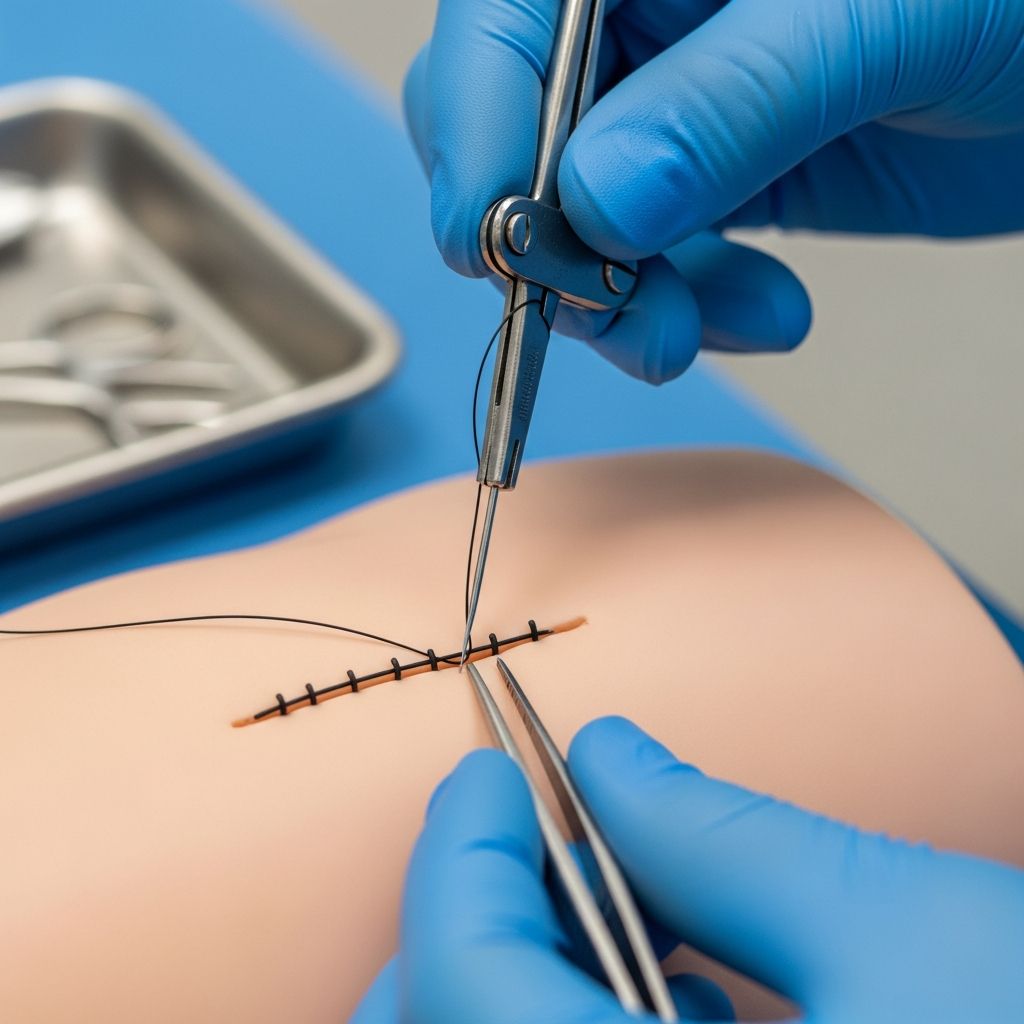
The aim of this page is to demonstrate the basic principles of suturing for the closure of cutaneous surgical wounds. Proper suturing techniques are fundamental in dermatological and surgical procedures to achieve optimal wound healing, minimize scarring, and ensure excellent cosmetic results. Sutures approximate wound edges, reduce tension, eliminate dead space, and provide support during the healing process.
Who is qualified to perform suturing?
Suturing should be performed by trained medical professionals, including dermatologists, plastic surgeons, general surgeons, and appropriately skilled general practitioners or nurses. Proficiency requires hands-on training, understanding of wound dynamics, and knowledge of suture materials. In emergency settings, emergency physicians and physician assistants with certification may also perform suturing.
What suture materials should be used?
Selection of suture materials depends on the wound location, tension, infection risk, and desired cosmetic outcome. Non-absorbable sutures like nylon, polypropylene (Prolene), or silk are ideal for skin surfaces where removal is feasible. Absorbable options such as polyglactin (Vicryl), polydioxanone (PDS), or polyglycolic acid are used for deep layers. Needle types include cutting (tapered with sharp edges for skin) or tapered (smooth for delicate tissues). Fine gauges (5-0 to 6-0) are preferred for facial wounds to minimize scarring.
- Non-absorbable: Nylon, Prolene – superficial skin closure.
- Absorbable: Vicryl, PDS – buried dermal/subcuticular.
- Needles: Reverse cutting for skin; straight or curved based on access.
Needle holders and instruments
Needle holders (also called needle drivers) must securely grasp the needle without damaging it. Toothed or non-toothed forceps stabilize tissue, while skin hooks or iris scissors assist in eversion and cutting. Adson forceps with fine teeth prevent tissue crush injury. Proper instrument handling ensures precision and reduces trauma.
Knot tying
A secure square knot is essential to prevent slippage. The technique begins with the long end of the suture wrapped twice around the closed needle holder tip, grasping the short end, and pulling tight for the first double throw. Add two or three single throws, alternating directions across the wound edge to lock the knot. Each throw must be snug but not strangulating.
- Step 1: Double wrap long end around needle holder.
- Step 2: Grasp short end and tighten first knot.
- Step 3: Add single throws oppositely for security.
A surgeon’s knot variant uses an extra throw in the first tie for added friction on high-tension wounds.
Simple interrupted suture
The simple interrupted suture is the most common and versatile technique, ideal for most linear wounds. It allows precise edge approximation and individual adjustment. The wound edge is stabilized with toothed forceps or skin hook. The needle enters perpendicular to the skin surface, 3-5 mm from the edge, capturing a deep bite of dermis for eversion. Exit equidistant on the opposite side. Avoid flat-angle entry, which reduces eversion and worsens scarring.
Related Stories



- Stabilize edge perpendicularly.
- Enter 3-5 mm away, deep bite.
- Exit opposite side symmetrically.
- Tie square knot, cut tails 3-5 mm.
Space sutures 5-8 mm apart, closer on the face. This method excels in infected wounds as one loose suture doesn’t compromise the closure.
Continuous (running) suture
Continuous sutures are rapid for long wounds under low tension, like scalp lacerations. Start with an interrupted suture, leave a loop, and advance diagonally across, then perpendicular bites alternately. At closure, grasp the final loop to tie. Advantages include speed and even tension distribution; disadvantages are risk of purse-stringing if uneven.
- Initial interrupted suture with loop.
- Diagonal re-entry, perpendicular progression.
- Final loop tie-off.
Use non-absorbable material, remove early to avoid track marks.
Vertical mattress suture
This suture offers superior eversion, dead space reduction, and support for thick-skinned areas like palms or soles. Introduce needle 5-10 mm from edge, deep dermal-subcutaneous bite, exit opposite. Reverse needle, re-enter 1-3 mm from opposite edge with shallow bite, exit first side. Tie knot securely. Excellent for lip or high-tension sites but may cause puckering if overtightened.
| Advantages | Disadvantages |
|---|---|
| Maximal eversion | Potential tissue strangulation |
| Dead space closure | More time-consuming |
Horizontal mattress suture
Ideal for distributing tension in larger wounds, especially initial placement. Enter 5-10 mm from edge, exit opposite. Re-enter opposite side 3-5 mm along edge, exit first side same position. Tie knot. Far-near configuration spreads force evenly. Risk includes edge necrosis from vascular compromise; use sparingly on thin skin.
- Far-far entry (5-10 mm).
- Near-near exit for tension relief.
Running subcuticular suture
This cosmetic technique minimizes surface marks, perfect for face or visible areas. Enter 10 mm distal to apex intradermally, exit dermal apex. Take horizontal dermal bites alternately toward opposite end, exit 10 mm proximal. Secure ends with beads, crimps, or tie absorbable suture subdermally. Provides prolonged support without epidermal tracks.
Preferred with absorbable monofilament like PDS or Monocryl.
Buried suture
Buried dermal sutures offload tension from epidermis, close dead space, and enhance cosmesis. Evert edge with hook; enter subcutaneous fat, exit dermis same side. Cross to opposite dermis, exit subcutaneous symmetrically. Tie deep, cut short. Use absorbable material. Essential under surface sutures for layered closure.
Other techniques
- Corner suture: For flaps/tips; deep dermal pass under flap, exit opposite for precise alignment.
- Figure-of-eight: Nail beds or small avulsions; crosses for stabilization.
- Undermining: Relieves tension pre-suturing.
Frequently Asked Questions (FAQs)
What is the most important principle in suturing?
Perpendicular entry for deep bites ensuring wound edge eversion and minimal scarring.
When to use absorbable vs non-absorbable sutures?
Absorbable for buried/deep layers; non-absorbable for removable skin sutures.
How to prevent infection in sutured wounds?
Thorough irrigation, debridement, prophylactic antibiotics if contaminated.
What is the ideal suture spacing?
5-8 mm apart, matching bite depth for symmetry.
Removal timing by site?
- Face: 3-5 days
- Scalp/arms: 7-10 days
- Legs/trunk: 10-14 days
- Feet/joints: 14-21 days
Early removal prevents tracks; use adhesive strips post-removal.
Tips for optimal results
– Gently handle tissue to preserve viability.
– Approximate, don’t strangulate.
– Layered closure for deep wounds.
– Post-op: Keep dry 24-48 hrs, watch for dehiscence/infection.
References
- Suturing Techniques – DermNet NZ — DermNet New Zealand. 2008-05-17. https://dermnetnz.org/topics/suturing-techniques
- Suturing Dermnetnz — DermNet NZ (Scribd). 2013. https://www.scribd.com/document/148018115/Suturing-Dermnetnz
- Suture Materials – DermNet — DermNet New Zealand. Accessed 2026. https://dermnetnz.org/topics/suture-materials
- Wound Closure Techniques – DermNet — DermNet New Zealand. Accessed 2026. https://dermnetnz.org/topics/wound-closure
- Suturing Techniques | Journal of Medical Insight — JOMI. Accessed 2026. https://jomi.com/article/479/suturing-techniques
Similar Articles








Read full bio of medha deb