Sweat Gland Lesions: Types, Diagnosis, Treatment
Comprehensive guide to sweat gland lesions: from benign naevi and syringomas to malignant tumours, including diagnosis and treatment options.
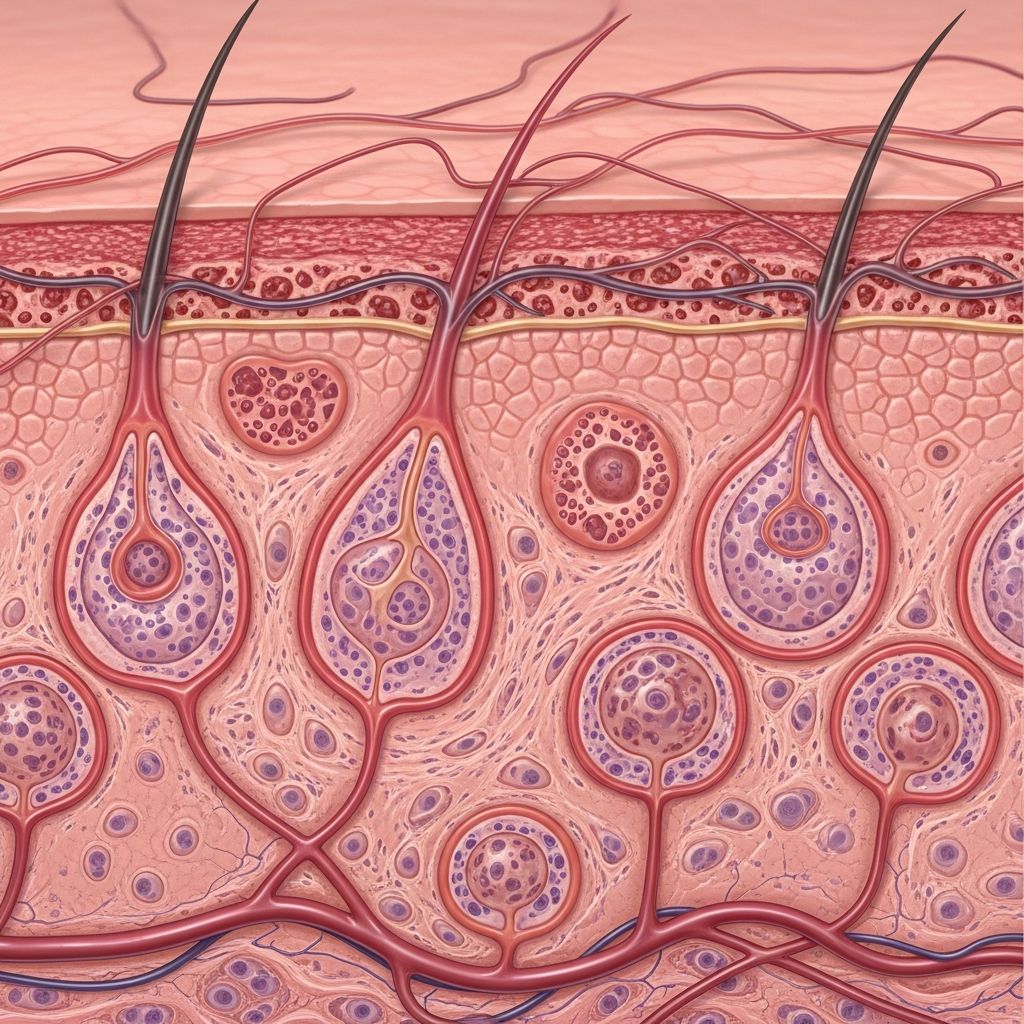
Sweat gland lesions originate from sweat gland or sweat duct cell lines and are rarely identified clinically without a biopsy. These lesions arise from epidermal adnexal structures, including eccrine glands, apocrine glands, hair follicles, and sebaceous glands. They exhibit variable differentiation towards eccrine or apocrine lineages, with significant histological overlaps challenging traditional classifications.
What are sweat glands?
The skin contains two primary types of sweat glands: eccrine glands and apocrine glands. Eccrine glands are crucial for thermoregulation, distributed across the body with highest density on palms and soles. They secrete a sterile electrolyte solution—primarily sodium chloride, potassium, and bicarbonate, plus glucose and antimicrobial peptides—reaching the skin via ducts. Sweat production varies by site, stress, and individual, peaking at 3 litres per hour under maximal stimulation.
Apocrine glands, in contrast, produce an oily fluid rich in triglycerides and fatty acids, which bacteria colonize to cause body odour. These glands are concentrated in areas like axillae, groin, and scalp.
Sweat gland naevi
Eccrine and apocrine naevi are rare congenital malformations with increased gland size and number. Eccrine naevi cause mucinous discharge or localized hyperhidrosis, triggered by heat or stress. They are benign and often require no treatment, though surgical excision is an option for symptomatic cases.
A distinctive variant, porokeratotic eccrine ostial and dermal duct naevus, falls under epidermal naevi and features hyperkeratotic plugs at eccrine duct openings.
Syringoma
Syringomas are benign adnexal tumours with ductal differentiation from eccrine or apocrine intraepidermal ducts (acrosyringium). They manifest as multiple small, firm, skin-coloured papules, predominantly around the eyes and eyelids, but can appear elsewhere, including genitals where they may itch with sweating.
More prevalent in Asian populations and associated with Down syndrome, some cases are familial. In skin of colour, they appear yellowish, hypopigmented, or hyperpigmented. Histology reveals well-circumscribed epithelial tubules, nests, and cords in dense fibrous stroma in the upper dermis.
Treatment is cosmetic: cryotherapy, electrosurgery, laser ablation, or excision. Deep location risks scarring; calcinosis cutis occurs in Down syndrome cases, and post-inflammatory pigmentation in darker skins.
Poroma
Poromas are benign tumours of poroid cells from the terminal duct, epidermis-connected, of eccrine or apocrine origin. They present as papules, plaques (resembling seborrhoeic keratoses), or nodules, often red from vascularity or darker pigmented.
- Eccrine poroma: Palms, soles, scalp.
- Hydroacanthoma simplex: Superficial, plaque-like.
- Dermal duct tumour: Deeper, nodule.
- Poroid hidradenoma: Cystic variant.
Multiple lesions indicate poromatosis. Treatment involves surgical excision or electrosurgery.
Hidradenoma / Acrospiroma
Hidradenoma (acrospiroma) is a benign dermal tumour related to poroma but epidermis-disconnected. It appears as solitary nodules or cysts (cystic hidradenoma), possibly discharging watery fluid, on any site. Complete excision cures it.
Related Stories



Spiradenoma
Spiradenomas are painful nodules on head, neck, or trunk, associated with cylindromas in Brooke-Spiegler syndrome (multiple spiradenomas, cylindromas, trichoblastomas). Benign; treated by conservative excision.
Cylindroma
Cylindromas present as smooth, red-brown nodules (‘turban tumours’ when multiple on scalp). They link to spiradenomas in Brooke-Spiegler syndrome, caused by CYLD gene mutations. Malignant transformation is rare (<0.55%). Excision for solitary lesions; scalp multiples may need staged removal.
Other benign lesions
- Microcystic adnexal carcinoma: Sclerosing, invasive on central face; Mohs surgery recommended.
- Digital papillary adenocarcinoma: Aggressive on digits; wide excision essential.
- Mucinous eccrine naevus: Localized hyperhidrosis with mucin.
- Nipple syringomatous adenoma: Benign, excision if symptomatic.
Related conditions like miliaria (heat rash) involve eccrine duct obstruction: crystallina (superficial vesicles), rubra (prickly papules), profunda (flesh-coloured papules). Managed by cooling; biopsy shows spongiosis.
Malignant sweat gland tumours
Malignant lesions are rare (0.001–0.003% of biopsies), often misdiagnosed as squamous cell carcinoma. Key types:
| Tumour | Site | Features | Treatment |
|---|---|---|---|
| Papillary eccrine adenocarcinoma | Digits | Aggressive, cystic | Wide excision, possible amputation |
| Apocrine adenocarcinoma | Axillae | Bateman tumour, invasive | Excision, axillary clearance |
| Mucinous carcinoma | Head/neck | Low-grade, recurrent | Mohs surgery |
| Spiradenocarcinoma | Trunk, limbs | Arises from spiradenoma | Wide excision |
| Cylindroccarcinoma | Scalp | From cylindroma | Excision |
| Microcystic adnexal carcinoma | Face | Sclerosing, perineural | Mohs |
Prognosis varies; digital papillary has 20% metastasis. Histology differentiates from metastases (e.g., breast carcinoma).
Diagnosis
Clinical suspicion prompts biopsy. Histology is definitive, showing ductal structures, stroma, and differentiation. Immunohistochemistry (e.g., CEA, S100) aids classification. Dermoscopy reveals polymorphous vessels in poromas.
Treatment
Benign lesions: Observation or excision for symptoms/cosmesis. Malignant: Wide excision, Mohs for low-risk, lymph node dissection if metastatic. No role for chemotherapy/radiotherapy generally.
Frequently Asked Questions (FAQs)
Q: Are sweat gland lesions cancerous?
A: Most are benign (e.g., syringomas, poromas), but rare malignant types like papillary adenocarcinoma exist, requiring biopsy for confirmation.
Q: How are syringomas treated?
A: Options include cryotherapy, laser ablation, electrosurgery, or excision, though scarring is a risk due to dermal depth.
Q: What causes painful spiradenomas?
A: Their pain stems from dense nerve fibres; they often occur on head/neck and associate with cylindromas in genetic syndromes.
Q: Can sweat gland naevi be removed?
A: Yes, surgically if hyperhidrosis or discharge bothers the patient; they are harmless congenital malformations.
Q: Is miliaria related to sweat gland lesions?
A: Miliaria is inflammatory duct obstruction (heat rash), not neoplastic, but shares eccrine origins; resolves with cooling.
References
- Sweat gland lesions — DermNet NZ. 2023-05-15. https://dermnetnz.org/topics/sweat-gland-lesions
- Heat rash (Miliaria): Images, Causes, and Treatment — DermNet NZ. 2024-02-10. https://dermnetnz.org/topics/miliaria
- Syringoma — DermNet NZ. 2023-11-20. https://dermnetnz.org/topics/syringoma
- Epidermal Inclusion Cysts (Sebaceous Cysts): Treatment & Causes — Cleveland Clinic. 2024-07-01. https://my.clevelandclinic.org/health/diseases/14165-sebaceous-cysts
Similar Articles








Read full bio of medha deb