Syndactyly: Webbed Fingers and Toes Explained
Understanding syndactyly: causes, types, treatment, and recovery for webbed digits.
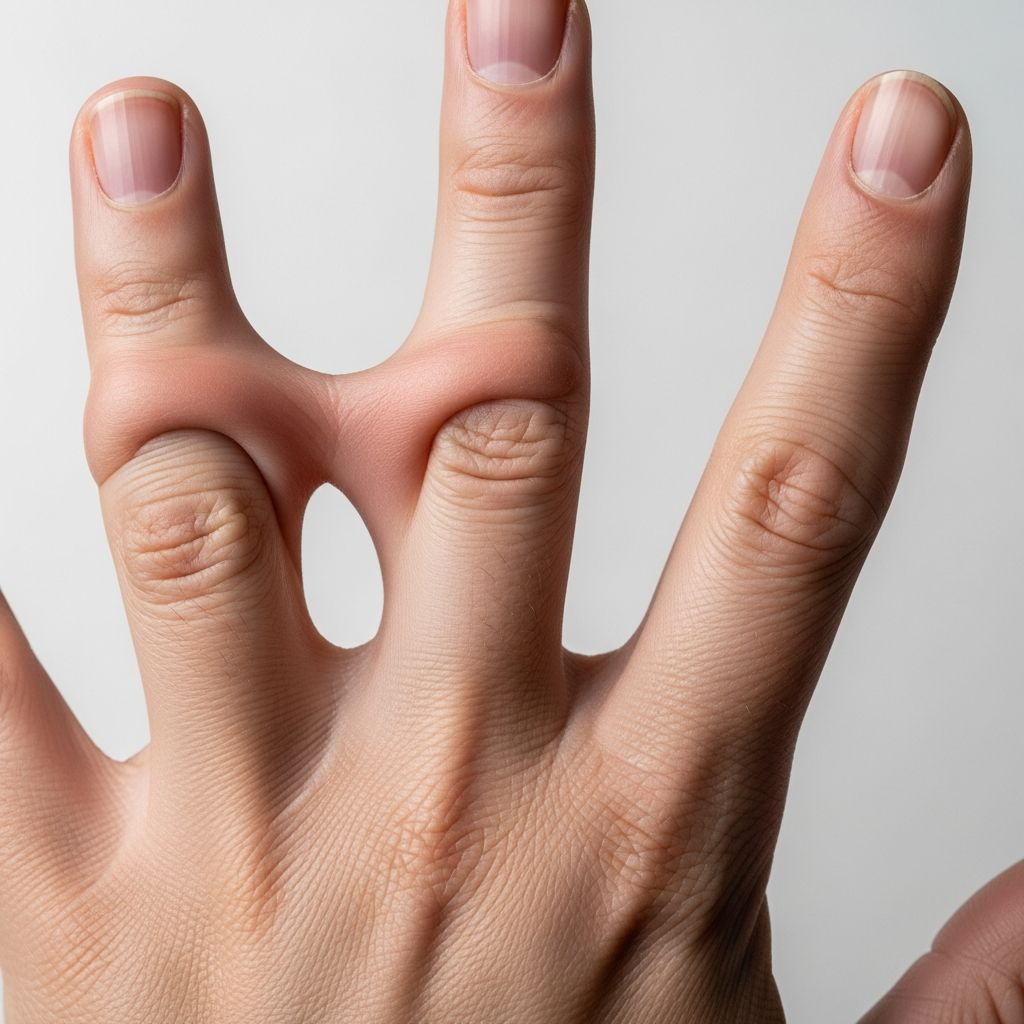
What is Syndactyly?
Syndactyly, pronounced “sin-dak-tuh-lee,” is a congenital birth defect in which two or more of your baby’s fingers or toes are fused or webbed together. This condition represents a form of congenital hand or foot difference that occurs during fetal development. Rather than being caused by fingers sticking together in the womb, syndactyly results from a failure during the sixth to eighth weeks of intrauterine life when the normal longitudinal interdigital necrosis—the natural separation process—does not occur properly.
Syndactyly is considered the most common abnormality of the newborn hand and can occur either as an isolated anomaly or as part of a genetic syndrome. When it occurs alone, it is always inherited as an autosomal-dominant disorder, meaning only one copy of the mutated gene from either parent is necessary to cause the condition. The prevalence of congenital syndactyly is estimated between 3 to 40 per 10,000 births, making it a relatively common condition that healthcare providers encounter regularly.
Types of Syndactyly
Syndactyly is classified into several distinct types based on which digits are affected and the characteristics of the webbing. Understanding these classifications helps healthcare providers determine the most appropriate treatment approach.
Type 1: Zygodactyly
Type 1, also known as zygodactyly, is the most common form of syndactyly. This type occurs between the long finger (middle finger) and ring finger and represents the majority of syndactyly cases seen in clinical practice.
Type 2: Synpolydactyly
Type 2 syndactyly also involves the long and ring fingers but includes an additional complication: a duplication of the ring finger between the two webbed fingers. This type combines elements of syndactyly with polydactyly and requires specialized surgical planning.
Type 3: Ring-Small Finger Syndactyly
Type 3 affects the ring finger and small finger and is usually bilateral, meaning it occurs on both hands. In some cases, the distal phalanges (the bones at the tips of the fingers) may be fused together. There may also be only a rudimentary or underdeveloped middle phalanx in the small finger.
Type 4: Haas-Type Syndactyly
Type 4, known as Haas-type syndactyly, is a rare form characterized by complete syndactyly of all digits. This severe form occasionally includes a sixth metacarpal and phalanges that may be incorporated into a cup-shaped hand configuration. This type requires extensive surgical intervention.
Type 5: Extensive Digital Fusion
Type 5 is another rare form in which both the long and ring fingers and the second and third toes are syndactylized together. The fourth and fifth metacarpals and metatarsals may also be fused, making this one of the most complex forms of the condition.
Classification Based on Clinical Features
Beyond the basic typing system, syndactyly is also classified based on clinical characteristics that help guide treatment decisions:
Complete Versus Incomplete Syndactyly
In complete syndactyly, the skin web extends all the way to the tips of the involved digits and sometimes produces a common fingernail shared by both fused fingers. In incomplete syndactyly, the web can stop at any point between the normal commissure (the natural fold where fingers meet) and the ends of the fingers.
Related Stories



Simple Versus Complex Syndactyly
Syndactyly is defined as simple when the webs contain only normal soft tissues without any bone involvement. Complex syndactyly occurs when adjacent phalanges are fused or when there is interposition of accessory phalanges. In complex webbing, abnormalities of nerves, vessels, and tendons may also be present. The distribution and presence of digital nerves in complex cases can be quite unpredictable, and the closer together the affected digits, the greater the likelihood of associated anatomical anomalies.
Causes and Risk Factors
The primary cause of syndactyly is a failure of the normal developmental process during early pregnancy. Specifically, during weeks six through eight of intrauterine development, the fingers and toes should naturally separate through a process of programmed cell death in the tissue between them. When this process fails to occur properly, the digits remain fused together.
If you have a biological family history of webbed fingers or webbed toes, you may want to consider genetic testing to determine whether you carry the genetic mutation that causes syndactyly. This is particularly important if you are planning to have children, as the autosomal-dominant inheritance pattern means there is a 50% chance of passing the condition to offspring.
Diagnosis and When to Seek Help
Your baby’s healthcare provider will probably diagnose your baby with syndactyly right after they are born through physical examination. The diagnosis is typically straightforward, as the webbing between digits is visually apparent. Healthcare providers will also perform imaging studies, such as X-rays, to determine the extent of any bone involvement and whether the condition is simple or complex.
You should talk to your baby’s healthcare provider if you notice any changes in your baby’s hands or feet. Visit the provider if your child is in pain or their separated digits develop any concerning symptoms, including signs of infection, excessive swelling, difficulty with movement, or any discoloration of the digits.
Treatment Options
Treatment will depend on the type of syndactyly, but will most likely involve surgery to separate your baby’s digits. While the idea of surgery on your baby may sound frightening, it is important to listen to your provider’s recommendation. Without separating your child’s digits, there is a chance they will have a harder time using them as they grow. This is especially true for fingers that are fused together, as the longer digit will inevitably develop a flexion contracture and may also show lateral deviation deformities if separation is delayed beyond one year of age.
Surgical Intervention
Most babies are treated for syndactyly when they are about a year old, though in some cases, particularly with complex syndactyly, procedures may begin as early as six months of age. A surgeon will surgically separate your child’s webbed toes or fingers, including any fused bones and other tissue. They will usually also perform a skin graft to cover the separated digits.
In cases where multiple digits are involved or where the syndactyly is complex, more than one surgery may be needed, as only one digit pair is typically separated at a time. This staged approach allows for better healing and reduces the risk of complications.
Post-Operative Care
Your child may need to wear a cast or splint on their surgically repaired hand or foot after surgery to support their separated fingers or toes. Proper immobilization is essential for optimal healing and to prevent the webbing from recurring. They may also need occupational therapy to make sure their hand or foot regains its strength and can fully function after surgery. Physical and occupational therapy are crucial components of the recovery process, helping children relearn how to use their newly separated digits and regain full functional capability.
Special Considerations
Acrosyndactyly
A severe manifestation of syndactyly known as acrosyndactyly involves not only webbing but also progressive tissue loss and fusion that extends toward the fingertips. This condition is classified into three severity levels: mild cases have three phalanges and two interphalangeal joints; moderate cases have two phalanges and one interphalangeal joint; and severe cases involve stubby fingers with one phalanx and no interphalangeal joints. Treatment for acrosyndactyly requires specialized surgical expertise and often involves multiple procedures.
Associated Syndromes
While syndactyly often occurs as an isolated condition, it can also be part of genetic syndromes such as Apert syndrome, which involves abnormal development of the skull, face, feet, and hands. When syndactyly is part of a syndrome, treatment may need to address multiple affected body systems and may require coordination among various medical specialists.
Recovery and Prognosis
You should expect your baby to make a full recovery from having their webbed toes or fingers separated. No matter which type of syndactyly your baby is diagnosed with, the surgery to correct it will not impact their future growth or development. Most children experience excellent outcomes following surgical separation, with restoration of normal hand or foot function.
Some children may experience recurrent syndactyly, sometimes referred to as “web creep,” if there are complications in healing or inadequate skin graft take. However, with proper surgical technique and post-operative care, this complication is relatively uncommon. Long-term follow-up care ensures that the separated digits continue to function properly as the child grows and develops.
When Syndactyly Affects the Feet
Syndactyly affecting the toes is generally considered primarily a cosmetic issue and is often not treated unless surgery is desired by the family. However, functional considerations should still be evaluated by healthcare providers. Some cases involving the feet may benefit from surgical separation to improve gait mechanics or prevent long-term complications, particularly in complex cases with bony fusion.
Frequently Asked Questions
Q: Is syndactyly inherited?
A: When syndactyly occurs as an isolated condition, it is always inherited as an autosomal-dominant disorder. This means that if one parent carries the genetic mutation, there is a 50% chance of passing it to each child. Genetic testing can help identify whether you or your partner carries this mutation if you are concerned about inheritance.
Q: At what age should syndactyly be treated?
A: Most babies with syndactyly are treated surgically around one year of age. However, treatment timing may vary depending on the severity and type of syndactyly. Complex cases may require earlier intervention, sometimes starting as early as six months. Your healthcare provider will recommend the optimal timing for your child’s specific situation.
Q: Will my child have normal hand or foot function after surgery?
A: Yes, most children achieve normal or near-normal function after surgical separation of webbed digits. With proper surgical technique, post-operative care, occupational therapy, and appropriate follow-up, children typically regain full functional capability of their hands or feet.
Q: Can syndactyly recur after surgery?
A: While recurrent syndactyly or “web creep” can occur in some cases, it is relatively uncommon when surgery is performed by experienced surgeons using proper techniques. Adequate skin grafting and appropriate post-operative care help minimize the risk of recurrence.
Q: What if syndactyly affects multiple digits?
A: When multiple digits are involved, more than one surgery may be needed, as surgeons typically separate only one digit pair at a time. This staged approach allows for better healing and reduces complication risk. Your surgeon will develop a treatment plan that addresses all affected digits systematically.
Q: Does syndactyly affect growth and development?
A: Surgery to correct syndactyly does not negatively impact your child’s future growth or development. When treated appropriately, children with syndactyly experience normal development and achieve full functional independence with their hands and feet.
References
- Webbed fingers (Syndactyly) — PubMed Central/NIH. Accessed 2025. https://pmc.ncbi.nlm.nih.gov/articles/PMC1200697/
- Syndactyly (Webbed Toes or Fingers): What It Is & Causes — Cleveland Clinic. 2025. https://my.clevelandclinic.org/health/diseases/23521-syndactyly-webbed-digits
- Correction of Simple Complete Syndactyly: Case Report and Operative Technique — Clinics in Surgery. 2018-02-16. https://www.clinicsinsurgery.com/open-access/correction-of-simple-complete-syndactyly-case-report-and-operative-technique-3341.pdf
- Polydactyly and Syndactyly — EBSCO Research Starters Health and Medicine. Accessed 2025. https://www.ebsco.com/research-starters/health-and-medicine/polydactyly-and-syndactyly
- Congenital Hand Differences: Types, Causes, & Treatment — Cleveland Clinic. 2025. https://my.clevelandclinic.org/health/diseases/16890-congenital-hand-differences
- Apert Syndrome: What Is It, Symptoms, Diagnosis & Treatment — Cleveland Clinic. 2025. https://my.clevelandclinic.org/health/diseases/22077-apert-syndrome
Similar Articles








Read full bio of medha deb