Synovial Sarcoma Pathology: Diagnostic Features And Genetics
Comprehensive guide to the histopathology, diagnosis, and molecular features of synovial sarcoma, a rare aggressive soft tissue malignancy.
Synovial sarcoma is a rare, aggressive soft tissue malignancy predominantly affecting young adults, characterized by a specific SS18-SSX gene fusion despite not originating from synovial tissue. It typically arises in deep soft tissues near joints, such as the extremities, and requires integrated microscopic, immunohistochemical, and molecular analysis for accurate diagnosis.
Introduction
Synovial sarcoma accounts for 5-10% of all soft tissue sarcomas, with an incidence of approximately 800-1000 cases annually worldwide, primarily in adolescents and adults under 30 years old. Despite its name, it does not arise from synovial lining but from primitive mesenchymal cells, often presenting as a firm, painless mass near tendons or joints. Early detection is crucial due to its propensity for local recurrence and distant metastasis, particularly to lungs.
Clinical Features
Synovial sarcoma commonly manifests in the extremities (80-90% of cases), with the lower limbs (especially near the knee) being the most frequent site. Patients typically present with a slowly enlarging, deep-seated mass, often painless initially but may cause swelling, pain, or limited joint mobility as it grows. Tumors are usually 5-10 cm at diagnosis, though smaller lesions (<5 cm) confer better prognosis. Rare sites include head/neck, trunk, and retroperitoneum. Systemic symptoms are uncommon unless metastatic.
- Demographics: Peak incidence 15-40 years; slight male predominance.
- Symptoms: Painless lump (60%), pain (30%), joint stiffness.
- Imaging: MRI shows heterogeneous mass with calcifications in ~30%.
Histopathology
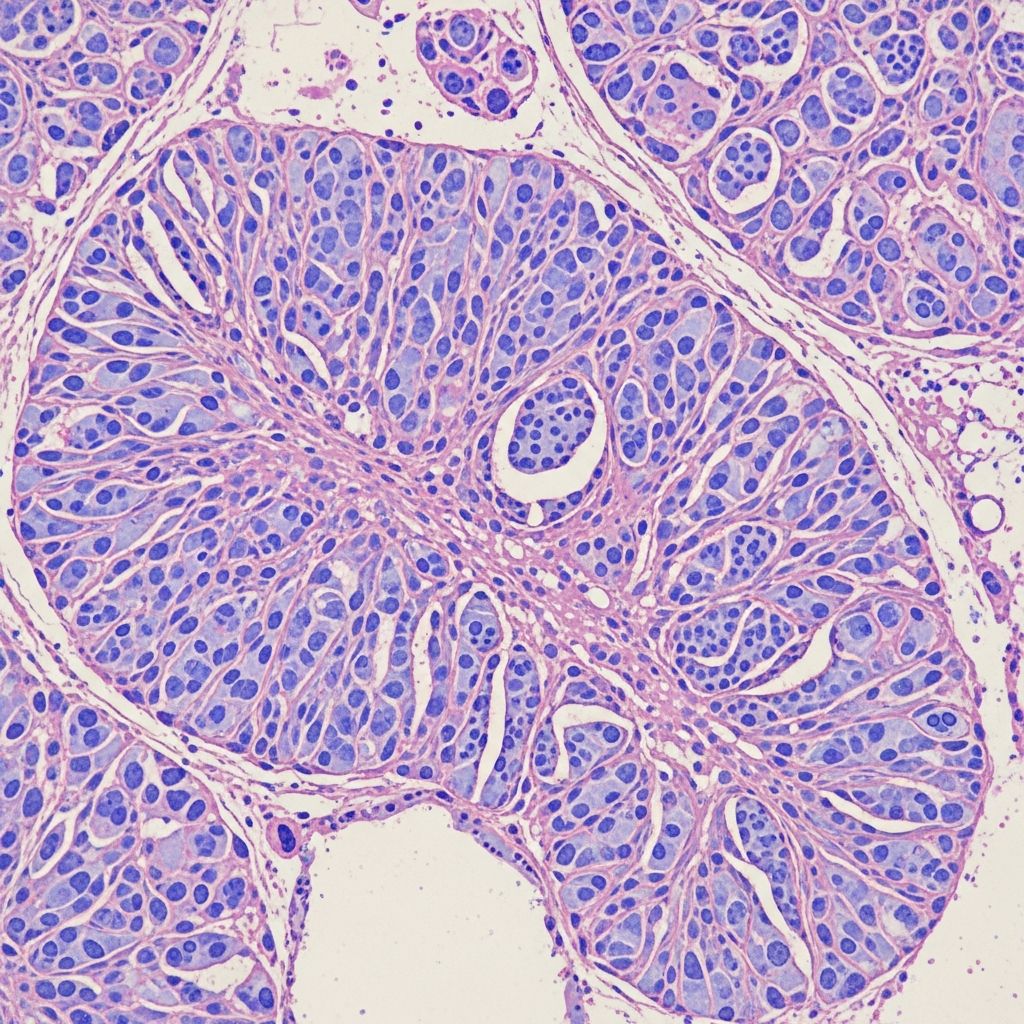
Microscopically, synovial sarcoma exhibits distinctive biphasic or monophasic patterns with high cellularity, uniform spindle cells, and variable epithelioid/glandular components. Calcifications, hemorrhage, and sclerosis are common stromal features.
Microscopic Appearance
Tumors show densely packed, hyperchromatic spindle cells arranged in fascicles or herringbone patterns, interspersed with collagen bands. Epithelial elements appear as glandular spaces lined by cuboidal cells, often with pink debris. Staghorn-like dilated vascular/glandular spaces mimic solitary fibrous tumor. Necrosis, mitoses, and atypia increase in aggressive variants.
| Feature | Description |
|---|---|
| Cellularity | High; uniform spindle cells with oval nuclei, scant cytoplasm. |
| Patterns | Herringbone, fascicular; sclerotic/hyalinized stroma. |
| Stroma | Ropey collagen, calcifications (~30%), hemorrhage. |
| Mitoses | Variable; >10/10 HPF in poorly differentiated. |
Histological Subtypes
Biphasic synovial sarcoma (classic, 50%): Equal spindle and epithelial components forming true glands.
Monophasic synovial sarcoma (40%): Pure spindle cell proliferation; subtle epithelial foci may be overlooked.
Poorly differentiated synovial sarcoma (10%): High-grade with marked atypia, rhabdoid cells, >6 mitoses/mm², necrosis; worse prognosis.
Cytology
Cytological smears reveal dispersed spindle cells with high N/C ratio, oval nuclei, fine chromatin, and inconspicuous nucleoli. Glandular clusters with vacuolated cytoplasm are seen in biphasic cases. Background may show necrosis or calcifications.
- Spindle cells: Plump, cohesive clusters.
- Epithelial: Acinar formations with lumina.
- High mitotic rate in aggressive tumors.
Histochemical Features
Minimal utility; PAS highlights intracytoplasmic glycogen in epithelial cells. Mucicarmine is negative, distinguishing from mucin-producing tumors. Calcifications stain with von Kossa.
Related Stories



Immunohistochemistry
IHC is pivotal for diagnosis, showing EMA and cytokeratins (AE1/AE3, CAM5.2) positive in epithelial components (strong, diffuse) and focal in spindle cells. TLE1 is highly sensitive/specific (90-100%) nuclear stain.
| Marker | Pattern | Utility |
|---|---|---|
| EMA | Strong in epithelium; patchy spindle | Key epithelial marker. |
| Cytokeratins | Focal/weak in monophasic | Search subtle positivity. |
| TLE1 | Diffuse nuclear | Highly supportive. |
| CD34 | Negative | Vs. solitary fibrous tumor. |
| S100 | Patchy (30-50%) | Does not exclude. |
| Others | BCL2+, CD99+; SMA-/desmin- | Supportive. |
Negative CD34 and focal S100 aid differential diagnosis.
Genetics
Hallmark is t(X;18)(p11;q11) translocation fusing SS18 (SYT) to SSX1/2/4 (95-100% cases). SS18-SSX1 in biphasic/monophasic fibrous; SS18-SSX2 in monophasic epithelial. Detected by FISH (break-apart probes) or NGS/RT-PCR.
- Frequency: Near-universal.
- Prognostic: SS18-SSX1 worse than SSX2.
- Testing: Recommended for confirmation.
Electron Microscopy
Spindle cells show interdigitating processes, rudimentary junctions, and intermediate filaments. Epithelial cells have microvilli, lumina, and desmosomes, confirming dual differentiation.
Prognosis
5-year survival 50-70%, worse with size >5 cm, high grade, poor differentiation, bone invasion, or non-extremity site. Metastasis risk: lungs (70%), nodes (10-15%).
- Favorable: <5 cm, low grade, extremities.
- Unfavorable: >10 cm, poorly differentiated, truncal.
Differential Diagnosis
| Tumor | Key Distinguishers |
|---|---|
| Malignant peripheral nerve sheath tumor | S100 diffuse; no SS18-SSX. |
| Leiomyosarcoma | Desmin/SMA+; fascicular. |
| Solitary fibrous tumor | CD34+; NAB2-STAT6. |
| Fibrosarcoma | No epithelium; collagen rosettes. |
| Ewing sarcoma | CD99 membrane; EWSR1-FLI1. |
Frequently Asked Questions
What is the hallmark genetic abnormality in synovial sarcoma?
The t(X;18) translocation resulting in SS18-SSX fusion, detected in nearly all cases.
How is synovial sarcoma graded?
Using FNCLCC system: differentiation, mitotic count, necrosis. Grade 1-3; high grade >6 mitoses/mm².
What is the role of TLE1 in diagnosis?
TLE1 is a highly sensitive and specific nuclear marker, positive in >90%.
Does synovial sarcoma arise from joint synovium?
No, despite name; from mesenchymal precursors near joints/tendons.
What is the most common metastatic site?
Lungs, in up to 70% of advanced cases.
Treatment Response and Staging
Post-neoadjuvant therapy, assess viable tumor percentage (necrosis >90% = excellent response). TNM staging: pT (size/invasion), N (nodes), M (metastases). N1 if nodal involvement.
References
- Your pathology report for synovial sarcoma – MyPathologyReport — Bibianna Purgina, MD FRCPC. 2024-08-16. https://www.mypathologyreport.ca/diagnosis-library/synovial-sarcoma/
- Synovial Sarcoma 101…Explained by a Soft Tissue Pathologist — YouTube (Pathology video). Accessed 2026. https://www.youtube.com/watch?v=ERUTFHJ1zZM
- Synovial Cell Sarcoma – StatPearls — NCBI Bookshelf. 2023-07-17. https://www.ncbi.nlm.nih.gov/books/NBK587366/
- Synovial Sarcoma – Pathology – Orthobullets — Orthobullets. Updated 2024. https://www.orthobullets.com/pathology/8052/synovial-sarcoma
Similar Articles








Read full bio of Sneha Tete