Systemic Lupus Erythematosus: 24 Clinical Images
Comprehensive visual guide to cutaneous manifestations of SLE, from malar rash to discoid lesions and beyond.
Author: Dr. Amanda Oakley, Dermatologist, Hamilton, New Zealand.
Systemic lupus erythematosus (SLE) is a chronic multisystem autoimmune disease predominantly affecting young women. Cutaneous manifestations occur in up to 85% of patients and are diverse, ranging from acute photosensitive rashes to chronic scarring lesions. This image gallery illustrates the spectrum of skin findings in SLE, highlighting key diagnostic features for clinicians. Early recognition of these lesions is crucial for timely management, as skin involvement often correlates with systemic disease activity.
What is the malar rash of lupus erythematosus?
The
malar rash
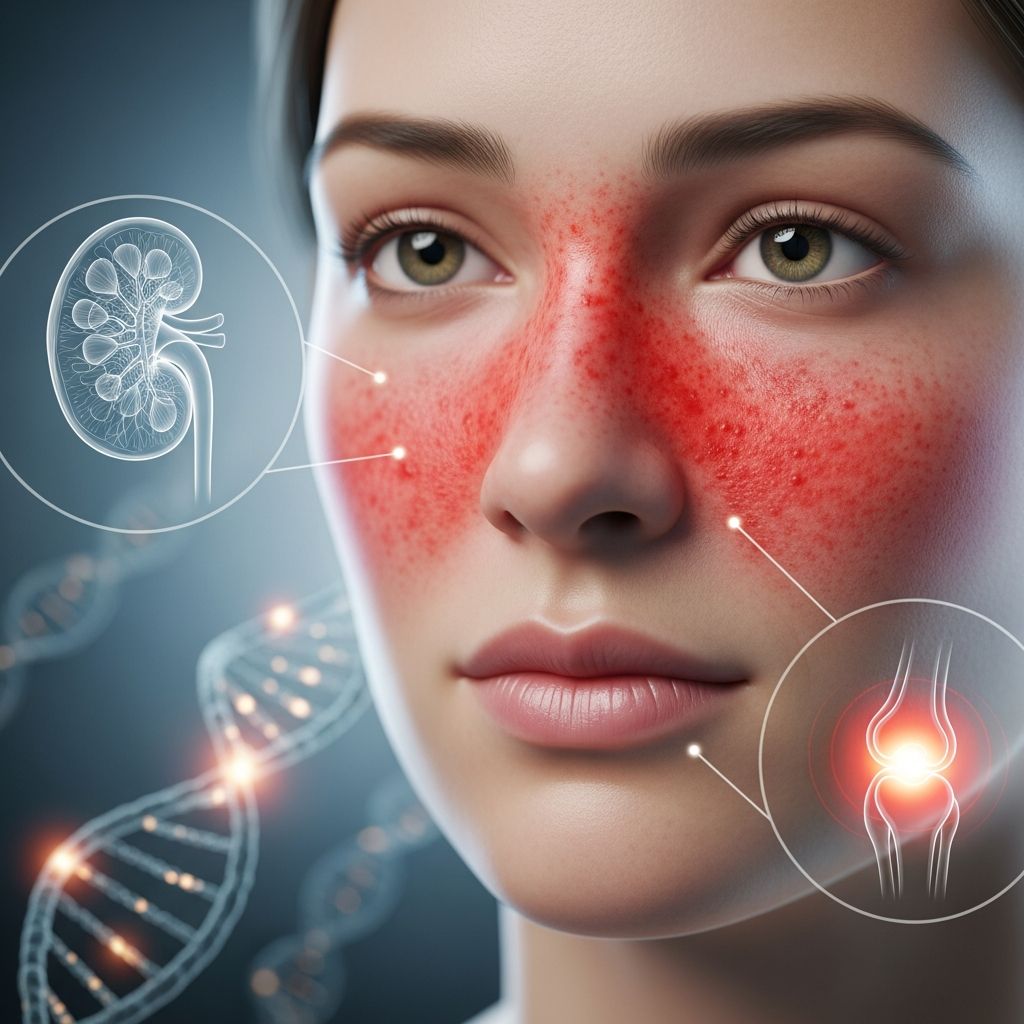
, also known as the butterfly rash, is a hallmark of acute cutaneous lupus erythematosus (ACLE). It presents as an erythematous, macular or slightly raised rash across the cheeks and nasal bridge, sparing the nasolabial folds. This distribution creates a characteristic “butterfly” pattern. The rash is often photosensitive, exacerbated by ultraviolet (UV) exposure, and may be pruritic or tender. Histologically, it shows interface dermatitis with basal vacuolization and dermal mucin deposition.Image 1: Classic malar rash in a 25-year-old woman with newly diagnosed SLE. Note the sharp cutoff at the nasolabial folds and mild scaling. The rash appeared 2 days after sun exposure.
Image 2: Edematous malar erythema in active SLE flare, accompanied by oral ulceration and arthralgias. Complement levels (C3/C4) were low, and anti-dsDNA antibodies were elevated.
Who gets a malar rash (epidemiology)?
Malar rash occurs in approximately 40-50% of SLE patients, more commonly in those with photosensitivity. It is associated with systemic flares involving kidneys, joints, and serositis. Risk factors include female sex (90% of cases), African or Asian ancestry, and positive anti-Sm or anti-dsDNA antibodies. Onset is typically in the second or third decade of life.
- Prevalence: 37-57% in Caucasian cohorts; higher (up to 68%) in African Americans.
- Triggers: UV light (80%), infections, medications (e.g., hydralazine).
- Prognosis: Resolves with treatment but recurs with flares; rarely scars unless chronic.
What does the malar rash look like?
The rash is symmetric, involving malar eminences and nasal bridge. Early lesions are erythematous macules; advanced ones show fine scale, edema, or telangiectasias. Differential diagnoses include rosacea, dermatomyositis, or seborrheic dermatitis. Dermoscopy reveals telangiectatic vessels and follicular plugging.
Image 3: Close-up of malar rash showing reticulated erythema and subtle poikiloderma.
Image 4: Bullous variant of malar rash with subepidermal vesicles, confirmed by biopsy showing lupus band on direct immunofluorescence.
How is the malar rash diagnosed?
Diagnosis relies on clinical pattern in the context of SLE criteria (e.g., ACR/EULAR 2019). Labs include ANA (95% sensitive), anti-dsDNA, low complements. Skin biopsy shows vacuolar interface dermatitis, perivascular lymphocytic infiltrate, and dermal mucin. Direct immunofluorescence (DIF) demonstrates IgG/C3 deposition at the dermoepidermal junction (lupus band test).
What is the treatment for malar rash?
First-line: Topical corticosteroids (class I-II) and broad-spectrum sunscreen (SPF 50+). Systemic hydroxychloroquine (HCQ) 200-400 mg/day is cornerstone, reducing flares by 50%. Severe cases require prednisone 0.5-1 mg/kg or immunosuppressants (mycophenolate, azathioprine). Photoprotection is essential: UPF 50+ clothing, avoid peak UV hours.
Other acute cutaneous lupus erythematosus lesions
Related Stories



ACLE encompasses photosensitive rashes beyond malar involvement. Lesions are transient, non-scarring, and resolve with treatment.
Image 5: Widespread photosensitive eruption on sun-exposed areas (V-neck, arms) in a patient with SLE nephritis.
Image 6: Annular polycyclic plaques on the trunk, mimicking subacute cutaneous lupus erythematosus (SCLE).
Subacute cutaneous lupus erythematosus
SCLE presents as annular or psoriasiform lesions on sun-exposed areas, often anti-Ro/SSA positive. Lesions heal without atrophy but may scar if untreated. Associated with 50% risk of progression to SLE.
Image 7: Annular SCLE on upper back with central clearing and peripheral arcuate erythema.
Image 8: Papulosquamous SCLE mimicking psoriasis on shoulders.
Chronic cutaneous lupus erythematosus (discoid lupus erythematosus — DLE)
DLE is the most common chronic form, causing scarring alopecia and atrophy. Lesions feature follicular plugging, scale, and central hypopigmentation/hyperpigmentation. Occurs in 20-30% of SLE patients.
Image 9: Classic DLE plaque on cheek with adherent scale, follicular keratotic plugs, and atrophic scar.
Image 10: Hypertrophic DLE variant with verrucous surface on the ear.
Image 11: Scalp DLE causing irreversible scarring alopecia.
Other chronic cutaneous lupus lesions
- Chillblains lupus: Tender, violaceous papules on acral sites (fingers, toes), exacerbated by cold.
- Discoid lupus of palms/soles: Hyperkeratotic plaques leading to fissuring.
Image 12: Chilblain lupus on fingers with periungual erythema.
Image 13: Palmar DLE with keratoderma-like changes.
Non-specific skin lesions in SLE
These lack lupus-specific histology but occur frequently.
- Urticarial vasculitis: Burning wheals lasting >24 hours, resolving with purpura. Image 14: Lower leg lesions with leukocytoclastic vasculitis on biopsy.
- Livedo reticularis: Mottled, fishnet pattern on legs/arms, associated with antiphospholipid syndrome (APS). Image 15: Extensive livedo in SLE+APS.
- Raynaud phenomenon: Triphasic color changes in fingers/toes. Image 16: Acrocyanosis during cold exposure.
Mucosal involvement
Oral ulcers are painless, shallow erosions on palate/buccal mucosa, seen in 20-40%.
Image 17: Multiple buccal ulcers with white fringe.
Image 18: Nasal septal perforation from chronic ulceration.
Nail and periungual changes
Image 19: Proximal nail fold erythema and splinter hemorrhages.
Image 20: Lupus-specific nail changes with ragged cuticles and periungual telangiectasia.
Bullous lupus erythematosus
Rare tense blisters on sun-exposed skin, DIF-positive. Image 21: Vesicles on trunk mimicking bullous pemphigoid.
Other rare cutaneous manifestations
- Image 22: Tumid lupus — juicy papules/plaques with mucinosis.
- Image 23: Lupus profundus — deep subcutaneous nodules with panniculitis.
- Image 24: Anetoderma — focal skin laxity from elastolysis.
Frequently Asked Questions
What causes skin lesions in SLE?
Skin lesions result from immune complex deposition, autoantibodies (ANA, anti-dsDNA), and UV-triggered apoptosis of keratinocytes.
Do all SLE patients get rashes?
No, but 70-85% develop cutaneous involvement; some have only internal disease.
Can lupus rashes scar?
Acute rashes do not scar; DLE and profundus cause permanent scarring/atrophy.
Is photoprotection enough treatment?
No, combine with HCQ and steroids for control; photoprotection prevents flares.
How to differentiate lupus rash from rosacea?
Lupus spares nasolabial folds, is bilateral, photosensitive; biopsy confirms.
Table: Classification of Cutaneous Lupus Erythematosus (CLE)
| ACLE | SCLE | DLE/CCLE |
|---|---|---|
| Transient, non-scarring Malar rash, photosensitive High systemic association | Annular/psoriasiform Minimal scarring Anti-Ro+ (70-90%) | Scarring, follicular plugging Head/scalp common 10-15% progress to SLE |
This gallery underscores the diagnostic value of skin findings in SLE. Consult a dermatologist or rheumatologist for biopsy-confirmed cases. Adjunct therapies include smoking cessation, vaccinations, and cardiovascular risk management.
References
- Systemic Lupus Erythematosus (SLE) — UCSF Hospital Handbook. 2023. https://hospitalhandbook.ucsf.edu/content/04-systemic-lupus-erythematosus-sle
- Systemic lupus erythematosus — MedlinePlus, NIH. 2024-01-15. https://medlineplus.gov/ency/article/000435.htm
- Systemic Lupus Erythematosus (SLE) — Merck Manual Professional. 2025. https://www.merckmanuals.com/professional/musculoskeletal-and-connective-tissue-disorders/systemic-rheumatic-diseases/systemic-lupus-erythematosus-sle
- Systemic Lupus Erythematosus — StatPearls, NCBI Bookshelf, NIH. 2024-06-20. https://www.ncbi.nlm.nih.gov/books/NBK535405/
- Lupus — American College of Rheumatology. 2024. https://rheumatology.org/patients/lupus
- 2025 ACR Guideline for SLE — ACR Journals. 2025-01-01. https://acrjournals.onlinelibrary.wiley.com/doi/10.1002/acr.25690
Similar Articles








Read full bio of Sneha Tete