Talon Noir Pathology: Understanding Black Heel
Comprehensive guide to talon noir pathology, causes, diagnosis, and treatment of black heel lesions.
Introduction to Talon Noir Pathology
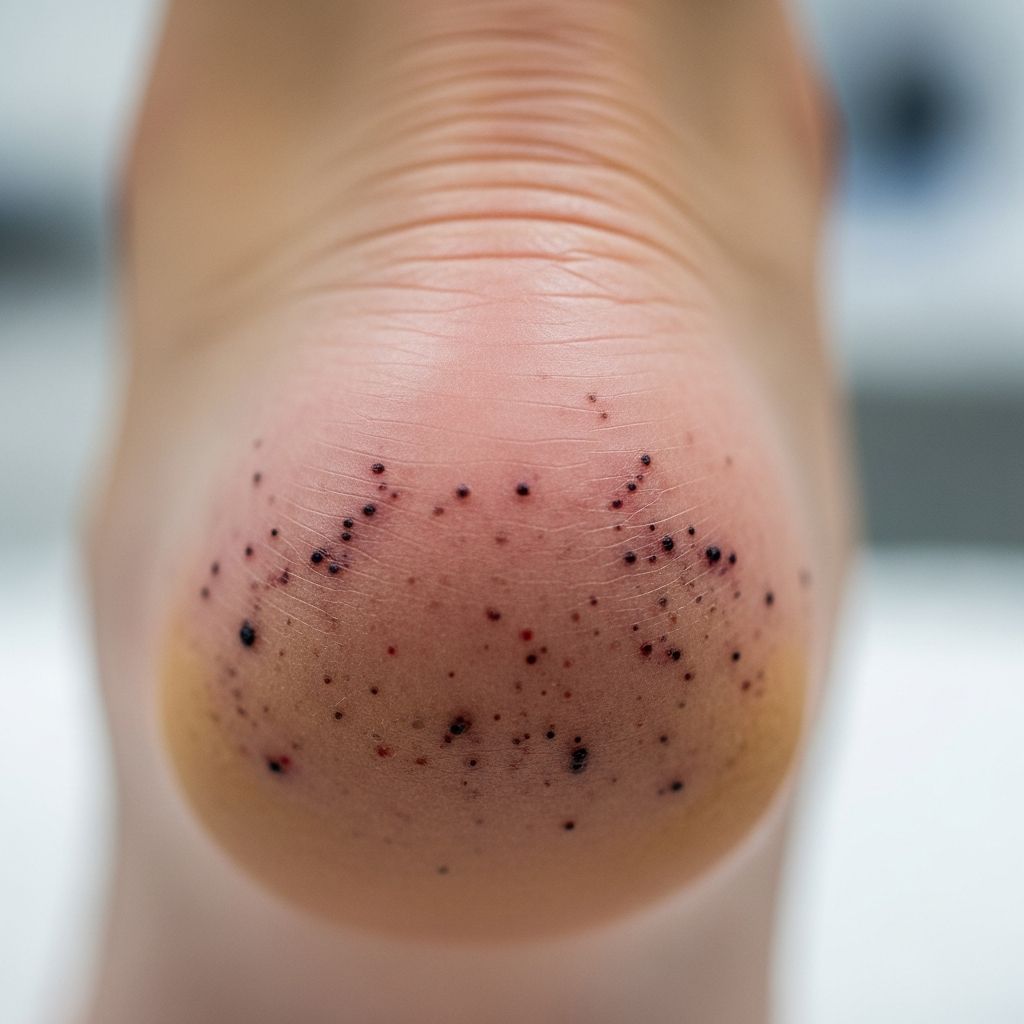
Talon noir, also known as black heel or calcaneal petechiae, represents a benign dermatological condition characterized by the accumulation of blood within the stratum corneum of the skin. The term originates from French, literally translating to ‘black heel,’ accurately describing the dark discoloration that appears on the heel and surrounding pressure-bearing areas of the foot. While the condition predominantly affects the heel, it can also manifest on the hands, lateral foot, and other acral surfaces. This self-limiting condition, though alarming in appearance, requires understanding of its pathophysiological mechanisms to ensure proper diagnosis and appropriate clinical management.
Pathophysiology and Mechanism of Talon Noir
The pathophysiology of talon noir involves a cascade of events triggered by mechanical trauma to the skin. Repetitive shearing forces or sudden directional changes on hard surfaces produce sufficient stress to disrupt vulnerable capillaries located within the papillary dermis. These shearing injuries, common in athletic activities, tear blood vessel walls and initiate hemorrhage in the dermal layer.
Once capillary integrity is compromised, extravasated erythrocytes escape into the surrounding tissue. Rather than remaining in the dermis, these red blood cells are eliminated transepidermally through sweat ducts, which provide the path of least resistance. The sweat ducts serve as natural channels for the blood to migrate upward through the epidermal layers toward the surface of the skin.
The critical pathological feature of talon noir is the location of hemorrhage within the stratum corneum, the outermost layer of the epidermis. This anatomical localization is fundamental to understanding why talon noir persists. Because the stratum corneum consists of dead, keratinized cells that form the skin’s protective barrier, phagocytic cells—the body’s immune scavengers responsible for clearing debris and damaged cells—cannot penetrate this layer effectively. Consequently, once hemoglobin becomes trapped and oxidized within the stratum corneum, it cannot be rapidly cleared, leading to the characteristic dark discoloration that persists until the stratum corneum naturally sheds through normal desquamation.
Histopathological Features
Microscopic examination of talon noir lesions reveals distinctive histological characteristics that confirm the diagnosis. The primary findings include:
- Severe hyperkeratosis – excessive thickening of the stratum corneum, reflecting the protective response of skin subjected to repetitive pressure and friction
- Parakeratosis – retention of nuclei in the stratum corneum, indicating abnormal keratinization patterns
- Acanthosis – thickening of the stratum spinosum layer of the epidermis
- Intraepidermal hemorrhage – presence of red blood cells within the epidermal layers, particularly the stratum corneum
- Acute inflammatory exudates – collections of inflammatory fluid and cells indicating the tissue’s response to injury
- Degenerated red cells – breakdown products of erythrocytes within the epidermal layers
- Large areas of papillary dermal hemorrhage – bleeding within the upper dermal papillae, representing the primary site of vascular injury
Importantly, histological examination reveals no evidence of melanoma or malignant transformation, a critical distinction given the lesion’s concerning appearance. The presence of intracorneal hemoglobin and absence of melanin deposits help differentiate talon noir from other pigmented lesions.
Clinical Features and Presentation
The clinical presentation of talon noir is relatively consistent and distinctive when properly recognized. Lesions typically appear as blue-black or brown-colored macules, representing aggregates of smaller petechiae that coalesce to form larger hyperpigmented patches. Multiple satellite lesions often surround a central area of greater pigmentation, creating a characteristic appearance.
Anatomically, talon noir displays a predilection for specific locations on the foot. Lesions characteristically present on the posterior or posterolateral aspect of the heel, positioned just superior to the hyperkeratotic edge of the plantar surface. The lesions tend to be horizontally oriented and typically unilateral, though bilateral involvement can occur. Most lesions measure up to 3 centimeters in diameter, though larger lesions have been documented.
Related Stories



A crucial clinical feature of talon noir is that affected areas are neither elevated, depressed, nor indurated—the lesions remain flat and do not create tactile abnormalities. This distinguishes talon noir from other dermatological conditions that produce palpable changes. Additionally, patients characteristically report no associated symptoms; talon noir is entirely asymptomatic, with no pain, pruritus, bleeding, or drainage.
Risk Factors and Demographics
Talon noir demonstrates a clear predilection for specific populations and activities. Young athletes represent the primary demographic affected by this condition, particularly those engaged in activities generating repetitive foot trauma. Sports involving intensive running, jumping, or lateral movements—such as basketball, tennis, and track and field—create ideal conditions for talon noir development.
Mountain climbers also represent a significant at-risk group, experiencing repetitive shearing forces through climbing activities. Runners in particular frequently develop talon noir on the heels and toes due to the repetitive impact forces and frictional trauma inherent in running on hard surfaces. The condition can also occur in non-athletic individuals who experience sudden or prolonged mechanical trauma to the feet or hands, though such cases are less common.
Interestingly, talon noir has been documented in individuals without recognized athletic activity, suggesting that any activity involving repetitive pressure or friction to acral surfaces carries risk. The condition affects individuals across age groups, though young athletes represent the predominant population.
Diagnosis and Differential Diagnosis
Diagnosis of talon noir begins with careful clinical evaluation and history. A thorough patient history revealing recent strenuous athletic activity or trauma coinciding with lesion appearance provides important diagnostic context. Dermoscopic examination, which magnifies the lesion surface, reveals the characteristic speckling pattern created by multiple punctate hemorrhages aggregated together.
One of the most valuable diagnostic techniques is superficial curettage, which involves gentle scraping of the lesion surface. This simple procedure can reveal dried blood specks within the stratum corneum, providing physical evidence supporting the diagnosis of talon noir. This technique proves particularly valuable in cases where clinical diagnosis remains uncertain.
The primary diagnostic challenge with talon noir involves distinguishing it from acral melanoma, a malignant skin cancer that can present with dark pigmentation on the feet and hands. Importantly, research indicates that nearly 50 percent of talon noir cases are initially misdiagnosed as acral melanoma or melanocytic nevi. Close inspection reveals that talon noir comprises an aggregate of smaller punctate lesions rather than a uniform pigmented lesion. Dermoscopic features showing the absence of the ABCDE criteria for melanoma, combined with a history of recent trauma and the benign clinical course, support the diagnosis of talon noir.
When diagnostic uncertainty persists, particularly in older patients or those without clear trauma history, skin biopsy provides definitive diagnosis through histopathological examination. Biopsy confirms the presence of intraepidermal hemorrhage and excludes malignancy.
Comparison Table: Talon Noir vs. Acral Melanoma
| Feature | Talon Noir | Acral Melanoma |
|---|---|---|
| Composition | Aggregate of punctate lesions | Uniform pigmented patch |
| Symptoms | Asymptomatic | May show signs of change or irritation |
| Associated Trauma | Clear history of recent activity | No temporal relationship to trauma |
| Clinical Course | Stable or slowly resolving | Progressive changes over time |
| Histology | Intraepidermal hemorrhage, no melanoma cells | Atypical melanocytes |
Treatment and Management
The treatment approach for talon noir is fundamentally conservative, as this condition requires no active intervention. Talon noir is a self-limiting condition that resolves naturally over time as the stratum corneum sheds through normal physiological desquamation. This process typically occurs over weeks to months, depending on the thickness of the affected stratum corneum and individual skin turnover rates.
For asymptomatic patients requiring reassurance, education about the benign nature of the condition and its expected natural resolution often suffices. The primary clinical goal involves excluding malignancy and reassuring patients that no treatment is necessary.
In cases where patients desire more rapid resolution or find the appearance psychologically bothersome, several approaches may be considered. Gentle superficial curettage or dermabrasion of the affected area can mechanically remove the hemorrhage-laden stratum corneum, though this approach requires caution to avoid inducing further trauma or secondary infection. Topical therapies offer minimal benefit given the location of hemorrhage within the stratum corneum, which limits drug penetration.
Prevention of recurrence focuses on activity modification. Athletes can reduce talon noir risk by:
- Wearing properly fitting athletic footwear with adequate cushioning and support
- Using appropriately sized climbing equipment if climbing is the inciting activity
- Implementing gradual increases in training intensity and volume to allow tissue adaptation
- Using protective padding on pressure-bearing areas during high-risk activities
- Maintaining proper technique in sports to minimize abnormal shearing forces
Clinical Significance and Prognosis
The clinical significance of talon noir lies primarily in its potential for misdiagnosis as a malignant lesion. The benign prognosis of talon noir contrasts sharply with the serious implications of acral melanoma, making accurate diagnosis essential. Reassurance of patients regarding the benign nature and expected resolution is a critical component of clinical care.
The prognosis of talon noir is universally favorable. No complications, malignant transformation, or systemic manifestations occur. Complete resolution occurs in all cases through natural desquamation, and recurrence can be minimized through activity modification and appropriate footwear selection.
Additional Terminology and Variants
Talon noir represents part of a broader category of posttraumatic cutaneous hemorrhagic lesions affecting acral surfaces. Related conditions include tache noir (‘black palm’) affecting the palms, and lesions referred to as ‘PlayStation thumb’ affecting digital surfaces from repetitive pressure or friction. Basketball heel and tennis heel represent alternative names reflecting the sports associations with the condition. These variants follow the same pathophysiological mechanisms and benign clinical course as talon noir.
Frequently Asked Questions
Q: Is talon noir dangerous or cancerous?
A: No, talon noir is entirely benign and cannot transform into cancer. It consists of blood trapped in the outermost skin layer and resolves naturally. However, its appearance can resemble melanoma, making professional evaluation important to confirm the diagnosis and exclude malignancy.
Q: How long does talon noir take to resolve?
A: Talon noir typically resolves over weeks to months as the stratum corneum naturally sheds. The exact timeline depends on individual skin turnover rates and the amount of blood present in the lesion. Most cases clear within 2-6 months with no treatment.
Q: Can talon noir be treated or removed?
A: Talon noir does not require treatment and resolves spontaneously. For patients desiring faster resolution, gentle superficial curettage can mechanically remove the affected stratum corneum. However, this may not be necessary as natural resolution occurs without intervention.
Q: Who is most likely to develop talon noir?
A: Young athletes are most commonly affected, particularly those engaged in running, basketball, tennis, and mountain climbing. Anyone experiencing repetitive pressure or shearing forces on the feet or hands can develop talon noir, though it is less common in non-athletes.
Q: Can talon noir occur on areas other than the heel?
A: Yes, while talon noir most commonly affects the heel, it can develop on the lateral foot, palms, and other pressure-bearing areas. When it appears on the palm, it is called tache noir. The underlying mechanism remains the same regardless of location.
References
- Black Heel: Symptoms, Diagnosis and Treatment — Symptoma. 2024. https://www.symptoma.com/en/info/black-heel
- Talon noir — VisualDx. 2024. https://iphone-services.visualdx.com/visualdx/diagnosis/talon+noir
- Talon Noir: A Case Report and Literature Review — National Institutes of Health. 2023. https://pmc.ncbi.nlm.nih.gov/articles/PMC10081566/
- Skin Findings in Runners: More Than Just Black and Blue Toes — HMP Global Learning Network. 2024. https://www.hmpgloballearningnetwork.com/site/thederm/article/skin-findings-runners-more-just-black-and-blue-toes
- Talon noire (Black heel, calcaneal petechiae) — Dermatology Advisor. 2024. https://www.dermatologyadvisor.com
- Calcaneal petechiae — DermNet New Zealand. 2024. https://dermnetnz.org/topics/calcaneal-petechiae
- Using Superficial Curettage to Diagnose Talon Noir — The Hospitalist. 2024. https://blogs.the-hospitalist.org/content/using-superficial-curettage-diagnose-talon-noir
Similar Articles








Read full bio of medha deb