Talus Bone: Anatomy, Function, And 3 Common Problems
Complete guide to talus bone anatomy, function, injuries and when to seek care.
What Is the Talus Bone?
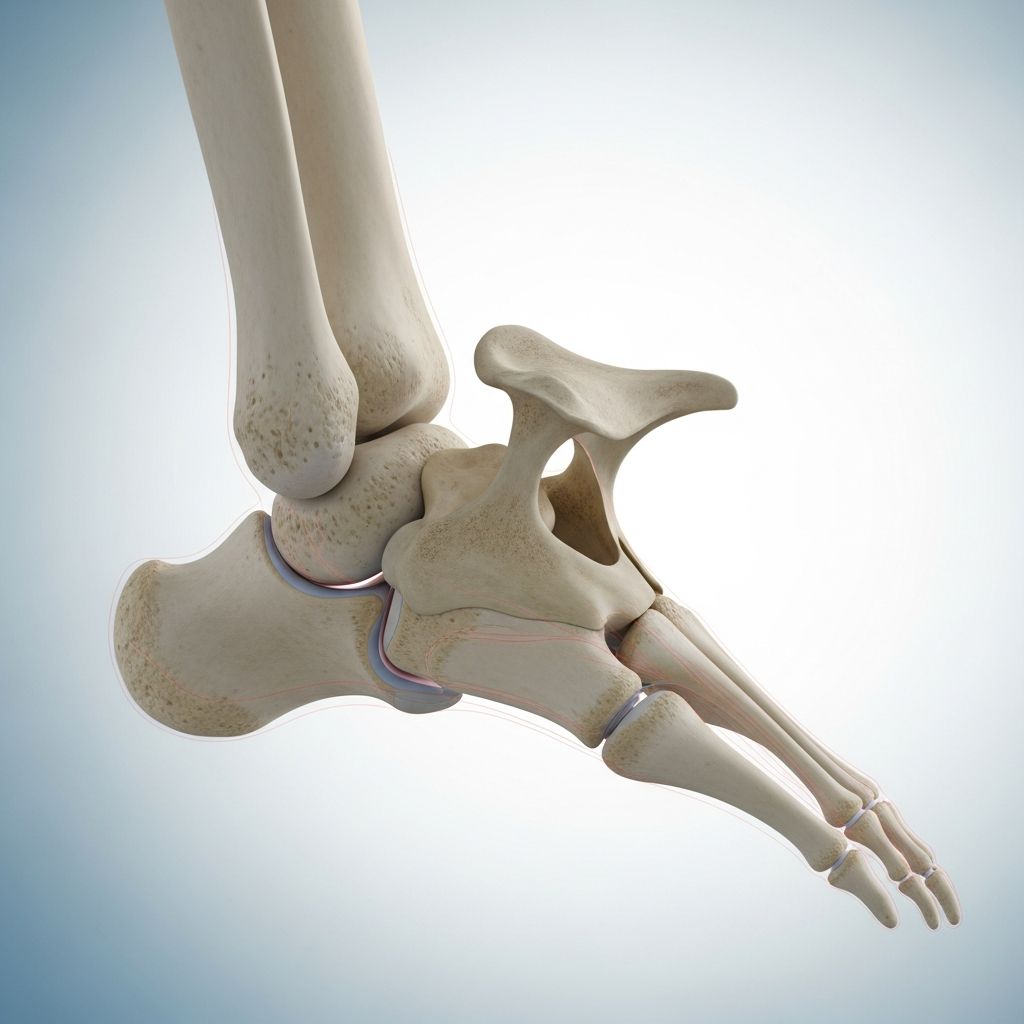
The talus bone is one of the most important bones in your foot and ankle. It serves as the primary connection between your foot and your leg, making it essential for movement and weight-bearing. Located in your ankle, the talus sits between your shin bone (tibia) and calf bone (fibula) above, and your heel bone (calcaneus) below. This unique position makes the talus a crucial link in your body’s structural chain, transferring weight and force from your leg through to your foot with every step you take.
The talus is distinctive because it’s the only bone in your foot that doesn’t have any muscles attached to it. Instead, it relies entirely on ligaments and tendons to maintain its position and support its function. The bone is mostly covered in cartilage—a smooth, slippery material that allows your bones to move smoothly against each other without friction.
Anatomy and Structure of the Talus Bone
Physical Characteristics
The talus is a small but mighty bone, approximately the size of a die, yet it bears tremendous responsibility in ankle function. Its structure is specifically designed to accommodate the complex movements of your ankle and foot. The bone has several distinct parts that work together:
- The body forms the main bulk of the talus
- The neck connects the body to the head
- The head articulates with the navicular bone in your midfoot
- Multiple articular surfaces allow movement with surrounding bones
Anatomical Relationships
Your talus bone connects with several other bones to create important joints. The ankle joint (also called the talocrural joint) forms where the talus meets your tibia and fibula. This joint is responsible for the up-and-down movement of your foot—the motion you use when you walk, run, or point your toes. Below the talus sits your heel bone (calcaneus), forming the subtalar joint. This joint enables the side-to-side tilting motion of your foot, allowing you to adjust to uneven surfaces.
The talus also articulates with your navicular bone toward the front of your foot, creating another important joint in your midfoot. All these connections are held together by a sophisticated network of ligaments and supported by muscles and tendons.
Functions of the Talus Bone
Weight Distribution
One of the primary functions of your talus is to transfer weight from your body through your ankle and foot. When you stand, walk, or run, the force of your body weight is channeled through your leg bones into the talus, which then distributes this force to your heel and the rest of your foot. This weight-bearing function is why the talus is covered with cartilage—this specialized tissue protects the bone and allows smooth weight transfer without damage.
Enabling Movement
The talus enables two distinct types of ankle movement. The ankle joint allows your foot to move up and down (called dorsiflexion and plantarflexion), while the subtalar joint allows side-to-side tilting (called inversion and eversion). Together, these movements allow you to walk on uneven surfaces, climb stairs, dance, and perform countless other activities. The cartilage covering the talus is essential for these movements—without it, the bones would grind against each other, causing pain and joint damage.
Related Stories



Common Talus Bone Problems and Injuries
Talus Fractures
Talus fractures are serious injuries that typically occur due to high-impact trauma such as car accidents, falls from significant heights, or severe sports injuries. Because the talus is so important for ankle function and bears tremendous force, a fracture in this bone can result in significant loss of motion and function in your ankle and foot.
Talus fractures are classified based on how much the bone fragments have moved from their normal position. Treatment varies depending on the type and severity of the fracture. Some simple fractures may be managed with casting and immobilization, while most talus fractures require surgery to realign the bone fragments and ensure proper healing. The recovery process can take several months, and the cast typically needs to be worn for eight to twelve weeks or longer.
Sinus Tarsi Syndrome
Sinus tarsi syndrome is a condition involving painful swelling in the small space between your talus and calcaneus (heel bone). The sinus tarsi is actually a passageway through your bones that allows ligaments, nerves, and blood vessels to pass through to other parts of your foot and ankle. When this area becomes inflamed, it causes pain and discomfort on the lower outside part of your ankle.
Ankle sprains are the most common cause of sinus tarsi syndrome. The swelling can sometimes be so noticeable that people think they have a lump or cyst under their skin. The pain is usually a constant ache that feels sharper or more stabbing when you move or use your foot. Fortunately, it’s rare to need surgery to treat this condition—most cases respond well to conservative treatment.
Ligament Injuries
The talus works closely with your ankle ligaments to maintain stability. These firm bands of fibrous tissue connect your foot bones (including the talus and calcaneus) with your lower leg bones (tibia and fibula). There are three main sets of ligaments in your ankle: the medial (deltoid) ligaments on the inner side, the lateral ligaments on the outer side, and other supporting ligaments. When these ligaments are sprained or torn, your ankle can become unstable, affecting how the talus functions.
Symptoms of Talus Problems
If you have an injury or condition affecting your talus, you may experience several symptoms:
- Severe ankle pain, especially with weight-bearing
- Swelling and bruising around the ankle
- Difficulty walking or bearing weight on the affected foot
- Stiffness and reduced range of motion
- A sensation of instability or the ankle giving way
- Difficulty performing normal daily activities
If you experience severe ankle pain, especially after an injury, it’s important to seek medical attention promptly. Talus injuries can have serious consequences if not properly treated.
Diagnosis of Talus Conditions
When you see a healthcare provider for suspected talus problems, they will conduct a physical examination and may order imaging tests. The examination will include checking for swelling, bruises, and cuts, as well as assessing your ankle’s range of motion and stability. Your healthcare provider may use various imaging techniques to confirm a diagnosis and determine the best treatment approach:
- X-rays to visualize bone fractures and alignment
- CT scans for detailed three-dimensional images
- MRI scans to evaluate soft tissue damage and ligament injuries
- Ultrasound for dynamic assessment of movement
Treatment Options
Conservative Treatment
For stable talus fractures or minor injuries, conservative treatment may be appropriate. Your healthcare provider may recommend immobilization in a splint or cast to keep your foot and ankle from moving while the bone heals. During this period, you won’t be able to put weight on the affected foot. Additional conservative measures may include ice application, elevation, and physical therapy once initial healing has occurred.
Surgical Treatment
Most talus fractures require surgery because of the high-energy force that typically causes them. If your bones are out of place or broken into several pieces, a foot and ankle surgeon will perform an open reduction and internal fixation (ORIF). In this procedure, the bone fragments are repositioned and held together with metal plates and/or screws until the bone heals. In some cases where excessive swelling is present, an external fixator may be used temporarily—this device uses large pins placed in your bones, held together with special bars visible from outside the skin, to maintain alignment until swelling decreases.
Recovery and Rehabilitation
Recovery from a talus injury is a gradual process that requires patience and adherence to medical recommendations. You’ll need to wear a cast or splint for an extended period, typically eight to twelve weeks or longer, depending on the complexity of your injury. During this time, you cannot put any weight on the affected foot. Your healthcare provider will monitor your progress with periodic X-rays to ensure proper healing.
After the cast is removed, you may still experience pain, swelling, and stiffness. Physical therapy is crucial for regaining strength, flexibility, and normal function. Your therapist will guide you through progressive exercises to restore your ankle’s range of motion and help you return to normal activities safely.
Prevention and Maintenance
While some talus injuries result from unavoidable accidents, you can take steps to protect your ankle health:
- Wear appropriate footwear with good ankle support during activities
- Warm up and stretch before exercise
- Strengthen ankle muscles through regular exercises
- Be mindful of your surroundings to avoid trips and falls
- Use proper technique during sports and physical activities
- Maintain a healthy weight to reduce stress on your joints
Frequently Asked Questions
Q: What exactly is the talus bone?
A: The talus is a small but crucial ankle bone that connects your foot to your leg. It sits between your shin bone (tibia) and calf bone (fibula) above, and your heel bone (calcaneus) below. It’s the only bone in your foot without any muscles attached to it.
Q: How serious is a talus fracture?
A: Talus fractures are serious injuries that can cause significant loss of ankle and foot function. Most require surgery to repair properly, and recovery typically takes several months. However, with appropriate treatment, most people can regain good function.
Q: Can a talus fracture heal without surgery?
A: Some simple, stable talus fractures can be managed with immobilization and casting alone. However, most talus fractures require surgery because of the forces involved and the critical nature of this bone for ankle function.
Q: How long does it take to recover from a talus injury?
A: Recovery time varies depending on the severity of the injury. You’ll typically wear a cast for 8-12 weeks or longer, and full recovery can take several months. Physical therapy after cast removal is essential for restoring normal function.
Q: What is sinus tarsi syndrome?
A: Sinus tarsi syndrome is a painful condition involving swelling in the small space between your talus and heel bone. It’s commonly caused by ankle sprains and usually responds well to conservative treatment without requiring surgery.
Q: When should I see a doctor about ankle pain?
A: You should see a healthcare provider if you experience severe ankle pain, especially after an injury, or if you have persistent swelling, instability, or difficulty bearing weight on your foot.
References
- Talus Fractures: Types, Symptoms, Treatment & Recovery — Cleveland Clinic. 2021-10-19. https://my.clevelandclinic.org/health/diseases/22154-talus-fracture
- Sinus Tarsi Syndrome: What It Is, Symptoms & Treatment — Cleveland Clinic. https://my.clevelandclinic.org/health/diseases/sinus-tarsi-syndrome
- Ankle Ligaments: What They Are, Anatomy & Function — Cleveland Clinic. https://my.clevelandclinic.org/health/body/21609-ankle-ligament
- Foot and Ankle Anatomy — Valley Bone & Joint Specialists. https://www.vbjs.net/foot-ankle-anatomy-bone-joint-specialists-gilbert-scottsdale-phoenix-az.html
- Ankle: Anatomy & How It Works — Cleveland Clinic. https://my.clevelandclinic.org/health/body/24909-ankle-joint
Similar Articles








Read full bio of Sneha Tete