Target And Targetoid Lesions: Essential Guide For Diagnosis
Understanding the distinctive bull's-eye skin lesions: classic targets in erythema multiforme and targetoid mimics in diverse dermatoses.
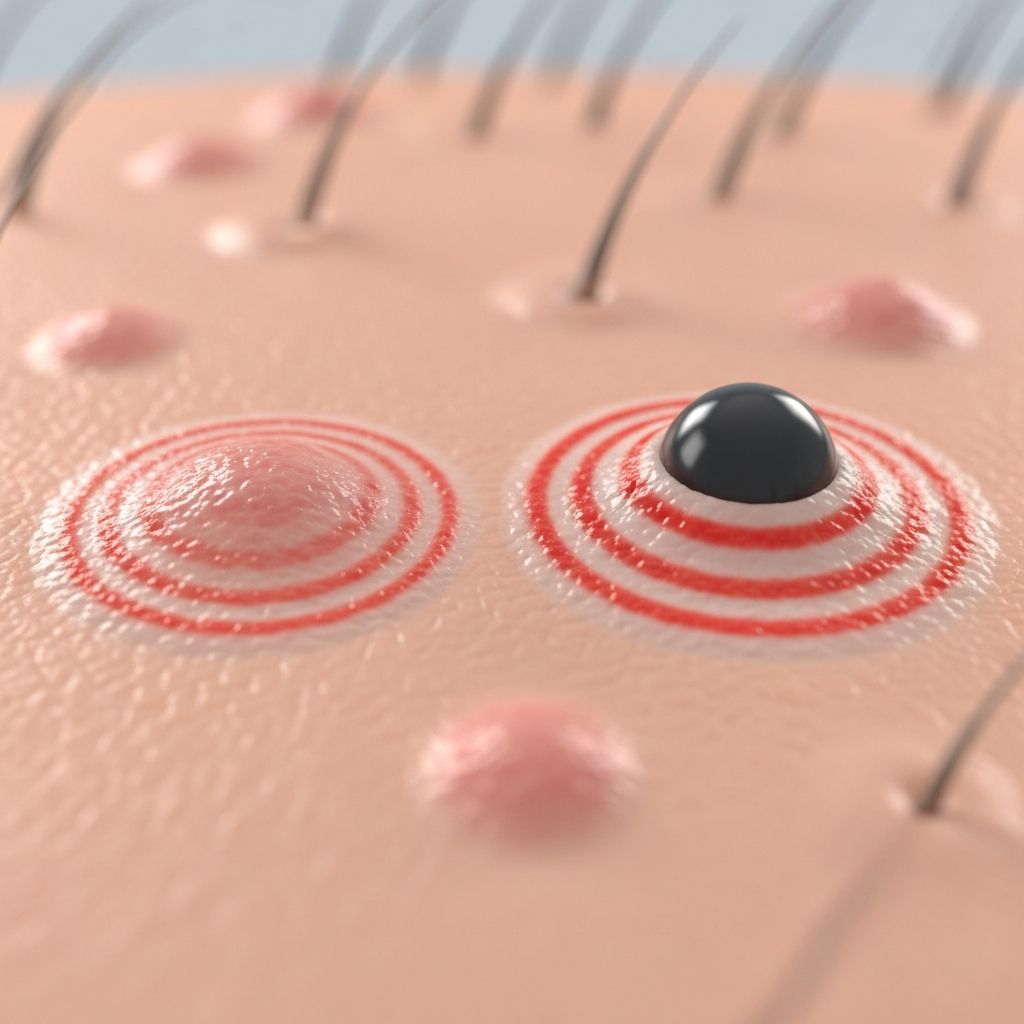
Target and targetoid lesions are distinctive skin eruptions characterized by their concentric, bull’s-eye appearance, playing a crucial role in dermatological diagnosis. These lesions help clinicians differentiate between benign reactions, infections, autoimmune disorders, and severe conditions like Stevens-Johnson syndrome.
What are target lesions?
A
target lesion
is defined as a round skin lesion featuringthree concentric colour zones
: a darker centre often with a blister or crust, surrounded by a paler pink ring, and an outer erythematous border. This classic morphology, also known as a bull’s-eye or cockade lesion, is pathognomonic forerythema multiforme
.Target lesions typically measure less than 3 cm in diameter and can appear on any body site, including the face, upper chest, back, arms, legs, hands, feet, and mucous membranes such as the lips. In erythema multiforme, they evolve over 24-48 hours, starting as red macules or papules that develop the zonal pattern.
- Central zone: Dusky, purpuric, or necrotic area, sometimes with a blister or crust.
- Middle zone: Pale, edematous ring indicating dermal edema.
- Outer zone: Sharply demarcated erythematous halo.
These lesions are raised (papular) in classic erythema multiforme and symmetrically distributed, often on acral sites like palms and soles.
What are targetoid lesions?
**Targetoid lesions** resemble targets but lack the full three-zone classic appearance or arise from conditions other than erythema multiforme. They typically show
two zones
(e.g., central dusky area with surrounding erythema) and/or an indistinct border. These may be raised (atypical targets in EM) or flat (in SJS/TEN).Targetoid lesions evolve differently, may not blanch, and occur in a broad differential including urticaria, drug eruptions, infections, and inflammatory dermatoses. Their recognition prevents misdiagnosis of severe entities.
Target lesions in erythema multiforme
**Erythema multiforme (EM)** is an acute, immune-mediated mucocutaneous disorder primarily triggered by infections (e.g., herpes simplex virus, Mycoplasma pneumoniae) or medications. It presents with symmetrical, erythematous target lesions, classified as EM minor (skin-only) or EM major (with mucosal involvement).
Lesions erupt over 24-48 hours, persist 1-2 weeks, and favor extremities, palms, soles, and dorsal hands. Prodromal symptoms like fever, malaise, or sore throat may precede in EM major.
Histology shows interface dermatitis with lymphocyte exocytosis, apoptotic keratinocytes, and dermal edema, supporting the clinical diagnosis.
Atypical target lesions
Atypical targets deviate from the classic form:
- Raised atypical targets: Palpable, edematous with two zones or blurred borders; seen in EM.
- Flat atypical targets: Non-palpable, macular with two zones; characteristic of Stevens-Johnson syndrome/toxic epidermal necrolysis (SJS/TEN).
- Macules ± blisters: Irregular erythematous macules, often in SJS/TEN with epidermal detachment.
Bastuji-Garin classification distinguishes EM (raised typical/atypical targets) from SJS/TEN (flat targets, >10% detachment).
Conditions associated with targetoid lesions
Numerous dermatoses produce targetoid lesions, necessitating a broad differential.
Urticaria
Urticaria features transient weals: raised, pruritic plaques changing within 24 hours. Targetoid urticaria shows central normal skin surrounded by a circular weal; dermographism may coexist. Unlike EM, lesions migrate and blanch completely.
Related Stories



Polymorphic light eruption
Sun-exposed skin develops pruritic papules/papulovesicles hours post-exposure. Targetoid forms are uncommon but possible in this photosensitive eruption.
Erythema annulare centrifugum
Starts as pink papules expanding into annular plaques with trailing scale, mimicking three zones. Associated with infections, drugs, or malignancy.
Subacute cutaneous lupus erythematosus
Annular/polycyclic plaques on sun-exposed upper trunk post-UV exposure. Targetoid variants show three zones; anti-Ro/La positive.
Rowell syndrome
Rare lupus variant with large, raised targetoid lesions, chilblains, and speckled ANA, anti-Ro/La, or RF positivity.
Linear IgA bullous dermatosis
Tense bullae on targetoid macules, often drug-induced (vancomycin). Mimics EM/SJS with flat targets and central bullae.
Erythema chronicum migrans
Lyme disease: expanding >5 cm plaque with dusky center post-tick bite, sparing center later. Lower limbs common.
Mycoplasma-induced rash and mucositis (MIRM)
Severe mucositis with sparse polymorphic skin lesions (48% targetoid: flat purpuric macules). Centrally distributed; PCR confirms.
Other associations
- Fixed drug eruption: Recurrent dusky plaques resolving with hyperpigmentation.
- Sweet syndrome: Painful plaques/papules, neutrophilic.
- Neutrophilic figurate erythema: Annular targetoids in myelodysplasia.
Additional causes: pityriasis rosea, guttate psoriasis, insect bites.
Diagnosis
Diagnosis relies on clinical morphology, history (triggers, evolution), and distribution. Skin biopsy confirms in ambiguous cases: EM shows lymphocytic interface changes; urticaria shows dermal edema.
| Feature | Classic Target (EM) | Targetoid (Others) |
|---|---|---|
| Zones | 3 distinct | 2 or indistinct |
| Palpability | Raised | Variable (flat/raised) |
| Duration | 1-2 weeks | Transient or persistent |
| Blanching | Partial | Often complete (urticaria) |
Differential diagnosis
- **Erythema multiforme vs SJS/TEN:** Mucosal involvement, detachment favor SJS/TEN.
- **Urticaria:** Itch, transience.
- **Lyme:** Tick history, expansion.
- **Lupus:** Photosensitivity, serology.
Frequently asked questions
What causes target lesions?
Primarily herpes simplex or Mycoplasma in EM; drugs in SJS/TEN.
Are targetoid lesions dangerous?
Depends on cause: benign in urticaria, severe in SJS/TEN or bullous diseases.
How to distinguish EM from urticaria?
EM fixed, partial blanch; urticaria migrates, fully blanches.
Do target lesions itch?
Mildly in EM; intensely in urticaria.
Treatment for erythema multiforme?
Symptomatic; treat trigger (antivirals for HSV).
References
- Targetoid – Wikipedia — Wikipedia contributors. 2023-10-15. https://en.wikipedia.org/wiki/Targetoid
- A widespread erythematous targetoid eruption — Medicine Today. 2023. https://medicinetoday.com.au/mt/supplements/regular-series/widespread-erythematous-targetoid-eruption
- Target and targetoid lesions – DermNet — DermNet NZ. 2024-01-01. https://dermnetnz.org/topics/target-and-targetoid-lesions
- Target and targetoid lesions in dermatology — Indian Journal of Dermatology, Venereology and Leprology. 2022-05-20. https://ijdvl.com/target-and-targetoid-lesions-in-dermatology/
- Erythematous Lesions With Central Pallor — Clinical Advisor. 2023-08-10. https://www.clinicaladvisor.com/home/dermatologic-look-alikes/erythematous-lesions-central-pallor/4/
- Erythema Multiforme – StatPearls — NCBI Bookshelf. 2023-07-17. https://www.ncbi.nlm.nih.gov/books/NBK470259/
- Erythema multiforme – Symptoms, diagnosis and treatment — BMJ Best Practice. 2024-11-12. https://bestpractice.bmj.com/topics/en-us/367
Similar Articles








Read full bio of medha deb