Temporal Arteritis and Giant Cell Arteritis: Symptoms, Diagnosis, and Treatment
Comprehensive guide to understanding giant cell arteritis, its symptoms, diagnosis methods, and evidence-based treatment options.
Overview of Temporal Arteritis and Giant Cell Arteritis
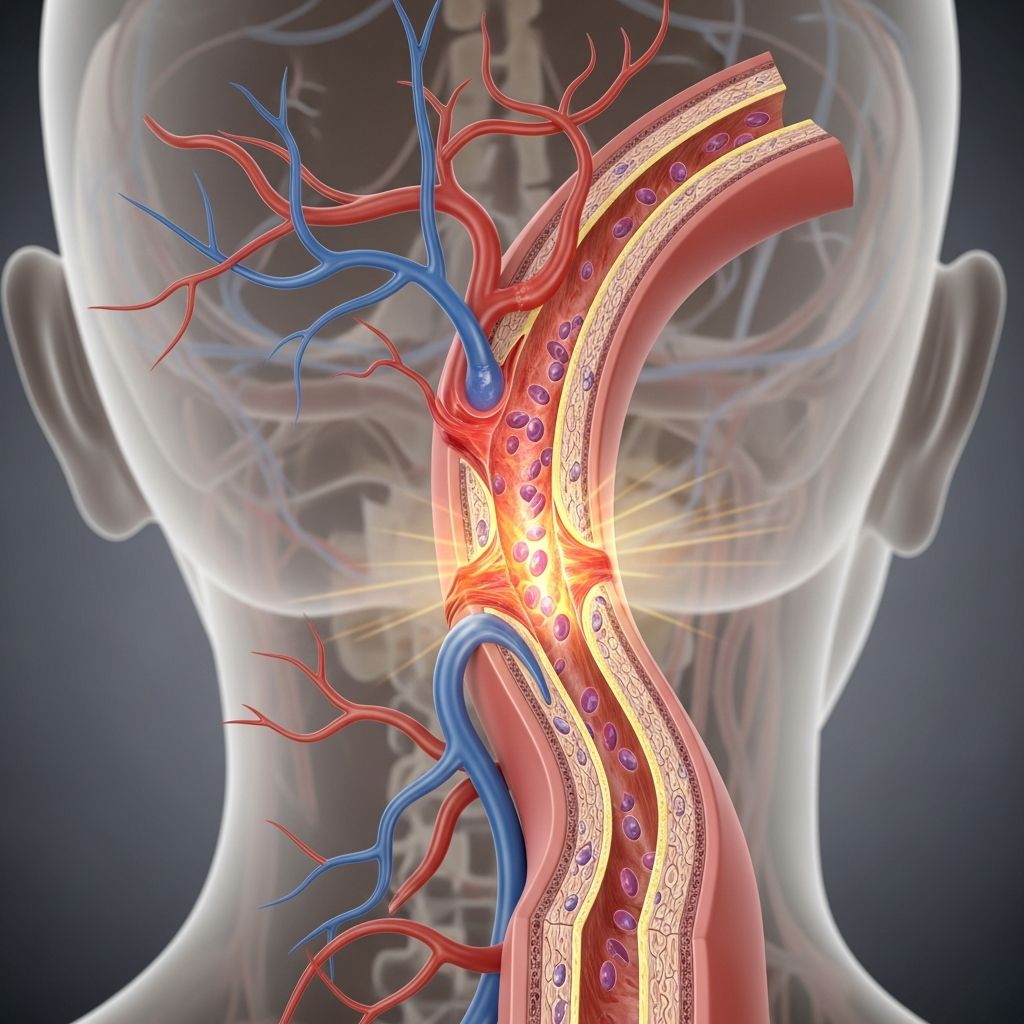
Temporal arteritis and giant cell arteritis (GCA) refer to the same systemic vasculitis condition that primarily affects medium-sized and large arteries throughout the body. Giant cell arteritis is a common large-vessel vasculitis that predominantly involves the thoracic aorta, large arteries emerging from the aorta in the neck, and extracranial branches of the carotid arteries. The condition occurs most often in the extracranial branches of the carotid arteries near the temple and represents the most common large-vessel vasculitis affecting older adults.
The disease is characterized by inflammation of arterial walls, which can lead to serious complications including visual loss, stroke, limb claudication, and aortic aneurysm if left untreated. Understanding this condition is crucial for early recognition and prompt treatment to prevent irreversible complications.
Understanding the Pathophysiology
Giant cell arteritis involves a complex inflammatory process that affects the structure and function of large arteries. The disorder tends to affect arteries containing elastic tissue, most often the temporal, cranial, or other carotid system arteries. In this condition, mononuclear cell infiltrates accumulate in the adventitia (the outermost layer of the artery) and form granulomas containing activated T cells and macrophages.
Multinucleated giant cells, when present, cluster near the disrupted elastic lamina. The intimal layer becomes markedly thickened, resulting in concentric narrowing and occlusion of the arterial lumen. This pathological process can occur in multiple locations throughout the body, with the temporal arteries being most frequently affected. Recent research has revealed that temporal arteries are inhabited by communities of bacteria in both healthy and diseased states, suggesting that the microbiome may play a role in the inflammatory process.
Clinical Presentations and Symptoms
Giant cell arteritis presents with diverse clinical manifestations depending on which arteries are affected. The condition can present with cranial symptoms, extracranial large-vessel involvement, or polymyalgia rheumatica.
Cranial GCA Symptoms
Cranial GCA represents the best-characterized clinical presentation and causes characteristic symptoms including:
- New-onset headache, most often in the temporal area but possibly anywhere throughout the head (occurring in approximately two-thirds of patients)
- Visual disturbances and visual loss, which represent the most serious complication
- Jaw claudication (pain in the jaw muscles during chewing)
- Diplopia (double vision)
- Temporal artery tenderness or nodularity on examination
Systemic and Extracranial Symptoms
Patients may also experience systemic inflammatory symptoms, including fever, weight loss, malaise, and fatigue. On physical examination, the temporal arteries may be tender or nodular, and the pulses may be felt above the zygomatic arch, above and in front of the tragus of the ear. A temporal artery that rolls under the examiner’s fingers, rather than collapses, is considered abnormal and suggests arteritis. Large-vessel involvement is commonly present and may result in serious complications such as visual loss, stroke, limb claudication, and aortic aneurysm.
Polymyalgia Rheumatica Association
Giant cell arteritis is frequently associated with polymyalgia rheumatica, a condition characterized by pain and stiffness in the shoulders, neck, and hips. Patients may present with symptoms of polymyalgia rheumatica either preceding or coinciding with the development of GCA.
Related Stories



Diagnostic Approach and Testing
Accurate diagnosis of giant cell arteritis requires a combination of clinical assessment, laboratory findings, and confirmatory testing. The diagnostic approach is multifaceted and designed to identify the disease while excluding other conditions.
Laboratory Testing
Laboratory tests often reveal characteristic findings indicating systemic inflammation. Results typically show:
- Anemia, leukocytosis, and thrombocytosis
- Elevated acute-phase reactants including C-reactive protein (CRP)
- Significantly elevated erythrocyte sedimentation rate (ESR), often exceeding 50 mm/hour and sometimes 100 mm/hour
These laboratory abnormalities reflect the intense acute-phase response characteristic of giant cell arteritis and help support the clinical diagnosis.
Temporal Artery Biopsy: The Gold Standard
Temporal artery biopsy is the standard diagnostic procedure for confirming giant cell arteritis. The biopsy should be performed on the same side as the symptoms or abnormal findings on examination. Performing a biopsy in both temporal arteries may increase the diagnostic yield. The mean sensitivity of unilateral temporal artery biopsy is 86.9%.
Typical positive histologic findings include inflammation with panarteritis, CD4-positive lymphocytes, macrophages, giant cells, and fragmentation of the internal elastic lamina. Confirming the diagnosis of giant cell arteritis requires histologic findings of inflammation in the temporal artery.
When GCA is suspected, treatment with glucocorticoids should be started immediately and biopsy performed as soon as possible. Research has shown that delaying biopsy for 14 days or more may not affect the accuracy of biopsy studies, allowing time for proper diagnostic confirmation without compromising treatment initiation.
Imaging Studies
Color Doppler ultrasound of the temporal artery may detect vessel wall edema, seen as a halo, when performed by experts, and can sometimes substitute for temporal artery biopsy in the diagnosis of giant cell arteritis in selected cases. Ultrasound of the temporal artery should be done before treatment is started or within 5 days, because corticosteroids decrease the test sensitivity. Among many advantages, the test is noninvasive, involves no exposure to radiation, and can image other cranial vessels. However, the diagnostic usefulness of temporal artery ultrasound is heavily dependent on the ultrasound operator’s skills and equipment.
Additional imaging of the aorta and other large vessels should be considered to assess for extracranial large-vessel involvement, particularly when aortitis is suspected.
Treatment and Management
Effective management of giant cell arteritis requires prompt initiation of therapy to prevent serious complications, particularly visual loss which is usually irreversible.
Glucocorticoid Therapy
Glucocorticoid therapy remains the foundation of GCA treatment and is highly effective in managing the condition. Symptoms of giant cell arteritis usually respond rapidly and completely to glucocorticoid therapy. High-dose glucocorticoid therapy should be started as soon as the diagnosis of GCA is suspected, even before biopsy confirmation.
For patients at risk of imminent visual loss or who have already experienced visual loss in one eye, a higher initial dose of glucocorticoid is usually employed, utilizing pulses of 500 or 1,000 mg of intravenous methylprednisolone followed by high-dose oral corticosteroids. Treatment typically requires continuation for at least one year, and some patients cannot discontinue therapy completely without recurrence of symptoms. In patients treated with glucocorticoids alone, the relapse rate is high when the drugs are tapered; thus, prolonged treatment is required.
Tocilizumab as Adjunctive Therapy
Tocilizumab, a monoclonal antibody targeting the interleukin-6 receptor, has emerged as an important adjunctive treatment for giant cell arteritis. A randomized, placebo-controlled trial demonstrated the efficacy and safety of tocilizumab in induction and maintenance of disease remission. The primary outcome of complete remission at 12 weeks was achieved in 85% of patients who received tocilizumab plus tapered prednisolone, compared with 40% of patients who received placebo plus tapering prednisolone.
The tocilizumab group also demonstrated favorable results in secondary outcomes including relapse-free survival at 52 weeks, time to first relapse after induction of remission, and cumulative dose of prednisolone. The GiACTA trial has shown an impressive improvement in the relapse-free remission period in patients with GCA taking tocilizumab. However, much work needs to be done to define the safety of this medication and determine which patients should be started on it.
Currently, tocilizumab is recommended for patients who do not tolerate glucocorticoids or whose disease flares during glucocorticoid taper. Treatment typically involves administration once a week or every other week for at least one year.
Management of Glucocorticoid Side Effects
Adverse effects of glucocorticoid treatment, particularly bone loss, need to be actively managed. Long-term corticosteroid use requires careful monitoring and preventive measures to address osteoporosis and other systemic side effects. Patients should be counseled on appropriate bone health strategies and may require supplementation with calcium and vitamin D.
Complications and Prognosis
Giant cell arteritis, if untreated or inadequately managed, can lead to serious complications. Visual loss represents the most devastating consequence and is usually irreversible. Other significant complications include stroke, myocardial infarction, aortic aneurysm rupture, and limb claudication.
The prognosis for patients receiving prompt and appropriate treatment is generally favorable, with most experiencing rapid symptom resolution. However, ongoing management and monitoring are necessary to prevent relapse and manage long-term complications.
Frequently Asked Questions
Q: What is the difference between temporal arteritis and giant cell arteritis?
A: These terms refer to the same condition. Temporal arteritis emphasizes the involvement of temporal arteries, while giant cell arteritis describes the systemic vasculitis affecting large arteries throughout the body. The terms are used interchangeably in medical practice.
Q: Who is at risk for giant cell arteritis?
A: Giant cell arteritis predominantly affects older adults, with most cases occurring in individuals over 50 years of age. The condition is more common in people of Northern European descent.
Q: How quickly can visual loss occur in GCA?
A: Visual loss can develop suddenly and is often irreversible, which is why prompt recognition and treatment are critical. Some patients may experience warning symptoms such as amaurosis fugax (transient vision loss) before permanent vision loss occurs.
Q: How long does GCA treatment typically last?
A: Most patients require glucocorticoid therapy for at least one year. However, many patients require prolonged treatment beyond this period, and some cannot discontinue therapy completely without experiencing disease recurrence.
Q: Can GCA be cured?
A: Giant cell arteritis is a chronic inflammatory condition that typically requires long-term management. While modern treatments can effectively control symptoms and prevent complications, complete cure remains elusive for most patients.
Q: What role does temporal artery biopsy play in diagnosis?
A: Temporal artery biopsy remains the gold standard for confirming GCA, providing definitive histologic evidence of arteritis. However, diagnosis should not be delayed pending biopsy results, as prompt treatment is essential to prevent irreversible complications.
References
- Giant cell arteritis: An updated review of an old disease — Cleveland Clinic Journal of Medicine. 2019. https://www.ccjm.org/content/86/7/465
- Giant Cell Arteritis – Musculoskeletal and Connective Tissue Disorders — MSD Manuals. 2024. https://www.msdmanuals.com/professional/musculoskeletal-and-connective-tissue-disorders/vasculitis/giant-cell-arteritis
- Microbiome of Temporal Arteries in Patients with Giant Cell Arteritis Differs from Healthy Controls — Cleveland Clinic Consult QD. https://consultqd.clevelandclinic.org/microbiome-of-temporal-arteries-in-patients-with-giant-cell-arteritis-differs-from-healthy-controls
- Giant cell arteritis: Suspect it, treat it promptly — Cleveland Clinic Journal of Medicine. 2009. https://www.ccjm.org/content/ccjom/78/4/265.full.pdf
Similar Articles








Read full bio of Sneha Tete