Physiology and Pharmacology of Adrenaline
Comprehensive overview of adrenaline's synthesis, physiological roles, receptor actions, and clinical applications in medicine.
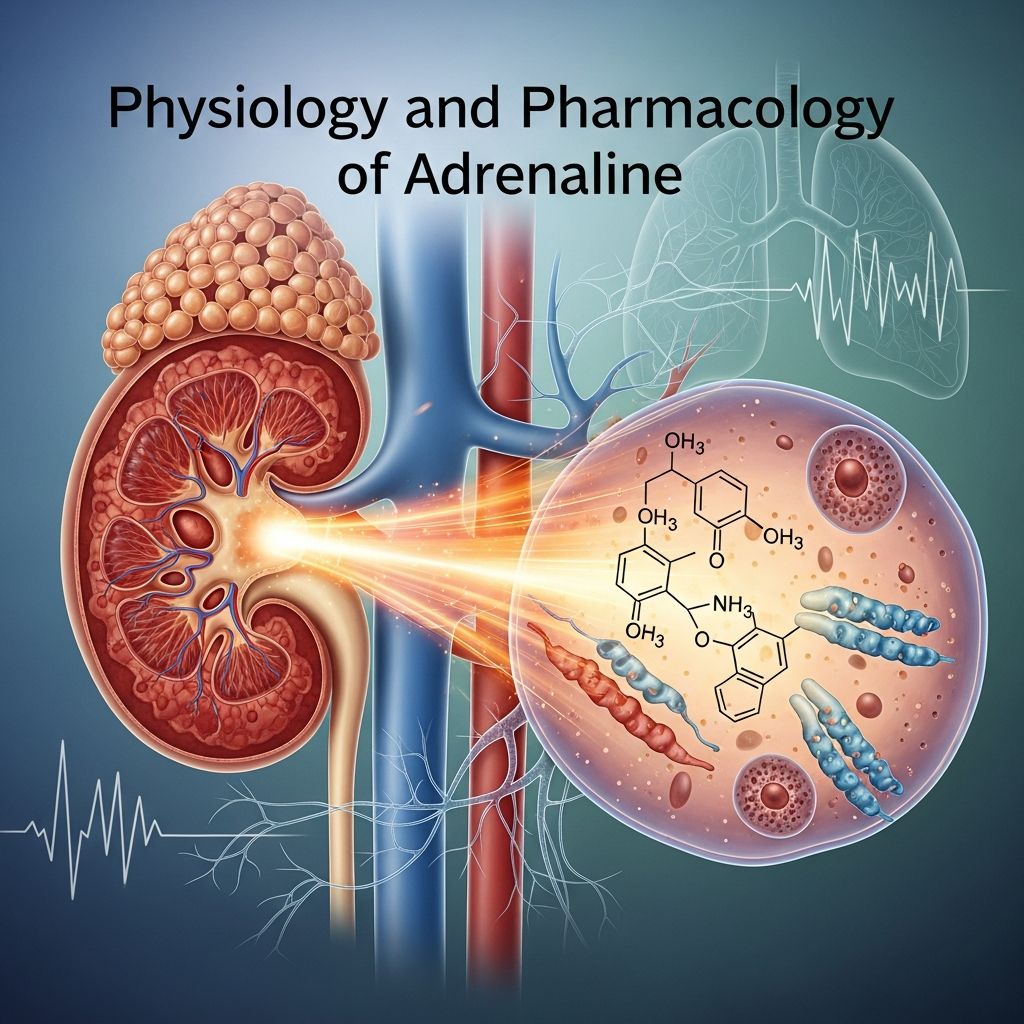
Adrenaline, also known as epinephrine, is a key catecholamine hormone and neurotransmitter produced primarily by the adrenal medulla. It plays a critical role in the body’s fight-or-flight response, mediating rapid physiological changes to stress through activation of adrenergic receptors. This article details its biosynthesis, physiological effects, mechanisms of action, pharmacokinetics, and pharmacological applications.
What is adrenaline?
Adrenaline (epinephrine) is an endogenous catecholamine classified as a sympathomimetic agent. It functions both as a hormone released into the bloodstream from the adrenal medulla and as a neurotransmitter in certain neurons. Unlike noradrenaline, adrenaline exhibits less receptor selectivity, binding to alpha and beta adrenergic receptors to produce diverse effects. The adrenal medulla contributes over 90% of circulating adrenaline, with minimal presence in other tissues like chromaffin cells.
Synthesis of adrenaline
Adrenaline biosynthesis occurs in chromaffin cells of the adrenal medulla via a multi-step pathway from amino acids phenylalanine and tyrosine. The process begins with tyrosine oxidation to L-DOPA by tyrosine hydroxylase (rate-limiting step), decarboxylation to dopamine by DOPA decarboxylase, conversion to noradrenaline by dopamine beta-hydroxylase (requiring ascorbic acid and copper), and final N-methylation of noradrenaline by phenylethanolamine N-methyltransferase (PNMT) using S-adenosyl methionine. ACTH and sympathetic stimulation enhance enzyme activity, while cortisol upregulates PNMT. Calcium triggers exocytosis of chromaffin granules containing adrenaline via VMAT1 transporter. Unlike many hormones, adrenaline lacks negative feedback on its own synthesis.
Release of adrenaline
Adrenaline release is stimulated by the sympathetic nervous system and splanchnic nerve activation during stress, hypoglycemia, or hemorrhage. Preganglionic sympathetic fibers innervate chromaffin cells, releasing acetylcholine to trigger calcium influx and granule exocytosis. Circulating levels rise rapidly, but adrenaline has a brief half-life of 2-3 minutes due to rapid metabolism.
Physiological effects of adrenaline
Adrenaline induces widespread effects via adrenergic receptors, preparing the body for acute stress. Key organ-specific responses include:
- Heart: Increases rate, contractility, and AV node conduction via β1 receptors.
- Lungs: Bronchodilation and increased respiratory rate via β2 receptors.
- Liver and muscle: Stimulates glycogenolysis and glycolysis for glucose provision.
- Brain: Enhances cerebral oxygenation.
- Vascular system: α1-mediated vasoconstriction in skin/gut; β2-mediated vasodilation in skeletal muscle.
- Metabolic: Lipolysis, inhibits insulin, stimulates glucagon/ACTH.
Overall, it elevates blood glucose, fatty acids, heart rate, and redirects blood flow to vital organs.
Receptors for adrenaline
Adrenaline binds α1, α2, β1, and β2 adrenergic receptors. α1 (Gq-coupled) increases IP3/calcium for vasoconstriction and smooth muscle contraction. β1/β2 (Gs-coupled) elevate cAMP, promoting cardiac stimulation, bronchodilation, and vasodilation. Skeletal muscle beds show β2 dominance at low doses, shifting to α1 vasoconstriction at high doses.
| Receptor | Subtype | Main Effects | Second Messenger |
|---|---|---|---|
| Alpha | α1 | Vasoconstriction, smooth muscle contraction | IP3/Ca²⁺ |
| Alpha | α2 | Inhibits glands, presynaptic inhibition | cAMP ↓ |
| Beta | β1 | Cardiac stimulation | cAMP ↑ |
| Beta | β2 | Bronchodilation, vasodilation, glycogenolysis | cAMP ↑ |
Metabolism and excretion of adrenaline
Related Stories



Adrenaline’s action terminates via neuronal reuptake, dilution, and enzymatic degradation by COMT and MAO into metanephrine and 3,4-dihydroxymandelic acid. Hepatic/gut first-pass metabolism clears 86-93%, yielding a 2-3 minute half-life; venous levels remain stable despite infusion changes. Elevated levels occur in pheochromocytoma or exogenous administration.
Pharmacology of exogenous adrenaline
Pharmacokinetics
Intravenous adrenaline has rapid onset and short duration due to metabolism. In septic shock, low doses act as vasoconstrictors with stable output; high doses add α1 effects. In cardiogenic shock, it functions as an inodilator, boosting output while reducing SVR. It elevates lactate via β2-stimulated Na+/K+ ATPase increasing glycolysis.
Pharmacodynamics
Dose-dependent: low doses favor β effects (inotropy, chronotropy, vasodilation); high doses α effects dominate (vasoconstriction). Used in anaphylaxis, cardiac arrest, shock.
Clinical uses of adrenaline
Adrenaline treats anaphylaxis (IM 0.01mg/kg max 0.5mg), cardiac arrest, septic/cardiogenic shock, and bronchospasm. In anaphylaxis, it reduces airway swelling and stabilizes cardiovascular symptoms.
- Anaphylaxis: IM into thigh.
- Cardiac arrest: IV bolus.
- Shock: Infusion titrated to effect.
Adrenaline in dermatological emergencies
In exercise-induced anaphylaxis or drug-induced urticaria, IM adrenaline is first-line for life-threatening reactions with throat swelling or hypotension. DermNet emphasizes prompt administration to counteract mast cell mediator effects.
Frequently Asked Questions
What is the primary source of adrenaline?
The adrenal medulla’s chromaffin cells produce over 90% of circulating adrenaline.
How does adrenaline affect the heart?
It increases heart rate, contractility, and conduction via β1 receptors.
What is adrenaline’s half-life?
Approximately 2-3 minutes, due to rapid COMT/MAO metabolism.
In which emergencies is adrenaline used?
Anaphylaxis, cardiac arrest, and shock; IM for dermatologic emergencies like urticaria with swelling.
Does adrenaline increase lactate levels?
Yes, via β2-mediated Na+/K+ ATPase activation enhancing glycolysis.
Adverse effects and contraindications
High doses cause tachyarrhythmias, hypertension, hyperglycemia, lactic acidosis. Contraindicated in hypertrophic cardiomyopathy; caution in hyperthyroidism.
References
- Adrenaline | Deranged Physiology — Deranged Physiology. 2023. https://derangedphysiology.com/main/cicm-primary-exam/cardiovascular-system/Chapter-973/adrenaline
- Adrenaline – Wikipedia — Wikipedia Contributors. 2024-01-15. https://en.wikipedia.org/wiki/Adrenaline
- Exercise-induced anaphylaxis – DermNet — DermNet NZ. 2023. https://dermnetnz.org/topics/exercise-induced-anaphylaxis
- Drug-induced urticaria – DermNet — DermNet NZ. 2023. https://dermnetnz.org/topics/drug-induced-urticaria
- Anaphylaxis – DermNet — DermNet NZ. 2023. https://dermnetnz.org/topics/anaphylaxis
Similar Articles








Read full bio of medha deb