Thoracic Duct: Anatomy, Function, and Clinical Significance
Understanding the thoracic duct: anatomy, function, and its role in lymphatic drainage.
Understanding the Thoracic Duct
The thoracic duct represents one of the most important structures within the lymphatic system, serving as the primary channel through which lymph travels throughout the body. This remarkable vessel plays a crucial role in immune function, fluid balance, and nutrient absorption. The thoracic duct is responsible for collecting and transporting lymph from the lower body and left side of the upper body, ultimately returning this fluid to the circulatory system. Understanding the anatomy and function of the thoracic duct is essential for comprehending how the body maintains homeostasis and protects itself from infection and disease.
Anatomy and Structural Characteristics
The thoracic duct is a remarkable vessel with specific dimensional and structural properties that enable it to perform its vital functions efficiently. The duct measures approximately 38 to 45 centimeters in length, making it the longest vessel in the lymphatic system. Its diameter ranges from 2 to 5 millimeters, allowing for substantial lymph transport while remaining relatively unobtrusive within the thoracic cavity. The wall structure of the thoracic duct consists of three distinct layers: the intima, media, and adventitia, along with a supporting basement membrane. The medial layer contains smooth muscle fibers and connective tissue that contract rhythmically to propel lymph upward through the vessel. This active pumping mechanism, combined with one-way valves throughout the duct, ensures unidirectional lymph flow toward the venous system.
Course and Pathway Through the Body
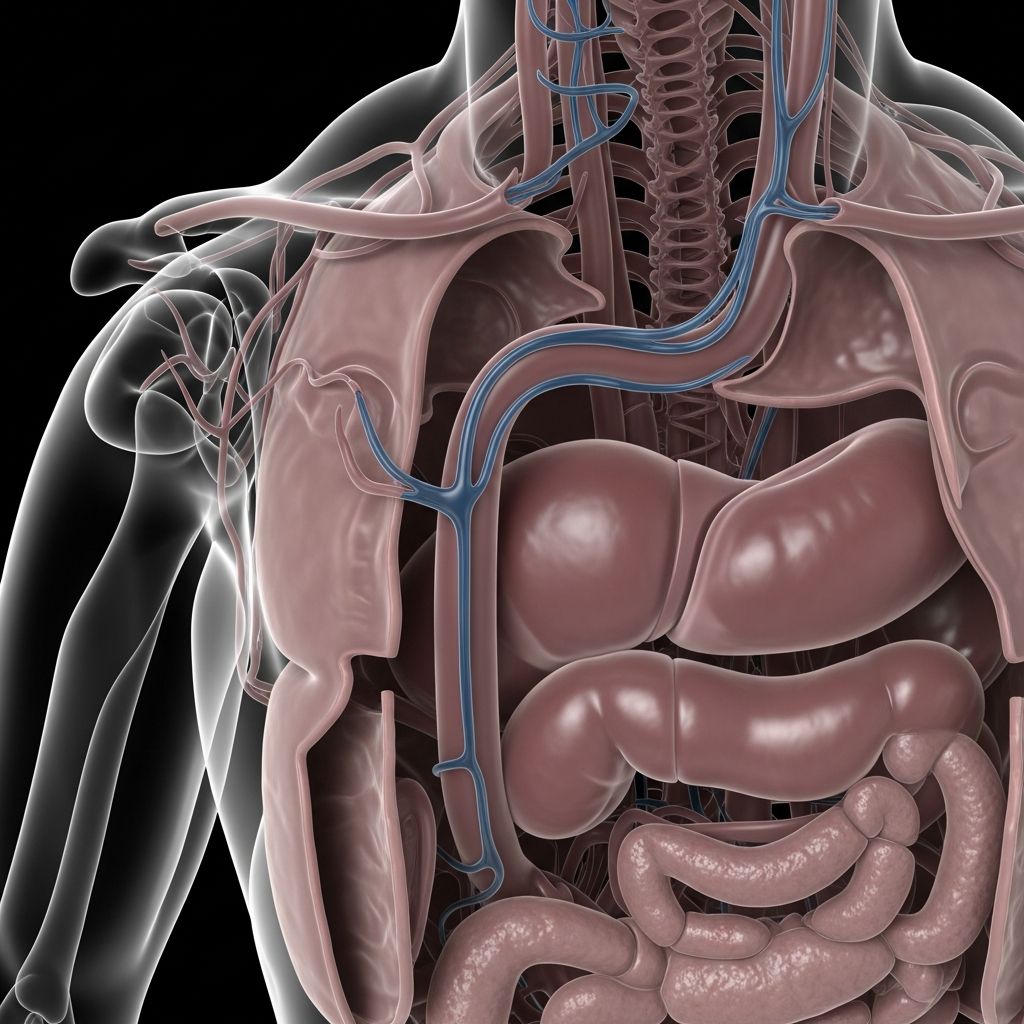
The thoracic duct originates from the superior aspect of the cisterna chyli, an elongated lymphatic sac located at approximately the L2 vertebral level in the lower abdomen. From this origin point, the duct enters the thoracic cavity by passing through the aortic hiatus of the diaphragm, positioning itself in the posterior mediastinum. Initially, the duct courses to the right of the midline, running between the descending thoracic aorta and the azygos vein. As the duct ascends through the thorax, it maintains a relationship with several important structures. The esophagus lies anterior to the duct, while the vertebral column and intercostal arteries remain posterior. Around the T5 vertebral level, the thoracic duct gradually crosses the midline, transitioning to the left side of the thorax and entering the superior mediastinum.
Continuing its ascent toward the neck, the thoracic duct courses posterior to the esophagus and runs behind the aorta. As it approaches the thoracic inlet, the duct arches laterally at the level of the seventh cervical vertebra, with its arch rising 2 to 3 centimeters above the clavicle. In this region, the duct passes posterior to the left common carotid artery, the vagus nerve, and the internal jugular vein. The thoracic duct then descends slightly to reach its termination point at the junction of the left subclavian and internal jugular veins, where it opens into the venous system.
Valve Structure and Function
The thoracic duct contains numerous valves strategically positioned throughout its length to prevent lymph backflow. These valves may be unicuspid, bicuspid, or tricuspid in structure, though bicuspid valves predominate in most individuals. The most significant valve is the bicuspid valve located at the junction where the thoracic duct meets the venous system. This terminal valve is particularly important as it prevents venous blood from flowing backward into the lymphatic system, maintaining the integrity of lymph circulation. The valves work in concert with the smooth muscle contractions of the duct wall to ensure that lymph always moves in the correct direction toward the heart.
Related Stories



Function and Lymphatic Transport
The primary function of the thoracic duct is to transport lymph back into the circulatory system, completing the lymphatic circulation pathway. The process begins when interstitial fluid accumulates in the tissue spaces surrounding body cells. Lymph capillaries collect this interstitial fluid from the tissue spaces, and the collected lymph flows through increasingly larger lymphatic vessels. As lymphatic vessels merge and converge, they eventually form lymphatic ducts, including the thoracic duct, which drain directly into the venous system. The thoracic duct delivers an estimated 1.38 milliliters of lymph per kilogram of body weight per hour to the venous system, representing a substantial volume of fluid transport.
Lymph Collection and Distribution
The thoracic duct collects lymph from extensive regions of the body through its tributaries. Four main abdominal lymph trunks converge to form the cisterna chyli, the origin point of the thoracic duct. The lumbar trunks deliver lymph from the abdominal organs and lower extremities. The ascending lumbar lymph trunks from the upper lateral aortic nodes ascend and pierce the diaphragmatic crura, joining the thoracic duct at various levels within the thorax. The upper intercostal trunks drain the intercostal nodes in the upper 5 to 6 left intercostal spaces. The left subclavian trunk typically joins the thoracic duct but may occasionally open independently into the left internal jugular vein. The left bronchomediastinal lymph trunk, which drains the heart, lungs, and mediastinal structures, also contributes to the thoracic duct’s lymph supply.
Overall, the thoracic duct is responsible for draining lymph from the entire body except for the right side of the head and neck, the right upper portion of the chest, and the right upper extremity. These right-sided regions are drained by the right lymphatic duct, which is considerably smaller and opens into the right subclavian vein.
Embryological Development and Anatomical Variations
Developmental Origins
The thoracic duct develops through a complex embryological process involving the formation and anastomosis of lymphatic trunks. In the developing embryo, lymph sacs form from venous structures, with the jugular lymph sacs, cisterna chyli, and iliac lymph sacs appearing at specific developmental stages. Lymphatic vessels subsequently develop to connect these sacs and form the early lymphatic system. The thoracic duct develops from lymphatic trunks positioned on either side of the aorta that anastomose to create a channel connecting the jugular lymph sacs to the cisterna chyli. The trunks continue to anastomose and enlarge, forming embryonic right and left thoracic ducts. The adult thoracic duct is derived from both of these embryonic structures, with the right primitive thoracic duct developing into the lower adult thoracic duct and the left primitive thoracic duct developing into the upper portion of the adult thoracic duct.
Anatomical Variations
Anatomical variations of the thoracic duct are relatively common, resulting from variations in the embryological fusion patterns of the bilateral lymphatic trunks. These variations can affect the clinical management of thoracic conditions and should be recognized during surgical procedures. A bifid lower aspect of the trunk represents a common variation caused by the embryonic right and left lymphatic trunks failing to fuse properly. Another notable variation involves the lower thoracic duct being replaced by a plexus of lymphatic vessels that eventually converge into a single duct higher in the mediastinum. Two rare variations include complete bilateral thoracic ducts, where functioning ducts exist on both sides, and termination of the duct into the azygos venous system rather than the standard subclavian-jugular junction.
Variations in termination are also well-documented in anatomical literature. In the majority of individuals (over 95%), the thoracic duct terminates in the internal jugular vein, the subclavian vein, or the angle between these two vessels. However, in 2% to 3% of cases, the duct empties on the right side of the neck, and in up to 1.5% of cases, termination occurs bilaterally. These anatomical variations underscore the importance of careful surgical planning and anatomical knowledge when performing procedures in the thoracic region or lower neck.
Clinical Significance and Medical Implications
Thoracic Duct Dysfunction
As a central structure to lymphatic flow and movement, dysfunction of the thoracic duct and the resulting accumulation of chyle is concerning for various pathological conditions, most notably malignancy. Chyle is lymph that contains high concentrations of lipids and proteins and normally flows through the thoracic duct. When the thoracic duct becomes obstructed or damaged, chyle can accumulate in the thoracic cavity, a condition known as chylothorax. This condition may result from trauma, surgical complications, malignancy, infection, or congenital abnormalities affecting the thoracic duct.
Lymph Drainage Patterns and Cancer Prognosis
An important clinical consideration is that lymph from certain organs can drain directly into the thoracic duct without necessarily passing through lymph nodes first. This anodal drainage route has been observed for the diaphragm, esophagus, and parts of the lungs. The drainage pattern may significantly influence the prognosis of cancers originating in these organs, as direct drainage to the thoracic duct potentially allows malignant cells to reach distant sites more readily. This pattern may also explain the clinical phenomenon of distant metastases occurring without demonstrable lymph node involvement, a presentation that challenges traditional staging systems and treatment planning.
Frequently Asked Questions
What is the primary function of the thoracic duct?
The primary function of the thoracic duct is to transport lymph from the lower body and left upper body back into the circulatory system. It collects lymph from tissue spaces and returns it to the venous system at the junction of the left subclavian and internal jugular veins, delivering approximately 1.38 milliliters of lymph per kilogram of body weight per hour.
How long is the thoracic duct and what is its diameter?
The thoracic duct measures approximately 38 to 45 centimeters in length, making it the longest vessel in the lymphatic system. Its diameter ranges from 2 to 5 millimeters throughout most of its course, though it may vary slightly in different regions.
Where does the thoracic duct originate?
The thoracic duct originates from the superior aspect of the cisterna chyli, an elongated lymphatic sac located at approximately the L2 vertebral level in the lower abdomen. The cisterna chyli is formed by the convergence of the four main abdominal lymph trunks.
What anatomical structures does the thoracic duct pass near as it ascends?
As the thoracic duct ascends through the thorax, it passes near several important structures including the aorta, esophagus, azygos vein, and vertebral column. In the neck region, it passes posterior to the left common carotid artery, vagus nerve, and internal jugular vein.
Are anatomical variations of the thoracic duct common?
Yes, anatomical variations of the thoracic duct are relatively common. Common variations include bifid lower aspects caused by incomplete fusion of embryonic ducts, and replacement of the lower duct with a plexus of vessels. Rare variations include bilateral thoracic ducts and alternative termination sites such as the azygos vein.
What is chylothorax and how does it relate to thoracic duct dysfunction?
Chylothorax is the abnormal accumulation of chyle in the thoracic cavity, resulting from thoracic duct obstruction or damage. This condition can result from trauma, surgery, malignancy, infection, or congenital abnormalities and represents a serious medical complication requiring intervention.
References
- Anatomy, Thorax, Thoracic Duct — National Center for Biotechnology Information (NCBI) StatPearls. 2024. https://www.ncbi.nlm.nih.gov/books/NBK513227/
- Anatomy of the Thoracic Duct — Pediatric Interventional Radiology. https://www.pediatricir.com/uploads/5/4/7/8/54786829/anatomy_of_thoracic_duct.pdf
- Thoracic Duct: Lymphatic System, Circulation, Drainage — Encyclopaedia Britannica. Revised 2024. https://www.britannica.com/science/thoracic-duct
Similar Articles








Read full bio of Sneha Tete