Thyroid: What It Is, Function & Problems
Understand the thyroid gland's role in metabolism, common disorders like hypothyroidism and hyperthyroidism, and effective management strategies.
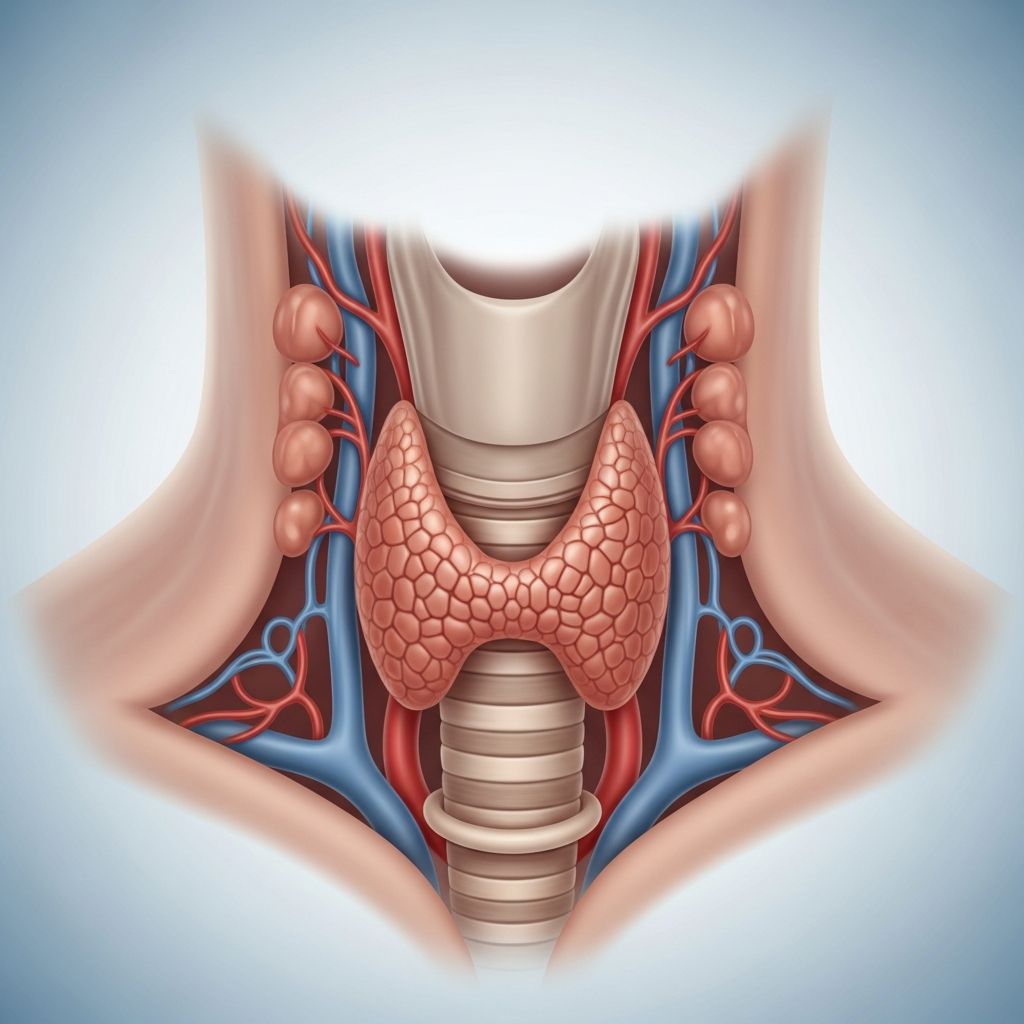
The thyroid is a small, butterfly-shaped endocrine gland located at the front of the neck that plays a critical role in regulating metabolism, energy use, and numerous body functions through hormone production.
What Is the Thyroid?
Your thyroid gland is a vital part of the endocrine system, situated just below the Adam’s apple, wrapping around the windpipe. It weighs about 20 to 60 grams and consists of two lobes connected by an isthmus. The gland is enclosed in fibrous capsules, allowing it to move during swallowing, and is composed of thyroid follicle cells (thyrocytes) that produce hormones and C-cells that secrete calcitonin.
As an endocrine gland, the thyroid secretes hormones directly into the bloodstream, influencing nearly every cell in the body. It requires iodine from diet—found in iodized salt and seafood—to synthesize these hormones.
Thyroid Gland Anatomy
The thyroid features two symmetrical lobes linked by the isthmus, forming its characteristic butterfly shape. Follicles within lobules store thyroid hormones as droplets, surrounded by connective tissue. Key components include:
- Thyroid Follicles: Sacs filled with colloid storing T3 and T4 precursors.
- C-Cells (Parafollicular Cells): Produce calcitonin, which regulates calcium levels.
- Capsules: Outer layer connects to neck structures; inner allows mobility.
Location of the Thyroid Gland
Positioned in the anterior neck, anterior to the trachea and inferior to the larynx, the thyroid spans from the fifth cervical vertebra to the first thoracic. Its superficial location makes it palpable, and enlargement (goiter) is often visible.
Function of the Thyroid Gland
The thyroid’s primary function is to produce hormones that control metabolism—the rate at which the body converts food into energy. This affects heart rate, body temperature, digestion, and growth.
Hormones Produced by the Thyroid
The gland secretes three main hormones:
- Triiodothyronine (T3): The active form, more potent than T4, directly influences cellular metabolism.
- Thyroxine (T4): Prohormone converted to T3 in tissues; constitutes 80% of thyroid output.
- Calcitonin: Lowers blood calcium by inhibiting bone resorption, aiding bone health.
How the Thyroid Works
Iodine is absorbed from the gut, trapped by thyroid cells, and incorporated into T3 and T4 via organification. Regulation occurs via the hypothalamic-pituitary-thyroid (HPT) axis: Hypothalamus releases TRH, stimulating pituitary TSH, which prompts thyroid hormone release. Negative feedback maintains balance.
T3 and T4 increase basal metabolic rate (BMR), raising energy expenditure, heart rate, body temperature, and promoting growth in children. They enhance oxygen consumption and nutrient breakdown.
Thyroid Problems and Disorders
Thyroid diseases affect ~20 million Americans, with women 5-8 times more likely to be diagnosed. Disorders are primary (thyroid-origin) or secondary (pituitary-origin).
Hypothyroidism (Underactive Thyroid)
Hypothyroidism occurs when the thyroid produces insufficient hormones, slowing metabolism. It impacts ~10 million U.S. adults.
Symptoms: Fatigue, weight gain, cold intolerance, dry skin, hair loss, constipation, depression, muscle aches, and irregular periods.
Causes:
- Hashimoto’s thyroiditis (autoimmune).
- Iodine deficiency (rare in iodized salt regions).
- Thyroid surgery/radiation.
- Medications (e.g., lithium).
Related Stories



Treatment: Levothyroxine (synthetic T4) daily, with TSH monitoring.
Hyperthyroidism (Overactive Thyroid)
Excess hormone production speeds metabolism, affecting ~1% of those over 12.
Symptoms: Weight loss, rapid heartbeat, anxiety, tremors, heat intolerance, sweating, diarrhea, and eye bulging (Graves’).
Causes:
- Graves’ disease (autoimmune).
- Toxic nodules/multinodular goiter.
- Thyroiditis.
Treatment: Antithyroid drugs (methimazole), radioactive iodine, or surgery; beta-blockers for symptoms.
Goiter
Enlarged thyroid affecting 5% of Americans; can be diffuse or nodular.
Causes: Iodine deficiency, Hashimoto’s, Graves’, nodules.
Treatment: Address underlying cause; levothyroxine for shrinkage or surgery if compressive.
Thyroid Cancer
~53,000 U.S. cases yearly; highly treatable, especially papillary/follicular types.
Risk Factors: Radiation exposure, family history, age >60 (women).
Treatment: Surgery (thyroidectomy), radioactive iodine, TSH suppression.
Thyroid Nodules
Common lumps; most benign. Evaluate via ultrasound/FNA biopsy.
Thyroid Disease Risk Factors
- Gender: Females 5-8x higher risk.
- Age: >60 years.
- Family History: Genetic predisposition.
- Autoimmune Diseases: Type 1 diabetes, rheumatoid arthritis.
- Iodine Imbalance: Deficiency or excess.
Diagnosis and Tests
Diagnosis involves:
- TSH Blood Test: First-line; high in hypo, low in hyper.
- Free T4/T3: Confirm hormone levels.
- Antibody Tests: For autoimmune (anti-TPO, TgAb).
- Ultrasound: Nodules/goiter.
- Fine-Needle Aspiration (FNA): Biopsy suspicious nodules.
- Radioactive Iodine Uptake Scan: Function assessment.
Treatment Options
Treatments vary by condition:
| Condition | Treatment |
|---|---|
| Hypothyroidism | Levothyroxine lifelong. |
| Hyperthyroidism | Antithyroids, RAI, surgery. |
| Goiter/Nodules | Observation, meds, surgery. |
| Cancer | Thyroidectomy + RAI. |
Prevention and Thyroid Health
Ensure dietary iodine (150 mcg/day adults); follow balanced diet per NHS Eatwell Guide: fruits/veggies, whole grains, proteins, limit processed foods. Selenium (Brazil nuts), iron, zinc, vitamin D/B12 support function, especially in hypothyroidism or Graves’. Regular check-ups for at-risk groups.
Selenium trials show benefits for mild thyroid eye disease in Graves’, reducing antibodies without affecting function.
Frequently Asked Questions (FAQs)
What are early signs of thyroid problems?
Common signs include unexplained weight changes, fatigue, temperature sensitivity, hair thinning, and heart rate irregularities.
Can diet affect thyroid health?
Yes; adequate iodine, selenium, iron, and zinc are crucial. Avoid excess iodine in hyperthyroidism.
Is thyroid disease curable?
Hypo/hyper often managed lifelong with meds; cancer/goiter may be cured via surgery.
Who should get tested?
Women >60, family history, symptoms, or autoimmune conditions.
Does stress impact the thyroid?
Chronic stress may exacerbate autoimmune thyroiditis like Hashimoto’s.
References
- Thyroid: What It Is, Function & Problems — Cleveland Clinic. 2023-10-14. https://my.clevelandclinic.org/health/body/23188-thyroid
- In brief: How does the thyroid gland work? — InformedHealth.org – NCBI Bookshelf. 2016-05-17. https://www.ncbi.nlm.nih.gov/books/NBK279388/
- Diets and supplements for thyroid disorders — British Thyroid Foundation. 2023. https://www.btf-thyroid.org/diets-and-supplements-for-thyroid-disorders
Similar Articles








Read full bio of medha deb