Tibia/Fibula Fracture: Open Reduction and Internal Fixation
Complete guide to ORIF surgery for tibia and fibula fractures: procedure, recovery, and outcomes.
Understanding Tibia/Fibula Fracture Open Reduction and Internal Fixation (ORIF)
Open reduction and internal fixation (ORIF) is a surgical procedure designed to treat broken bones in the lower leg. When you suffer a tibia or fibula fracture, your orthopedic surgeon may recommend ORIF to realign the broken bone pieces and secure them with specialized hardware. This procedure helps ensure proper healing and restores function to your lower leg, allowing you to return to normal activities with minimal long-term complications.
The tibia, commonly known as the shinbone, is the larger of the two bones in your lower leg and bears most of your body weight. The fibula, positioned on the outer side of your leg, provides structural support and serves as an attachment point for muscles and ligaments. Both bones form critical joints—the tibia connects to the knee joint at the top and the ankle joint at the bottom. When either or both of these bones break, particularly in displaced or complex fractures, ORIF becomes a necessary treatment option to restore proper alignment and function.
What Does ORIF Mean?
Open Reduction
Open reduction refers to the surgical technique of realigning broken bone pieces through a direct surgical incision. Unlike closed reduction, where a physician manipulates the bone from outside the body, open reduction allows the surgeon direct visualization of the fracture site. This approach provides superior accuracy in repositioning bone fragments, particularly in complex or severely displaced fractures where the pieces are far from their correct anatomical position.
Internal Fixation
Internal fixation involves using specialized surgical hardware to hold the realigned bone pieces securely in place while they heal. This hardware becomes part of your body and typically remains permanently, though some devices may be removed in specific circumstances. The fixation devices prevent the bones from shifting or rotating during the healing process, which is essential for achieving proper bone healing and preventing deformity or chronic pain.
When Is ORIF Necessary?
Not all tibia or fibula fractures require ORIF surgery. Many uncomplicated fractures heal well with conservative treatment using casts, splints, braces, and pain management. However, your orthopedic surgeon will recommend ORIF if your fracture meets certain criteria that would compromise healing or function without surgical intervention.
You are more likely to need ORIF if:
- Your fracture is displaced, meaning the bone pieces are significantly out of alignment
- The broken bone has pierced through your skin (an open or compound fracture)
- Your tibia or fibula broke into multiple pieces (comminuted fracture)
- The fracture involves the knee or ankle joint
- Previous conservative treatment failed to promote proper healing
- You have severe bone fragmentation that would prevent normal healing
Additionally, certain medical conditions increase the likelihood of needing ORIF. Patients with osteoporosis, diabetes, or poor circulation may have compromised bone healing capacity. Smokers also face increased risks of complications and delayed healing, making surgical intervention more likely to be recommended.
Related Stories



The ORIF Surgical Procedure
Pre-Operative Preparation
Before your ORIF procedure, your surgical team will conduct a thorough evaluation including imaging studies such as X-rays, CT scans, or MRI to fully understand your fracture pattern. You’ll meet with your orthopedic surgeon to discuss the procedure, risks, benefits, and expected outcomes. Pre-operative blood work and other tests will be performed to ensure you’re medically fit for surgery. You’ll receive instructions to avoid eating and drinking for several hours before the procedure and may be prescribed antibiotics to prevent infection.
Anesthesia and Positioning
You will receive general anesthesia, which puts you into a deep sleep so you don’t experience pain or awareness during the procedure. An anesthesiologist will monitor your vital signs throughout surgery, including heart rate, blood pressure, oxygen levels, and breathing. Once you’re asleep, the surgical team will position your leg to provide optimal access to the fracture site.
Surgical Technique
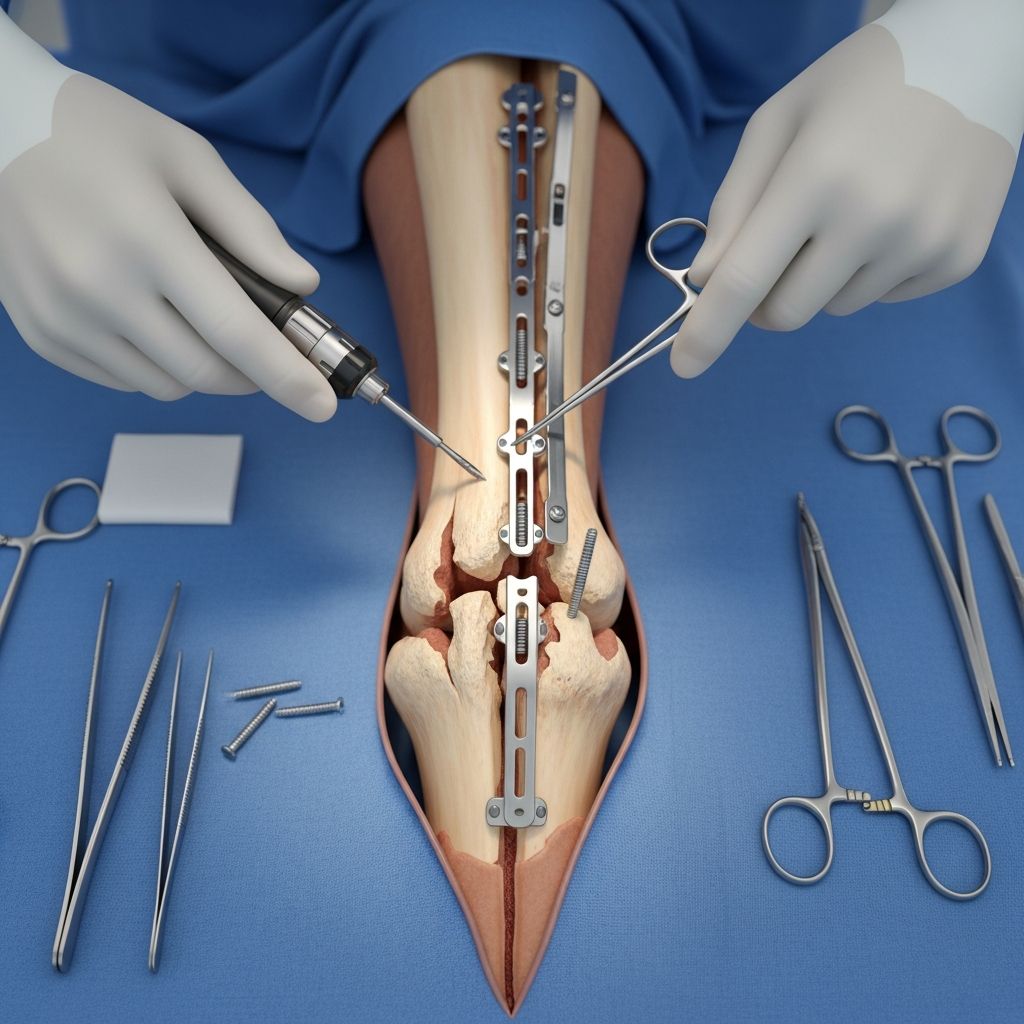
Your orthopedic surgeon will make an incision through the skin and muscle overlying the fracture site. The length and location of this incision depend on the specific location and severity of your fracture. Once the fracture is exposed, the surgeon carefully realigns all bone fragments to their correct anatomical positions—this is the “reduction” phase of the procedure.
After achieving proper alignment, the surgeon secures the bone pieces using internal fixation hardware. The specific fixation method depends on your fracture characteristics:
- Metal plates and screws: Plates are applied along the bone surface with screws passing through the plate into the bone on either side of the fracture
- Intramedullary nails: A long metal rod is inserted through the center of the bone, providing excellent stabilization for long bone fractures
- Screws: Metal screws are inserted across the fracture to hold pieces together
- Wires and pins: These are sometimes used in combination with other fixation methods, particularly for smaller bone fragments
For fractures affecting both the tibia and fibula, your surgeon may need to address both bones. Typically, if the fibula is fractured, it usually requires stabilization. The surgeon may approach both fractures through one incision or make separate incisions as needed. After securing all fracture pieces, the surgeon carefully closes the muscle, subcutaneous tissue, and skin layers with sutures or staples.
Recovery and Rehabilitation
Immediate Post-Operative Period
After surgery, you’ll spend time in the recovery room where medical staff will monitor you as you wake from anesthesia. You may experience pain, which will be managed with prescribed medications. Your leg will likely be immobilized with a splint or cast to protect the surgical site and maintain bone alignment during initial healing. You’ll receive instructions on keeping your incision clean and dry to prevent infection.
Early Healing Phase
During the first several weeks after surgery, your primary focus should be protecting the surgical site and managing pain and swelling. You’ll be prescribed pain medications and may benefit from ice therapy and leg elevation. Most surgeons recommend avoiding weight-bearing on the surgical leg during the initial healing phase, though this varies depending on your specific fracture and fixation method. You may use crutches or a walker to maintain mobility without putting weight on your injured leg.
Physical Therapy and Progressive Rehabilitation
Physical therapy is imperative once the fracture site has sufficiently healed, typically beginning within 4-6 weeks of surgery. Your physical therapist will guide you through progressive exercises designed to restore strength, flexibility, and function. Early therapy focuses on gentle range-of-motion exercises, gradually advancing to weight-bearing exercises as healing progresses. Later stages include strength training, balance exercises, and functional activities to return you to normal daily tasks.
The complete rehabilitation process typically takes 3-6 months, though some patients require longer depending on fracture severity and individual healing rates. Compliance with physical therapy is crucial for maximizing surgical success and achieving full or near-full functional recovery.
Potential Complications
While ORIF is generally a safe and effective procedure, like all surgeries, it carries certain risks and potential complications. Your individual risk profile depends on your age, fracture characteristics, overall health status, and medical conditions.
Possible complications include:
- Infection: Surgical site infections can range from superficial skin infections to deep bone infections (osteomyelitis), which are more serious
- Hardware complications: Tissue irritation from the metal implants, hardware loosening, or breakage
- Malunion or nonunion: The bone pieces fail to heal in the correct position (malunion) or fail to heal at all (nonunion), potentially requiring revision surgery
- Joint stiffness: Loss of normal range of motion in the knee or ankle joints
- Post-traumatic arthritis: Degenerative changes in the joint, particularly if the fracture involved the joint surface
- Blood clots: Deep vein thrombosis (DVT) in the leg or pulmonary embolism in the lungs
- Nerve or blood vessel injury: Damage to structures near the fracture site during surgery
- Compartment syndrome: Increased pressure within muscle compartments that can compromise tissue viability
Certain factors increase your risk of complications. Smokers have significantly higher infection and healing complication rates. Patients with diabetes or poor circulation may experience delayed or impaired healing. Advanced age and multiple medical comorbidities also increase complication risk. Discuss your specific risk factors with your surgeon to understand what applies to your situation.
Expected Outcomes
Most patients achieve excellent outcomes following ORIF for tibia and fibula fractures. The primary goal of ORIF is to restore proper bone alignment, which significantly increases the likelihood of normal healing compared to non-operative treatment of displaced fractures. Studies demonstrate that ORIF results in higher rates of bony union and better functional outcomes in complex fractures.
The majority of patients return to their normal activities and work within 3-6 months following surgery, though athletes and those in physically demanding occupations may require additional recovery time. Pain typically resolves within the first few months, though some mild discomfort during activity may persist longer. Most patients report good to excellent functional outcomes with restored strength and mobility.
When Should ORIF Be Performed?
Timing is an important factor in ORIF success. Ideally, ORIF should be performed as soon as feasible after injury, typically within the first few days. Performing surgery promptly reduces pain, minimizes swelling, decreases the risk of complications from immobility, and promotes optimal bone healing. Early surgical intervention also prevents deformity development and reduces the risk of chronic pain or dysfunction.
However, your surgeon may delay surgery if significant soft tissue swelling is present, as operating on severely swollen tissue increases infection risk and complication rates. In these cases, initial stabilization with external fixation or temporary immobilization may precede definitive ORIF once swelling subsides.
Frequently Asked Questions
Q: How long does ORIF surgery take?
A: The surgical time varies depending on fracture complexity, but most tibia/fibula ORIF procedures take between 1-3 hours. Simple fractures may be completed faster, while complex fractures with multiple fragments require additional time for precise reduction and fixation.
Q: Will I need to have the hardware removed after healing?
A: Most patients keep their internal fixation hardware permanently. However, in some cases, particularly with certain plate and screw configurations or if hardware causes problems, your surgeon may recommend removal after bone healing is complete, typically 12-24 months after surgery.
Q: How long will I be unable to bear weight on my leg?
A: Weight-bearing restrictions typically last 6-12 weeks depending on your fracture type and fixation method. Your surgeon will provide specific guidelines and may allow progressive weight-bearing as healing progresses. Your physical therapist will help you transition from non-weight-bearing to partial and then full weight-bearing.
Q: Can I return to sports after ORIF?
A: Most patients can return to sports after complete healing and rehabilitation, though this typically takes 4-6 months or longer. Contact your surgeon about specific return-to-sport timelines based on your fracture severity and sport demands.
Q: What are signs of complications I should watch for?
A: Contact your surgeon immediately if you experience increased redness, warmth, swelling, or drainage from your incision; fever; severe or worsening pain; loss of sensation or cold/pale skin in your foot; inability to move your toes; or symptoms of blood clots such as calf pain or swelling in the uninjured leg.
Q: Will I have permanent scarring from the surgical incision?
A: You will have a surgical scar that may be visible initially, but most scars fade significantly over 12-18 months. The scar’s appearance depends on your skin type, healing response, and incision location. Your surgeon uses techniques to minimize scarring and can discuss scar management options.
References
- Understanding Tibia/Fibula Fracture Open Reduction and Internal Fixation (ORIF) — University of Michigan Health. https://www.ummhealth.org/health-library/understanding-tibiafibula-fracture-open-reduction-and-internal-fixation
- Tibia/Fibula Fracture Open Reduction and Internal Fixation — University of Rochester Medical Center. https://www.urmc.rochester.edu/encyclopedia/content?contenttypeid=135&contentid=379
- Open Reduction and Internal Fixation (ORIF): What It Is — Cleveland Clinic. https://my.clevelandclinic.org/health/procedures/open-reduction-and-internal-fixation-orif
- ORIF – Compression plate for Extraarticular, simple fracture — AO Foundation. https://surgeryreference.aofoundation.org/orthopedic-trauma/adult-trauma/distal-tibia/extraarticular-simple-fracture/orif-compression-plate
- Tibia/Fibula Fracture Open Reduction and Internal Fixation — UW Medicine. https://healthlibrary.uwmedicine.org/Library/TestsProcedures/135,379
Similar Articles








Read full bio of Sneha Tete