Tibia (Shin Bone): Location, Anatomy & Common Conditions
Understanding your tibia: anatomy, function, and common conditions affecting your shin bone.
Understanding the Tibia (Shin Bone)
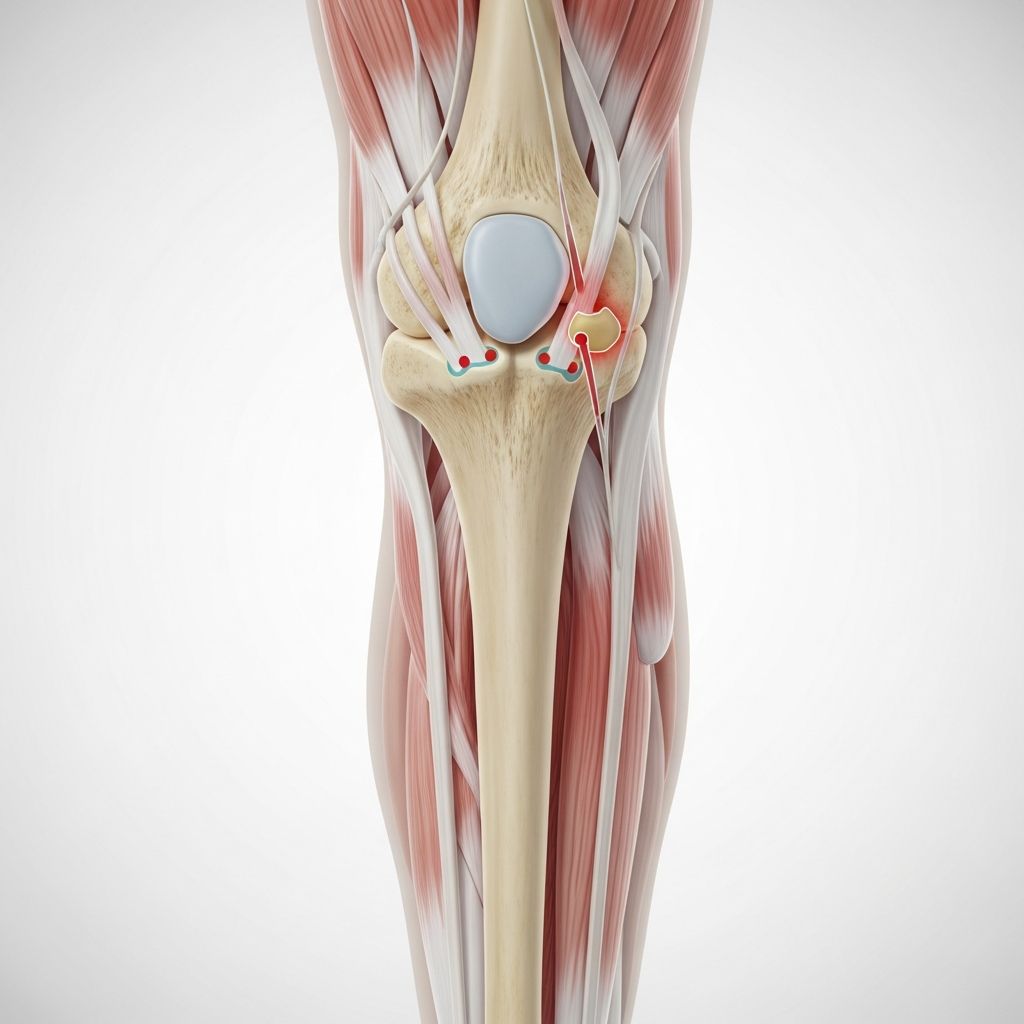
The tibia, commonly known as the shin bone or shank bone, is the larger and stronger of the two bones in your lower leg. Located on the medial (inner) side of your leg, the tibia runs from just below your knee to your ankle, forming a crucial component of your skeletal system. Unlike the fibula, which is the smaller, slender bone running alongside it on the lateral (outer) side, the tibia bears most of the weight and stress of your lower body. This significant bone plays an essential role in standing, walking, running, and maintaining overall mobility and stability.
Anatomy of the Tibia
The tibia is classified as a long bone, meaning it has a characteristic structure consisting of a shaft and two expanded ends. Understanding the anatomical components of the tibia helps healthcare providers diagnose injuries and conditions affecting this important bone.
Main Components of the Tibia
The tibia is composed of several distinct sections, each with specific anatomical features and functions:
The Proximal (Upper) End
The upper end of the tibia forms the bottom portion of your knee joint. This section features a flat, shelf-like surface with two prominent knobs called condyles. The proximal end includes:
–
Medial condyle
: The inner knob that articulates with the femur (thighbone)-Lateral condyle
: The outer knob that also connects with the femur and provides an articulation point for the fibula-Intercondylar eminence
: A raised area between the two condyles where important ligaments attach, including the anterior and posterior cruciate ligaments-Tibial plateau
: The broad, flat surface formed by the condyles that supports the weight transmitted from the femur-Tibial tuberosity
: A bony prominence on the anterior (front) surface where the patellar ligament attaches, a continuation of the quadriceps muscleThe Shaft (Middle Section)
The shaft is the long central portion of the tibia that bears your weight and forms the structure of your shin. This section has a distinctive triangular cross-section, resembling a three-sided prism. The shaft includes:
–
Anterior border
: The sharp edge on the front of your leg that you can feel just under your skin-Anterior surface
: The smooth front surface covered by the tendons of the extensor muscles-Posterior surface
: The back surface featuring the soleal line where calf muscles attach-Medial surface
: The inner surface running along the medial side-Lateral surface
: The outer surface that presents a groove for the tibialis anterior muscleThe Distal (Lower) End
The lower end of the tibia connects with your ankle bones and fibula. This section includes:
–
Medial malleolus
: A large bony bump on the inside of your ankle, sometimes called the “little hammer”-Fibular notch
: A wide groove on the outside lower part of the tibia that connects with the fibula, forming a stable joint-Inferior articular surface
: The smooth surface that articulates with the talus bone of the ankle, enabling ankle movementLocation of the Tibia
The tibia is located in your lower leg, positioned between your knee and ankle. It occupies the medial (inner) portion of your lower leg, running parallel to the fibula on the lateral (outer) side. The tibia is closer to the midline of your body than the fibula, making it more prominent and easier to palpate (feel) along the anterior surface of your shin. This anatomical position allows the tibia to bear the primary weight of your body during standing and movement activities.
Related Stories



Key Functions of the Tibia
The tibia serves multiple critical functions that are essential for daily movement and structural support:
Weight-Bearing Support
As the more prominent bone in your lower leg, the tibia is the primary weight-bearing bone. It’s significantly stronger than the fibula and supports the weight of your body as you stand, walk, run, and engage in various physical activities. This weight-bearing function is why the tibia is more commonly fractured than the fibula when trauma occurs to the lower leg.
Joint Articulation
The tibia plays a crucial role in forming two major joints:
–
Knee joint
: The proximal end of the tibia articulates with the femur, forming the lower component of the knee joint, the largest joint in your body-Ankle joint
: The distal end of the tibia connects with the talus bone and fibula, forming the ankle joint that enables foot movementMuscle and Ligament Attachment
The tibia serves as an attachment point for 11 different muscles, along with numerous tendons and ligaments. These muscular attachments enable flexion and extension of your knee joint as well as movement of your ankle joint. The various surfaces and landmarks of the tibia provide specific attachment sites for muscles including the quadriceps, hamstrings, tibialis anterior, and soleus.
Structural Stability
Working in conjunction with the fibula, which is connected by an interosseous membrane, the tibia provides structural stability to the lower leg. This configuration allows for coordinated movement while maintaining the integrity of the leg structure.
Relationship Between Tibia and Other Bones
The tibia connects with several other bones in your body, forming important joints and articulations:
| Connected Bone | Location of Connection | Type of Joint | Function |
|---|---|---|---|
| Femur (Thighbone) | Proximal tibia | Modified hinge joint | Enables knee flexion and extension |
| Fibula (Calf bone) | Proximal and distal tibia | Syndesmosis joint | Provides structural support and stability |
| Talus (Ankle bone) | Distal tibia | Hinge joint | Enables ankle dorsiflexion and plantarflexion |
| Patella (Kneecap) | Proximal tibia (via ligament) | Gliding joint | Enhances knee joint mechanics |
Common Tibia Conditions and Injuries
The tibia, being a weight-bearing bone, is susceptible to various conditions and injuries that can affect mobility and quality of life.
Tibial Fractures
Tibial fractures are among the most common lower leg injuries, typically resulting from trauma such as falls, car accidents, and sports injuries. Depending on the severity and location, tibial fractures can range from simple hairline cracks to complex compound fractures where the bone breaks through the skin.
Shin Splints
Shin splints, medically known as medial tibial stress syndrome, occur due to repetitive stress and overuse. This condition commonly affects athletes and manifests as pain along the anterior tibia.
Osteoporosis
Like all bones, the tibia can be affected by osteoporosis, a condition where bone density decreases, making bones more fragile and susceptible to fractures.
Tibial Plateau Fractures
These fractures occur at the proximal end of the tibia and can affect the knee joint’s function and stability.
Associated Nerves and Blood Supply
The tibia receives innervation from the tibial nerve, a peripheral nerve that supplies movement and feeling to parts of the back of your lower leg and foot. This nerve is crucial for muscle function and sensory perception in the lower leg. The bone also receives a rich blood supply through various arterial branches that provide nutrients essential for bone health and healing.
Frequently Asked Questions
What is the difference between the tibia and fibula?
The tibia is the larger, stronger bone that bears most of your body weight, while the fibula is the smaller, slender bone that provides structural support. Both bones work together to form the lower leg, with the tibia located on the medial (inner) side and the fibula on the lateral (outer) side.
Can you break your tibia from a fall?
Yes, tibial fractures commonly result from falls, especially from heights or with significant force. The tibia being a weight-bearing bone makes it particularly susceptible to fracture when exposed to trauma during falls or accidents.
How long does a tibial fracture take to heal?
Tibial fracture healing time varies depending on the severity and type of fracture. Simple fractures may heal in 6-8 weeks, while more complex fractures may require several months of healing and rehabilitation.
What causes shin splints?
Shin splints result from repetitive stress and overuse of the tibial muscles and surrounding tissues, commonly affecting athletes and individuals who engage in high-impact activities like running.
Why can I feel my tibia under my skin?
The tibia runs along the front of your lower leg with minimal soft tissue coverage, making it easily palpable. The anterior border of the tibial shaft can be felt just under the skin as a prominent ridge.
How many muscles attach to the tibia?
Eleven muscles attach directly to the tibia, along with numerous tendons and ligaments. These attachments enable various movements of the knee and ankle joints.
Maintaining Tibia Health
To maintain healthy tibia and prevent injuries, consider maintaining proper bone health through adequate calcium and vitamin D intake, engaging in weight-bearing exercise to strengthen bones, using proper form during physical activities, and wearing appropriate footwear that provides support and stability. Regular check-ups with healthcare providers can help identify potential bone health issues early.
References
- Tibia — Wikipedia. Retrieved from https://en.wikipedia.org/wiki/Tibia
- Tibia | Definition, Anatomy, & Facts — Britannica. Retrieved from https://www.britannica.com/science/tibia
- Tibia: Function, Location, and Common Conditions — WebMD. Retrieved from https://www.webmd.com/a-to-z-guides/tibia-what-to-know
- Tibia (Shin Bone): Location, Anatomy & Common Conditions — Cleveland Clinic. 2025. Retrieved from https://my.clevelandclinic.org/health/body/23026-tibia
- Knee Joint: Function & Anatomy — Cleveland Clinic. Retrieved from https://my.clevelandclinic.org/health/body/24777-knee-joint
- Ankle: Anatomy & How It Works — Cleveland Clinic. Retrieved from https://my.clevelandclinic.org/health/body/24909-ankle-joint
- Tibial Nerve: What It Is, Function, Anatomy & Conditions — Cleveland Clinic. Retrieved from https://my.clevelandclinic.org/health/body/21962-tibial-nerve
Similar Articles








Read full bio of medha deb