Tinea Corporis Pathology: 4 Histopathological Patterns Explained
Detailed histopathological analysis of tinea corporis, the pathology behind body ringworm fungal infections.
Author: Dr. Harriet Cheng, Dermatopathologist, Reviewed: Dr. Amanda Oakley, Dermatologist
Pathogenesis
Tinea corporis represents a dermatophyte infection of the glabrous skin (skin without terminal hairs). The term tinea refers to superficial mycoses (fungal infections) characterised by epidermal invasion by filamentous fungi known as dermatophytes.
These fungi exist as moulds** (filamentous structures) oryeasts
(unicellular forms). The three main genera of dermatophytes are Trichophyton, Microsporum and Epidermophyton. There are over 40 species capable of causing human disease.
Dermatophytes infect actively keratinised tissue u2014 the stratum corneum, hair and nails. Infection of the horny layer of the epidermis is termed a dermatophytosis or dermatophyte infection.
| Site | Disease name |
| Glabrous (non-hairy) skin | Tinea corporis |
| Scalp | Tinea capitis |
| Beard area | Tinea barbae |
| Face | Tinea faciei |
| Feet | Tinea pedis |
| Hands | Tinea manuum |
| Nails | Onychomycosis |
| Groin | Tinea cruris |
How do dermatophytes cause disease?
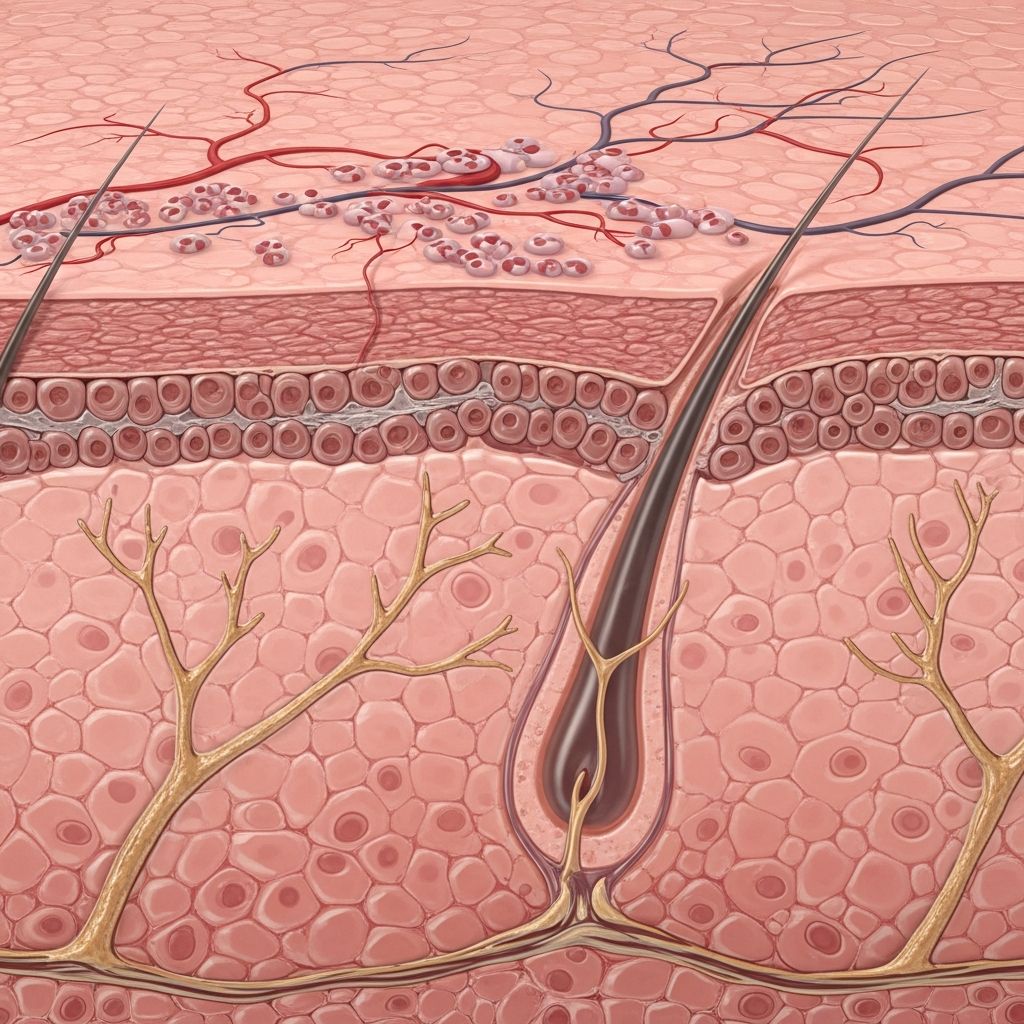
Dermatophytes produce keratinases (proteases that degrade keratin). These enzymes enable the fungus to penetrate keratinised tissue. The fungi grow in and colonise the keratin debris found between and within the cells of the stratum corneum.
The dermatophyte hyphae grow along the stratum corneum towards the skin surface, forming a mycelium (a branching network of hyphae). This is known as centrifugal** growth.Arthroconidia
(fungal spores) are formed from the hyphae by segmentation. These spores are shed from the skin surface and are the infectious agents.

Neutrophils are attracted to the site of infection. They release proteolytic enzymes that digest the surrounding epidermis, forming a subcorneal pustule.
Lymphocytes and histiocytes (macrophages) accumulate around the hair follicles and blood vessels in the superficial dermis.
Histology
The histopathological features of tinea corporis depend on the host immune response. There are four main patterns of reaction.
Pattern 1: Suppurative inflammation
The most acute pattern of response is suppurative** inflammation (**neutrophilic**. Collections of neutrophils infiltrate the stratum corneum formingspongiform pustules
of Kogoj (intraepidermal) and/orsubcorneal pustules
.

Septate hyphae and arthroconidia may be seen within the stratum corneum.

Pattern 2: Lymphohistiocytic inflammation
The most common pattern is lymphohistiocytic** inflammation (**chronic active). Alichenoid
(band-like) infiltrate of lymphocytes and histiocytes accumulates at the dermoepidermal junction.
Spongiosis (intercellular oedema) of the epidermis may be present.

Hyphae may be seen within the stratum corneum on higher power magnification (×40). A periodic acid-Schiff (PAS) stain highlights the fungal elements (magenta).

Pattern 3: Granulomatous inflammation
Granulomatous** inflammation (**chronic) consists of dermal nodules of histiocytes, multinucleated giant cells and lymphocytes.
This pattern may be seen with Majocchi granuloma (perifollicular dermatophyte infection) or when hyphae are difficult to identify.
Related Stories




Pattern 4: No inflammation
A minority of infections show fungal hyphae within the stratum corneum with no inflammatory response. This pattern may be seen in immunocompromised patients.
Histopathology images


Frequently asked questions
What is the pathogenesis of tinea corporis?
Dermatophytes produce keratinases that enable invasion of the stratum corneum. Hyphae grow centrifugally and arthroconidia are shed as infectious particles.
What are the four histopathological patterns in tinea corporis?
1. Suppurative (neutrophilic) inflammation with spongiform pustules
2. Lymphohistiocytic (lichenoid) inflammation
3. Granulomatous inflammation
4. No inflammation
How is the diagnosis of tinea corporis confirmed histologically?
Septate hyphae and arthroconidia within the stratum corneum, best visualised with PAS or GMS stains. Inflammatory patterns vary based on host response.
What is a spongiform pustule of Kogoj?
Intraepidermal collection of neutrophils within spongiotic epidermis, characteristic of acute dermatophyte infection.
Why might granulomatous inflammation occur?
Seen in Majocchi granuloma (perifollicular infection) or when fungal elements are sparse and difficult to identify.
References
- Tinea Corporis – StatPearls — NCBI Bookshelf. 2023-10-25. https://www.ncbi.nlm.nih.gov/books/NBK544360/
- Tinea corporis: an updated review — PubMed Central. 2020-07-15. https://pmc.ncbi.nlm.nih.gov/articles/PMC7375854/
- Tinea corporis (Body Ringworm) — DermNet NZ. 2024. https://dermnetnz.org/topics/tinea-corporis
- Tinea Corporis (Body Ringworm) — Merck Manual Professional Edition. 2023. https://www.merckmanuals.com/professional/dermatologic-disorders/fungal-skin-infections/tinea-corporis-body-ringworm
- Tinea — Primary Care Dermatology Society. 2023. https://www.pcds.org.uk/clinical-guidance/tinea
Similar Articles








Read full bio of medha deb