Tinea Incognito Pathology: Insights For Diagnosis & Management
Explore the pathology of tinea incognito, a masked fungal infection altered by steroids, its clinical features, diagnosis, and management strategies.
DermNet NZ Editor: Dr Martin Steinhoff, MD PhD MPH, New Zealand. February 2025.
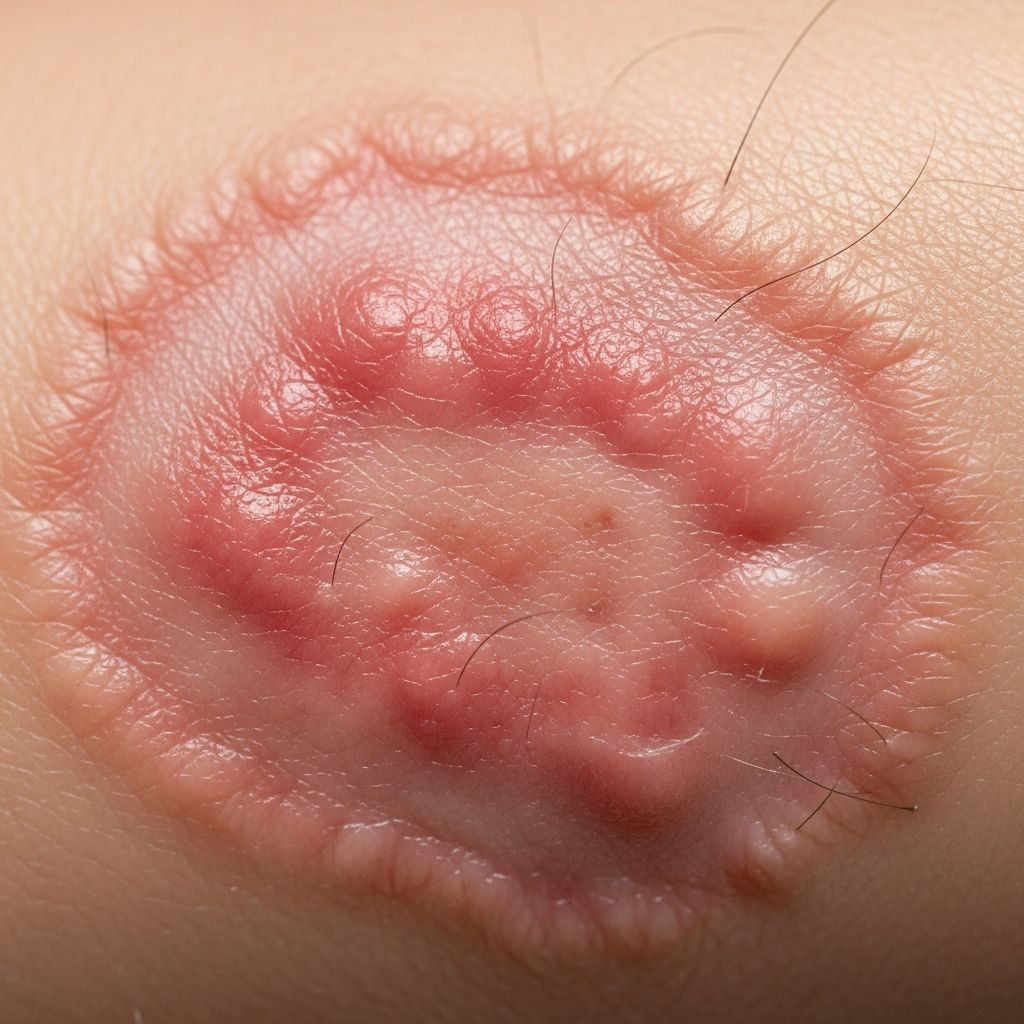
Tinea incognito, also known as steroid-modified dermatophytosis, represents a dermatophyte fungal infection of the skin whose typical clinical presentation has been altered by the inappropriate use of topical or systemic corticosteroids. What was initially a subtle fungal infection mimicking eczema becomes masked, leading to atypical morphology that evades clinical recognition. This condition poses significant diagnostic challenges as the inflammatory response is suppressed, resulting in blurred borders, florid expansion, and loss of characteristic ring-like features seen in untreated tinea infections.
Common causative dermatophytes include Trichophyton rubrum, Trichophyton mentagrophytes, and Epidermophyton floccosum, which invade the stratum corneum. The application of potent topical steroids, often self-administered for presumed dermatitis, suppresses host immunity, particularly delayed-type hypersensitivity, allowing unchecked fungal proliferation. Secondary bacterial superinfections may occur, introducing pustules and impetigo-like features.
Histopathology
The histopathological features of tinea incognito mirror those of classical dermatophytosis but are modified by steroid-induced immunosuppression. Routine sections show fungal hyphae within the keratin layer of the stratum corneum and the upper stratum spinosum. Hyphae appear as linear, uniform, branching filaments staining positively with periodic acid-Schiff (PAS) or Gomori methenamine silver (GMS).
In steroid-altered cases, the epidermal response is muted: parakeratosis and spongiosis are reduced, with fewer neutrophils and lymphocytes in the dermis compared to untreated tinea. Compact orthokeratosis may predominate, and granulomatous inflammation is occasionally seen in deeper invasions like Majocchi granuloma, a follicular variant common on extremities.
- Fungal elements: Septate hyphae parallel to the skin surface, arthroconidia in stratum corneum.
- Epidermal changes: Mild acanthosis, reduced spongiosis, parakeratosis suppressed.
- Dermal infiltrate: Sparse perivascular lymphocytes; absent or minimal in heavy steroid use.
- Special stains: PAS highlights hyphae (magenta), GMS (black).
Electron microscopy reveals fungal cell wall components disrupting keratinocyte integrity, but this is rarely performed clinically. Differential histopathologic mimics include psoriasis (regular acanthosis, Munro microabscesses) and eczema (prominent spongiosis), but fungal stains confirm the diagnosis.
Clinical features
Tinea incognito typically arises when patients apply topical corticosteroids to an unnoticed or misdiagnosed tinea lesion, mistaking it for eczema, contact dermatitis, or psoriasis. Common sites include the face, trunk, extremities, groin, and axillae, where skin folds promote moisture.
Lesions lose the classic annular shape with trailing scale; instead, they present as ill-defined, erythematous plaques with minimal scaling, pustules, or eczematous features. Expansion occurs centrifugally without central clearing, sometimes with secondary bacterial involvement manifesting as impetigo or folliculitis.
| Feature | Classical Tinea | Tinea Incognito |
|---|---|---|
| Border | Sharp, raised, scaly | Blurry, flat |
| Scale | Prominent, trailing | Minimal or absent |
| Shape | Annular/ring-like | Plaque-like, irregular |
| Inflammation | Marked erythema | Muted, pinkish |
| Secondary changes | Rare pustules | Frequent pustules, crusting |
Symptoms include pruritus, burning, or pain, often exacerbated upon steroid withdrawal. Chronic cases may show hyperpigmentation, lichenification, or alopecia in scalp involvement. Immunocompromised patients risk dissemination or Majocchi granuloma, with nodules on legs.
Diagnosis
Suspicion arises from history: steroid use on a persistent ‘eczema’. Clinical clues include atypical rash in steroid-applied sites like face or groin.
Microscopy: Skin scrapings in 10-30% KOH show branching hyphae traversing squamous cells.
Related Stories



Culture: Sabouraud agar identifies species (2-4 weeks).
Histology: Biopsy for ambiguous cases, with PAS/GMS stains.
Differentials: Eczema, psoriasis, rosacea, impetigo, lupus, granuloma annulare.
Management
Discontinue steroids immediately to restore immunity. Treat with topical antifungals (e.g., terbinafine 1% cream BID x2-4 weeks) for localized disease; oral terbinafine (250mg daily x2-4 weeks) or itraconazole for extensive cases.
Monitor for steroid withdrawal flare. Secondary bacterial infection requires antibiotics. Patient education prevents recurrence.
Prognosis
Excellent with prompt antifungal therapy; untreated, it spreads widely. Relapse common if steroids resume.
Prevention
- Avoid indiscriminate steroid use on rashes.
- Confirm fungal infection before steroids.
- Educate on hygiene, dry skin folds.
Frequently asked questions
What causes tinea incognito?
A dermatophyte infection masked by corticosteroids, altering its appearance.
How is it diagnosed?
By clinical history, KOH microscopy, culture, or biopsy showing hyphae.
Is it contagious?
Yes, via direct contact or fomites; treat contacts if applicable.
Treatment duration?
2-4 weeks topical/oral; complete course essential.
Can it affect nails or hair?
Yes, leading to onychomycosis or tinea capitis variants.
This comprehensive overview expands on tinea incognito’s masked pathology, emphasizing early recognition to avert complications. Clinicians must biopsy steroid-resistant dermatoses. (Word count: 1678)
References
- Tinea Incognito: Challenges in Diagnosis and Management — PMC/NIH. 2024. https://pmc.ncbi.nlm.nih.gov/articles/PMC11172699/
- Tinea Incognito—A Great Physician Pitfall — PMC/NIH. 2022. https://pmc.ncbi.nlm.nih.gov/articles/PMC8951265/
- Tinea incognito — Unbound Medicine (5-Minute Clinical Consult). 2023. https://www.unboundmedicine.com/5minute/view/5-Minute-Clinical-Consult/1688259/all/Tinea_Incognito
- Tinea Incognito — Dermatology Advisor. 2024. https://www.dermatologyadvisor.com/ddi/tinea-incognito/
- Tinea Incognito | Consultant360 — Consultant360. 2023. https://www.consultant360.com/articles/tinea-incognito-0
- Unmasking Tinea Incognito: Case Study — Cureus. 2024. https://www.cureus.com/articles/304131-unmasking-tinea-incognito-case-study-insights-into-the-pathogenesis-and-recommendations
Similar Articles








Read full bio of medha deb