Tinea Infections & Ringworm: Causes, Symptoms & Treatment
Complete guide to tinea infections and ringworm: understand causes, symptoms, diagnosis, and effective treatment options.
Understanding Tinea Infections and Ringworm
Tinea infections, commonly known as ringworm, are superficial fungal skin infections caused by specialized fungi called dermatophytes. These infections are among the most common fungal skin conditions worldwide, affecting people of all ages and backgrounds. Despite its name, ringworm has nothing to do with actual worms—the condition gets its name from the characteristic ring-shaped appearance of the lesions that develop on the skin. The term “tinea” is followed by a modifying word that indicates the specific body area affected by the infection.
Tinea infections are caused by fungi belonging to three main genera: Trichophyton, Epidermophyton, and Microsporum. Among these, Trichophyton rubrum is the most commonly isolated organism, responsible for the majority of tinea infections globally. The infection typically affects the body’s nonhairy (glabrous) areas and presents as distinctive annular or circular lesions with characteristic features that make diagnosis relatively straightforward.
Types of Tinea Infections
Tinea infections are classified based on the body area affected. Understanding these classifications helps healthcare providers and patients identify the specific type of infection and determine the most appropriate treatment approach.
Body and Groin Infections
Tinea corporis refers to ringworm of the body, typically affecting the trunk and extremities. This is one of the most common presentations of tinea infections. Tinea cruris, also called jock itch, specifically affects the groin area and is particularly common in warm, humid environments. Both conditions present with similar characteristics but affect different body regions.
Scalp and Beard Infections
Tinea capitis affects the scalp and hair-bearing areas of the head, while tinea barbae or tinea sycosis specifically targets the beard region. These infections can cause hair loss and scaling of the affected areas, making them particularly concerning for patients.
Extremity and Nail Infections
Tinea pedis, commonly known as athlete’s foot, affects the feet and can present in two forms: dry or inflammatory types. The inflammatory type may develop vesicles or blisters between the toes, while the dry type causes chronic redness and scaling. Tinea manuum affects the hands, and tinea unguium (onychomycosis) specifically targets the nails, causing them to become thick and brittle.
Causes and Risk Factors
Causative Organisms
The primary causative agents of tinea infections include multiple Trichophyton species, with T. rubrum being the most prevalent. Other significant organisms include T. mentagrophytes, T. tonsurans, T. violaceum, Microsporum canis, and Epidermophyton floccosum. An important emerging dermatophyte is T. indotineae, which has become a significant cause of skin infections in South Asia and has increasingly spread to other regions, including the United Kingdom and Germany.
Transmission Routes
Tinea infections spread through multiple pathways. Direct contact with infected individuals remains one of the most common transmission routes. Indirect transmission occurs through contaminated surfaces, including household items such as clothing, towels, bedding, combs, and shower floors. Close contact with infected animals, particularly cats and dogs carrying Microsporum canis, can also result in infection. Sexual transmission of certain Trichophyton species is increasingly recognized, particularly T. mentagrophytes genotype VII, which is associated with sexual transmission among men who have sex with men and with sex tourism to Southeast Asia.
Environmental and Personal Risk Factors
Several factors increase susceptibility to tinea infections. Excessive perspiration, particularly in warm and humid environments, creates ideal conditions for fungal growth. Poor hygiene practices, immunosuppression, and untreated related infections such as tinea pedis or onychomycosis increase infection risk. Close contact with infected individuals and sharing contaminated items amplify transmission likelihood.
Clinical Presentation and Symptoms
Characteristic Appearance
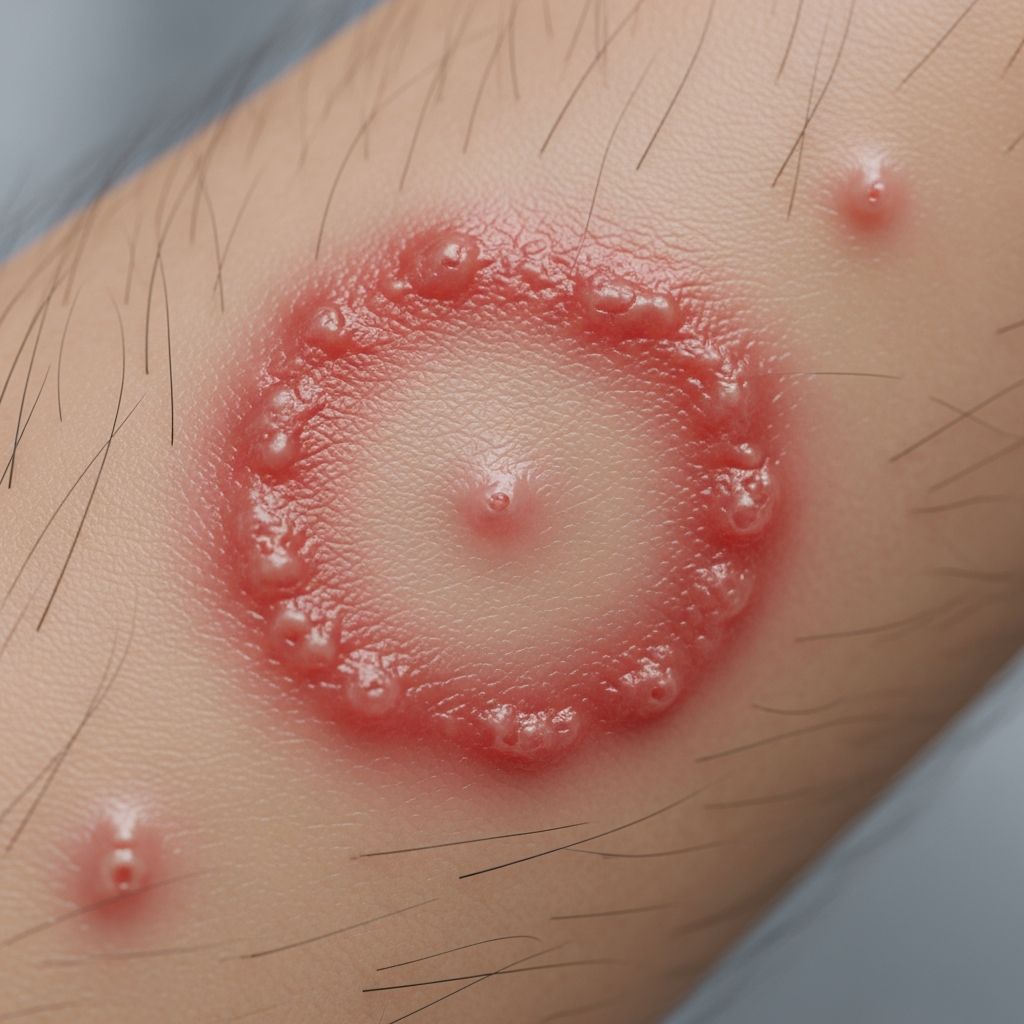
Patients with tinea infections commonly report an itchy, red rash that typically appears on exposed areas of the neck, trunk, or extremities. Physical examination reveals one or more circular or ovoid lesions, often presenting as patches or plaques with a distinctive appearance. The annular lesions show sharp margins with a raised, erythematous, scaly edge, sometimes containing vesicles or blisters. The degree of inflammation varies depending on the individual’s immune response and the specific fungal organism involved.
Progressive Features
The characteristic ring appearance of tinea lesions results from the expansion pattern of the infection. Lesions expand centrifugally (outward from the center), leaving central clearing with mild residual scaling behind as the infection spreads. This distinctive pattern is what gives rise to the common term “ringworm,” despite the absence of any actual worm involvement.
Special Presentations
Tinea imbricata, which literally means “overlapping like tiles,” is so called because its lesions consist of concentric rings of overlapping scales. This unique presentation occurs exclusively in Central America, Southeast Asia, India, and Polynesia. In immunocompromised individuals, tinea infections may become confluent or widespread, requiring more aggressive treatment approaches.
Diagnosis and Testing Methods
Clinical Evaluation
Tinea corporis diagnosis is typically made through clinical observation and patient history. A thorough history includes information about exposure to infected individuals, recent travel, contact with animals, and use of shared facilities. Physical examination focuses on identifying the characteristic annular lesions with central clearing and raised borders.
Laboratory Confirmation
While clinical diagnosis is often sufficient, laboratory confirmation may be necessary, particularly in atypical cases. Potassium hydroxide (KOH) microscopy of skin scrapings is a standard diagnostic method that reveals hyaline and septate hyphae characteristic of dermatophyte infections. Fungal culture can identify the specific pathogenic species, which is particularly important in refractory cases. Polymerase chain reaction (PCR) testing represents an advanced diagnostic option that can also identify the pathogenic species with high precision.
Advanced Diagnostic Techniques
Dermoscopy has emerged as a useful diagnostic tool to identify characteristic features of tinea infections. Research has identified 13 dermoscopic features in tinea corporis, 12 in tinea cruris, and 20 in tinea capitis. For cases that prove resistant to initial therapy, antifungal susceptibility testing on cultured organisms helps determine the most effective treatment regimen, ensuring use of the most appropriate antifungal agent.
Treatment Approaches
Topical Antifungal Therapy
The treatment of dermatophyte infections typically involves topical or oral antifungal agents, with the choice depending on various factors. Localized tinea corporis typically improves with topical therapy applied once or twice daily for 2 to 3 weeks. Topical antifungal medications include azoles and allylamines, which are applied directly to affected areas. Treatment continues until clinical resolution of symptoms occurs. Notably, topical nystatin is ineffective for treating tinea corporis and should not be used.
Oral Antifungal Therapy
Oral therapy becomes necessary in cases involving more widespread infection or failed topical treatment. Oral terbinafine or itraconazole is typically the preferred first-line treatment and is expected to clear the condition in approximately 2 to 3 weeks. For adults, alternative options include griseofulvin at doses of 500 to 1000 mg once daily for 2 to 4 weeks. Recent trials have shown that tinea corporis caused by terbinafine-resistant T. rubrum can be successfully treated with fosravuconazole, providing an important alternative for drug-resistant cases.
Addressing Underlying Factors
Effective treatment requires addressing predisposing factors such as excessive perspiration, close contact with infected individuals, and the use of contaminated items. Healthcare providers emphasize that topical corticosteroids should not be used for tinea corporis, as they eventually worsen infections.
Prognosis and Outcomes
The prognosis for tinea corporis is generally excellent with appropriate treatment. Most localized cases respond well to topical antifungal agents within 2 to 4 weeks, especially when underlying predisposing factors are effectively addressed. Systemic antifungal therapy is effective in more extensive or refractory cases, with a high success rate when adherence is maintained.
However, recurrence can occur, particularly in the presence of persistent risk factors such as immunosuppression, untreated tinea pedis or onychomycosis, and poor hygiene practices. Chronic or recurrent cases may require longer treatment courses or prophylactic measures. Delayed treatment or misdiagnosis can lead to atypical presentations or secondary bacterial infections, potentially complicating the clinical course.
Prevention Strategies
Preventing tinea infections involves minimizing exposure to dermatophytes and reducing environmental conditions favorable to fungal growth. Key prevention measures include maintaining good personal hygiene, keeping skin dry (particularly in warm, humid areas), avoiding sharing personal items such as towels, combs, and clothing, and wearing protective footwear in communal areas like shower rooms and swimming pools. Individuals with tinea pedis should seek prompt treatment to prevent spread to other body areas or transmission to others. Similarly, treating onychomycosis prevents complications and reduces transmission risk.
Frequently Asked Questions
Q: Is ringworm contagious?
A: Yes, ringworm is highly contagious and spreads easily from person to person through direct contact or contaminated surfaces. It can also spread from infected animals, particularly cats and dogs, to humans.
Q: How long does tinea infection treatment typically take?
A: Localized cases with topical treatment typically resolve within 2 to 3 weeks, while systemic oral therapy usually clears infections in approximately 2 to 3 weeks. Treatment duration may extend for chronic or recurrent cases.
Q: Can tinea infections recur after treatment?
A: Yes, recurrence can occur, particularly if underlying risk factors persist. Maintaining good hygiene, treating related fungal infections, and addressing factors like immunosuppression help prevent recurrence.
Q: Should I use over-the-counter antifungal creams for ringworm?
A: Over-the-counter topical antifungals can be effective for localized cases. However, if symptoms persist after 2 to 3 weeks or if the infection is extensive, consult a healthcare provider for prescription-strength treatment.
Q: Are there complications from untreated tinea infections?
A: Delayed treatment or misdiagnosis can lead to atypical presentations, secondary bacterial infections, and spread to other body areas, particularly in immunocompromised individuals.
References
- Tinea Corporis – StatPearls — National Center for Biotechnology Information (NCBI). 2024. https://www.ncbi.nlm.nih.gov/books/NBK544360/
- Tinea corporis/tinea cruris — Johns Hopkins ABX Guide. 2024. https://www.hopkinsguides.com/hopkins/view/Johns_Hopkins_ABX_Guide/540551/all/Tinea_corporis_tinea_cruris
- Ringworm: Cause, Symptoms, & Treatment — Britannica. Updated August 14, 2025. https://www.britannica.com/science/ringworm
- Dermatophytes — Johns Hopkins ABX Guide. 2024. https://www.hopkinsguides.com/hopkins/view/Johns_Hopkins_ABX_Guide/540160/all/Dermatophytes
- Fungal skin infections — Johns Hopkins University. 2024. https://pure.johnshopkins.edu/en/publications/fungal-skin-infections
Similar Articles







Read full bio of medha deb