Tinea Pedis Images: 16 Clinical Photos And Key Signs
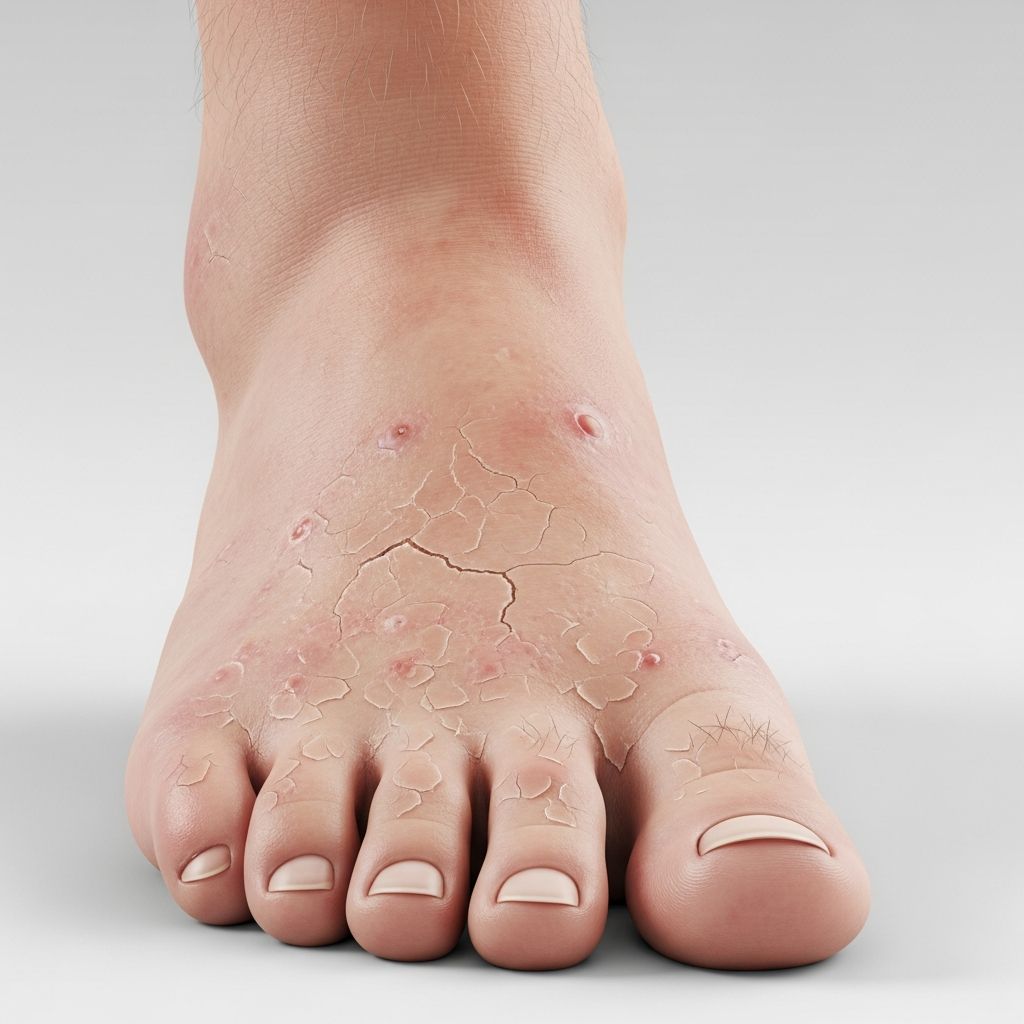
Comprehensive visual guide to athlete's foot (tinea pedis) with clinical images across all infection types and severities.
Author: Reviewed by Dr. Amanda Oakley, Dermatologist, Reviewed: 25 February 2022, Last Updated: 22 February 2024, Next Review due: February 2027
Tinea pedis, commonly known as athlete’s foot, represents the most prevalent dermatophyte infection worldwide, particularly thriving in hot, humid, tropical, and urban settings. This fungal infection of the feet is caused by dermatophytes—keratinophilic fungi that target the skin, hair, and nails. The condition manifests in several distinct clinical patterns, each characterized by unique appearances visible in clinical photography. This image gallery compiles authoritative visual examples of tinea pedis across its primary subtypes: interdigital, moccasin-type, vesicular, and ulcerative variants. These images, sourced from peer-reviewed dermatological atlases and clinical databases, aid healthcare professionals and patients in recognizing the spectrum of presentations, from mild scaling to severe erosions. Early identification is crucial, as untreated tinea pedis can lead to secondary bacterial infections, chronicity, or spread to other body sites like the nails (onychomycosis) or hands (tinea manuum).
The three predominant dermatophytes responsible include Trichophyton rubrum, Trichophyton interdigitale (formerly T. mentagrophytes var. interdigitale), and Epidermophyton floccosum. Risk factors encompass occlusive footwear, hyperhidrosis, communal bathing facilities, and immunocompromise. Images herein illustrate how moisture accumulation between toes fosters interdigital maceration, while sole involvement yields hyperkeratotic scaling mimicking moccasin leather. Vesicular forms present with pruritic bullae, and ulcerative types show deep fissures prone to superinfection.
Interdigital type
The interdigital subtype, accounting for approximately 70% of cases, predominantly affects the lateral toe webs, especially the second, third, and fourth interdigital spaces. Fungal hyphae proliferate in this warm, moist microenvironment, leading to epidermal maceration, desquamation, and fissuring. Clinically, it appears as white, soggy scaling with peeling skin, erythema, and intense pruritus that intensifies upon desocketing. Odoriferous discharge may occur due to bacterial overgrowth. Images depict the progression from subtle fissuring to erosive dermatitis.
- Image 1: Mild interdigital tinea pedis showing subtle scaling and erythema confined to the third web space of a Caucasian foot. The skin exhibits fine desquamation without significant fissuring.
- Image 2: Advanced interdigital involvement with macerated white plaques, fissuring, and peripheral erythema extending to the toe margins. Note the hyperkeratotic rim.
- Image 3: Bilateral symmetric interdigital tinea pedis in a tropical climate setting, with soggy toe webs and early nail dystrophy proximally.
- Image 4: Erosive interdigital type on darker skin phototype, presenting as hyperpigmented, peeling fissures with secondary lichenification from chronic scratching.
These visuals underscore the contagious nature, often acquired barefoot in public showers or locker rooms, emphasizing prevention via footwear.
Moccasin type
Moccasin tinea pedis, or dry-type, involves the plantar surfaces and lateral foot margins, evoking a slipper-like distribution. Trichophyton rubrum dominates, inducing hyperkeratosis, mild erythema, and diffuse scaling without blisters. The stratum corneum thickens, fissures develop, and itching is less prominent than in interdigital forms. This chronic variant resists topical therapy due to poor drug penetration and frequently coexists with onychomycosis. Images reveal the subtle, bilateral, symmetric scaling often mistaken for eczema or psoriasis.
- Image 5: Classic moccasin distribution with thick, adherent white scales on the soles and heels, sparing the interdigital spaces. Mild central erythema visible.
- Image 6: Severe hyperkeratotic moccasin tinea pedis with deep plantar fissures and callus-like thickening extending to the midfoot arches.
- Image 7: Moccasin type on pediatric foot, showing less pronounced scaling but early involvement of the weight-bearing areas.
- Image 8: Chronic moccasin variant with secondary bacterial superinfection, evidenced by pustules amid the hyperkeratosis.
Related Stories



Diagnosis often requires skin scrapings for microscopy and culture, as clinical resemblance to other keratodermas is high.
Vesicular type
Vesicular tinea pedis, less common (10-20% of cases), features pruritic serous blisters on the instep, midsole, or toe undersurfaces, typically triggered by T. interdigitale. Blisters rupture, yielding erosions and crusting, with auto-inoculation risk to distant sites. Images capture the acute inflammatory response, distinguishing it from pompholyx eczema.
- Image 9: Acute vesicular outbreak with multiple tense vesicles coalescing into bullae on the plantar arch.
- Image 10: Ruptured vesicles leading to denuded erosions with collarette scaling and surrounding erythema.
- Image 11: Extensive vesicular tinea pedis mimicking acute contact dermatitis, with intraepidermal pustules.
This subtype responds well to topical allylamines but warrants systemic therapy if widespread.
Ulcerative type
Ulcerative tinea pedis arises from neglected interdigital infections, yielding painful, weeping erosions prone to gram-negative superinfection. Predominantly in tropics, it presents with deep toe web ulcers, purulent discharge, and lymphadenopathy. Images highlight the severity, stressing urgent intervention.
- Image 12: Ulcerative interdigital erosion with ragged margins and exudate.
- Image 13: Superinfected ulcerative type showing pustular discharge and periungual involvement.
Other images
Atypical presentations include hyperkeratotic variants, nail involvement, and mixed types. These images broaden diagnostic acumen.
- Image 14: Tinea pedis with proximal subungual onychomycosis, yellow crumbly nails adjacent to scaling skin.
- Image 15: Palmoplantar mixed tinea (tinea manuum et pedis) with symmetric scaling.
- Image 16: Post-treatment resolution showing normalized skin texture after 4 weeks of terbinafine.
Diagnosis
Clinical pattern recognition suffices for most cases, but KOH microscopy (revealing hyphae) or fungal culture confirms. Dermoscopy may show mosaic patterns in moccasin type. Differential includes erythrasma, contact dermatitis, psoriasis, and bacterial cellulitis.
Treatment
First-line: Topical antifungals (terbinafine 1% cream BID x1-2 weeks, clotrimazole, etc.) with foot hygiene—dry interdigits meticulously, use absorbent socks, avoid occlusives. Refractory cases require oral terbinafine (250mg daily x2 weeks) or itraconazole. Evidence supports allylamines over azoles for mycologic cure.
| Type | First-line Topical | Duration | Oral Indication |
|---|---|---|---|
| Interdigital | Terbinafine cream | 1-2 weeks | Failure after 4 weeks |
| Moccasin | Terbinafine or butenafine | 4-6 weeks | Commonly needed |
| Vesicular | Allylamine + steroid if inflamed | 2-4 weeks | Dermatomal spread |
| Ulcerative | Systemic + antibacterial | Variable | Always |
Prevention
- Wear flip-flops in communal areas.
- Rotate shoes, use antifungal powders.
- Dry feet thoroughly post-bathing.
- Manage hyperhidrosis.
Frequently asked questions
What does athlete’s foot look like?
Athlete’s foot appears as scaling, fissuring, blisters, or hyperkeratosis per subtype, as illustrated.
Is tinea pedis contagious?
Yes, via fomites; practice hygiene.
How long does treatment take?
1-4 weeks topically; complete course to prevent recurrence.
Can it affect nails?
Yes, leading to onychomycosis.
References
- Athlete’s foot – Symptoms and causes — Mayo Clinic. 2023-10-12. https://www.mayoclinic.org/diseases-conditions/athletes-foot/symptoms-causes/syc-20353841
- Athlete’s foot symptoms & treatment — Aurora Health Care. 2024-01-15. https://www.aurorahealthcare.org/services/dermatology/athletes-foot
- Athlete’s Foot (Tinea Pedis) — Merck Manuals. 2023-05-01. https://www.merckmanuals.com/home/skin-disorders/fungal-skin-infections/athlete-s-foot-tinea-pedis
- Tinea pedis (fungal foot infection) — DermNet NZ. 2024-02-22. https://dermnetnz.org/topics/tinea-pedis
- Athlete’s foot – Diagnosis and treatment — Mayo Clinic. 2023-11-08. https://www.mayoclinic.org/diseases-conditions/athletes-foot/diagnosis-treatment/drc-20353847
Similar Articles








Read full bio of medha deb