Tolcapone for Parkinson’s Disease (Tasmar)
Comprehensive guide to Tolcapone (Tasmar): uses, dosage, side effects, and safety for Parkinson's symptom management.
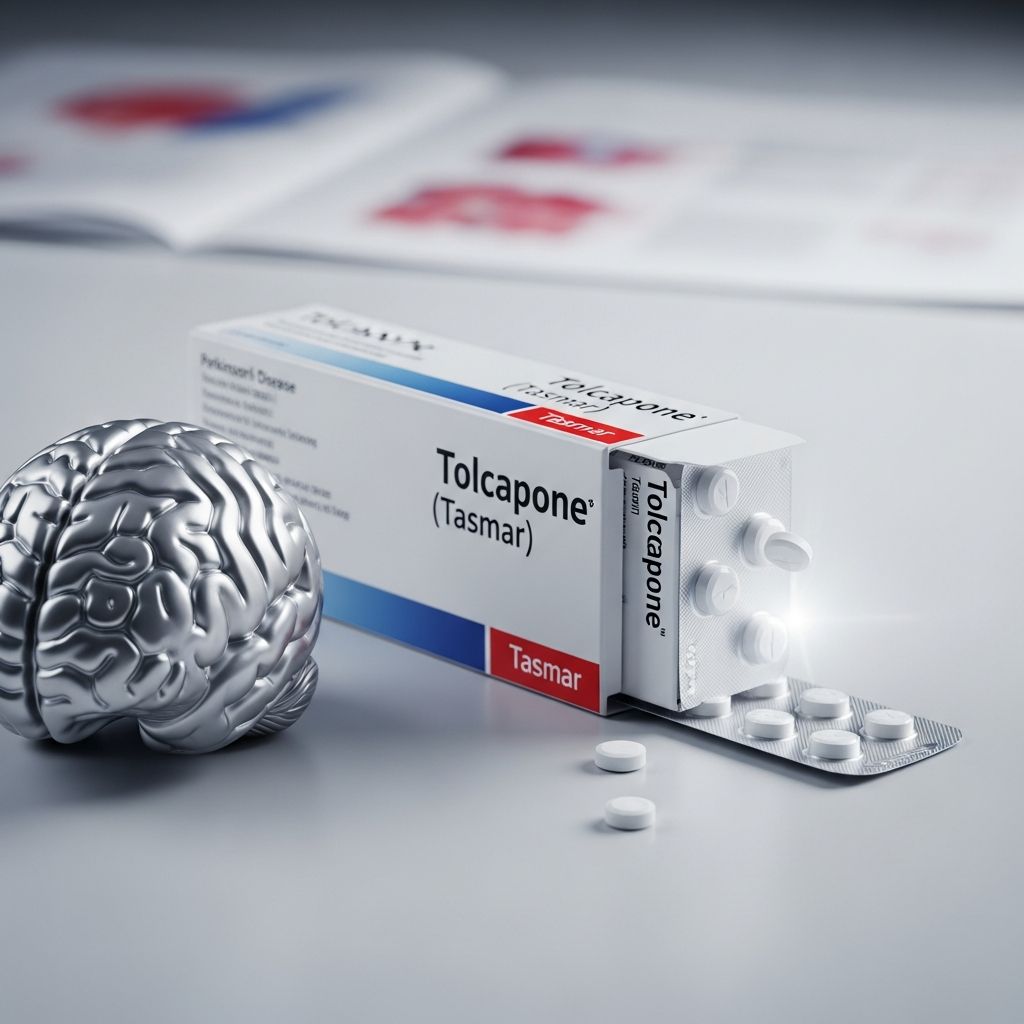
Tolcapone, marketed as Tasmar, is a catechol-O-methyltransferase (COMT) inhibitor used as an adjunct to levodopa/carbidopa therapy in patients with Parkinson’s disease (PD), particularly those experiencing motor fluctuations.
About tolcapone
Tolcapone is a selective, reversible inhibitor of COMT, an enzyme that metabolizes levodopa to 3-O-methyldopa, reducing levodopa’s availability to the brain. By inhibiting COMT both peripherally and centrally, tolcapone increases levodopa’s plasma levels, prolongs its half-life, and enhances dopaminergic stimulation in the brain without raising peak concentrations. This leads to more stable levodopa delivery, improving motor function and reducing ‘off’ time in PD patients.
In clinical trials, tolcapone (100 or 200 mg three times daily) significantly improved Unified Parkinson’s Disease Rating Scale (UPDRS) scores for activities of daily living (Subscale II) and motor function (Subscale III) in stable PD patients, with benefits sustained up to 12 months. It also allowed levodopa dose reductions of 29-40% while extending ‘on’ time by 20-30% and reducing ‘off’ time by 26-50% in fluctuating patients.
Approved by the FDA in 1998 as add-on therapy, tolcapone is reserved for patients with motor fluctuations unresponsive to other adjuncts due to hepatotoxicity risks.
Before taking tolcapone
Who can and cannot take tolcapone tablets
Tolcapone is indicated for adults with idiopathic PD receiving levodopa/carbidopa who have motor fluctuations and fail other therapies. It is contraindicated in patients with:
- Current or past liver disease or abnormal liver function tests (LFTs).
- Hypersensitivity to tolcapone or its components.
- Pheochromocytoma or paraganglioma due to catecholamine pressor effects.
Use cautiously in patients with biliary obstruction or severe dyskinesia.
Other medicines, food and drink, and pregnancy
Drug interactions: Tolcapone potentiates levodopa, necessitating dose adjustments; reduces ‘off’ time but may increase dyskinesias. Avoid with nonselective MAO inhibitors (risk of hypertensive crisis); use caution with selective MAO-B inhibitors. It may alter warfarin levels and enhance sedative effects of benzodiazepines.
Food/drink: Take with or without food; high-fat meals may delay absorption but not affect bioavailability.
Pregnancy/breastfeeding: Limited data; use only if benefits outweigh risks (Category C). Not recommended during breastfeeding.
Dosage and how to take tablets
The standard dose is 100 mg orally three times daily, at the first daily levodopa dose and 6 and 12 hours later. A 200 mg dose may offer greater benefit but increases hepatotoxicity risk; start at 100 mg. Tablets are swallowed whole; adjust levodopa dose based on response (often reduced by 20-30%).
| Patient Group | Recommended Dose | Frequency |
|---|---|---|
| Adults with PD motor fluctuations | 100 mg (up to 200 mg if tolerated) | Three times daily with levodopa |
| Children | Not recommended | – |
Missed dose: Take as soon as remembered unless near next dose; do not double.
How and when to take tolcapone
Administer 100-200 mg three times daily alongside levodopa/carbidopa to maximize synergy. Benefits may appear within 2-6 weeks, with levodopa reductions evident early and motor improvements sustained long-term. Regular LFT monitoring is mandatory: baseline, every 2 weeks for 1 year, then periodically.
Do not exceed 600 mg/day. Discontinue if LFTs exceed 2-3x upper limit of normal or symptoms of liver injury occur.
Related Stories



Side effects and dosage
Most side effects are dopaminergic, reflecting enhanced levodopa effects: dyskinesia (dose-related), nausea, dystonia, hallucinations. Non-dopaminergic: diarrhea (most common), urine discoloration, abdominal pain.
Hepatotoxicity: Rare but serious; elevated LFTs occur in 1-5%, with fulminant liver failure in post-marketing reports (mostly within 6 months). Incidence is dose-related; virtually all cases within first 6 months with monitoring.
- Common (>1/10): Dyskinesia, nausea, diarrhea.
- Serious: Liver failure (0.1-1%), rhabdomyolysis, neuroleptic malignant syndrome (on withdrawal).
Tolcapone lowers homocysteine levels associated with levodopa.
Pregnancy, breastfeeding and fertility while taking tolcapone
No adequate human studies; animal data show no teratogenicity but use caution. Fertility not impaired in preclinical studies. Consult physician; alternative therapies preferred in pregnancy.
Common questions about tolcapone
How long does it take to work?
Levodopa reductions seen in 2 weeks; UPDRS improvements in 6 weeks, sustained 1+ year.
Does tolcapone cause liver damage?
Rare risk with monitoring; abnormalities usually reversible if detected early. Strict LFTs essential.
Can tolcapone be used in early PD?
Efficacious in stable PD without fluctuations, improving daily activities and motor scores.
What if I experience diarrhea?
Mild-moderate; manage supportively; discontinue if severe.
Is tolcapone still available?
Yes, restricted in US/EU due to liver risks but used with monitoring.
Frequently Asked Questions (FAQs)
Q: What is tolcapone used for?
A: Tolcapone (Tasmar) treats PD symptoms as adjunct to levodopa/carbidopa, especially motor fluctuations, by prolonging levodopa effects.
Q: What are the main side effects of tolcapone?
A: Dyskinesia, nausea, diarrhea, and potential liver enzyme elevations requiring monitoring.
Q: How often should liver tests be done?
A: Baseline, every 2 weeks for 1 year, then as needed; discontinue if >3x normal.
Q: Can tolcapone reduce levodopa dose?
A: Yes, often by 25-40% while maintaining or improving symptom control.
Q: Is tolcapone safe long-term?
A: With rigorous monitoring, risk of irreversible liver injury is negligible after 6 months.
References
- Tolcapone in stable Parkinson’s disease: Efficacy and safety of long-term treatment — Neurology (American Academy of Neurology). 1997-09-01. https://www.neurology.org/doi/10.1212/WNL.49.3.665
- Tolcapone, a selective catechol-O-methyltransferase inhibitor for the treatment of Parkinson’s disease — PubMed (Clinical Neuropharmacology). 1998-11-01. https://pubmed.ncbi.nlm.nih.gov/9917075/
- Tasmar (tolcapone) for Parkinson’s disease — Parkinson’s News Today. Accessed 2026. https://parkinsonsnewstoday.com/tasmar/
- Tolcapone and Hepatotoxic Effects — JAMA Neurology. 2000-01-01. https://jamanetwork.com/journals/jamaneurology/fullarticle/775949
- Tolcapone: Uses, Interactions, Mechanism of Action — DrugBank (Government of Canada). Accessed 2026. https://go.drugbank.com/drugs/DB00323
- Tolcapone — MedLink Neurology. Accessed 2026. https://www.medlink.com/articles/tolcapone
- Tolcapone (oral route) – Side effects & dosage — Mayo Clinic. Accessed 2026. https://www.mayoclinic.org/drugs-supplements/tolcapone-oral-route/description/drg-20068038
Similar Articles








Read full bio of Sneha Tete