Topical Nitrogen Mustard: Guide To Usage, Efficacy & Safety
Effective topical therapy for early-stage mycosis fungoides and cutaneous T-cell lymphoma management.
Authoritative facts about topical nitrogen mustard (mechlorethamine) for mycosis fungoides and other skin conditions, includingwhat it is
,how it works
,usage guidelines
,efficacy data
,side effects
, andpatient considerations
.
What is topical nitrogen mustard?
Topical nitrogen mustard, also known as mechlorethamine hydrochloride, is a chemotherapy agent adapted for skin application. It has been a cornerstone therapy for cutaneous T-cell lymphomas (CTCL), particularly mycosis fungoides (MF), since the 1950s. This alkylating agent targets rapidly dividing cells, such as malignant T-lymphocytes in the skin, by cross-linking DNA strands and inhibiting cell replication.
Originally developed as a systemic anticancer drug, its topical form allows direct delivery to affected skin areas, minimizing systemic exposure. Formulations include aqueous solutions, ointments, and modern gels like Valchlor®, providing options for different patient needs.
Who gets topical nitrogen mustard?
Primary indication is early-stage mycosis fungoides (stages IA-IIA, T1/T2 disease), characterized by patches and plaques limited to less than 10% (T1) or more than 10% (T2) body surface area. It is FDA-approved for MF-type CTCL in adults.
- Stage IA (limited patches/plaques): Ideal candidates with high complete response (CR) rates of 65-93%.
- Stage IB (generalized patches/plaques): Effective with CR rates of 34-72%.
- Off-label uses: Pediatric MF, granulomatous slack skin, and salvage therapy for relapses.
- Contraindications: Hypersensitivity to nitrogen mustard, active infection, or pregnancy (category D).
History of topical nitrogen mustard in mycosis fungoides
Introduced in the 1940s-1950s at Stanford University, topical nitrogen mustard revolutionized MF management. Early studies on 123 patients showed overall response rates (ORR) of 88% in T1 and 69% in T2 disease. Long-term data from 203 patients confirmed 83% ORR and 50% CR, with 68% managed on monotherapy alone (median follow-up 5 years).
Pre-1980s, aqueous preparations were standard but unstable. Ointment bases improved stability, reduced hypersensitivity (from 66% to <10%), and enhanced compliance. Recent gel formulations like chlormethine gel show real-world success in 64% of patients (mean treatment 264 days).
Mechanism of action
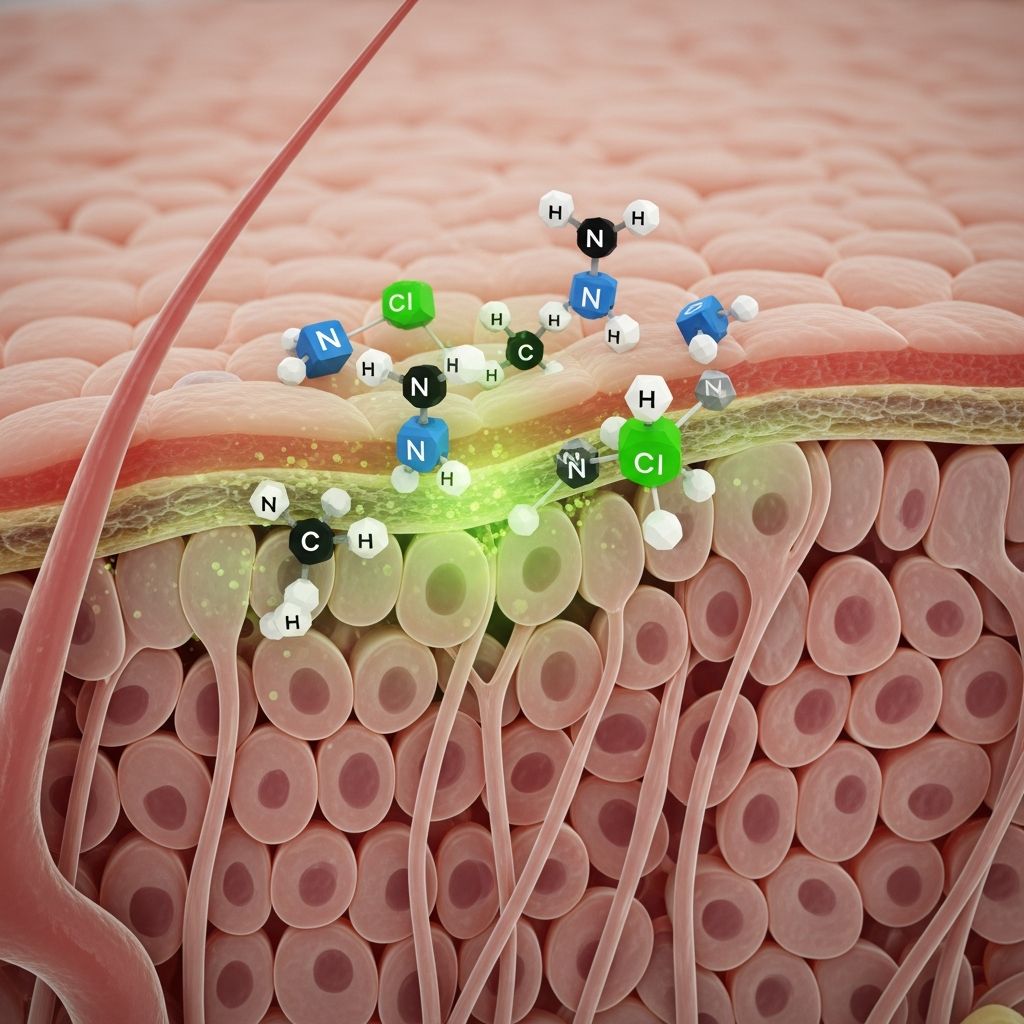
Nitrogen mustard forms a highly reactive aziridinium ion that alkylates DNA at the N7 position of guanine, leading to inter- and intra-strand cross-links. This halts DNA replication and transcription in proliferating lymphoma cells while sparing normal skin cells due to topical application and low systemic absorption.
No clinically significant systemic absorption occurs, even in pediatric patients or extensive application, making it safe for long-term use.
Preparations of topical nitrogen mustard
| Type | Concentration | Base | Advantages | Disadvantages |
|---|---|---|---|---|
| Aqueous | 10-20 mg/100 mL | Water | Easy mixing | Unstable, high hypersensitivity (up to 66%) |
| Ointment | 10-20 mg/100 g | Petrolatum/emollient | Stable, low allergy (<10%), moisturizing | Pharmacist compounding needed |
| Gel (Valchlor®) | 0.016% (160 mcg/g) | Gel base | Commercial, precise dosing | Higher cost |
Ointment is preferred for reduced irritancy and cost. Custom concentrations can increase to >20 mg/100 mL for resistant disease.
How to use topical nitrogen mustard
- Preparation: Thaw refrigerated product; apply within 30 minutes. Mix pharmacist-prepared ointment or self-mix aqueous daily.
- Application: Thin layer to dry skin (4 hours post-shower or 30 min pre). Cover entire affected areas or total skin for generalized disease. Dry 5-10 min before clothing.
- Frequency: Daily for 6-12 months induction, then maintenance 2-3x/week or less based on response.
- Moisturizers: Use emollients 2 hours before/after; avoid occlusion.
- Desensitization: For hypersensitivity, taper concentration/frequency or use buffers.
Related Stories



Avoid eyes, mucous membranes, genitals (increased cancer risk). Wash hands thoroughly.
Clinical efficacy
Stanford series (203 patients): 83% ORR, 50% CR overall; 93%/65% in T1, 72%/34% in T2. Freedom from progression (FFP) >90% at 20 years for monotherapy T1/T2 patients.
- 68% received only nitrogen mustard lifelong.
- Salvage therapy matches initial rates.
- T3/T4 (tumors/erythroderma): Low CR (0-22%), high progression.
Survival: T1 deaths mostly unrelated to MF; T2 half MF-related.
Side effects and risks
Common (>10%): Cutaneous irritation (erythema, dryness), hypersensitivity (aqueous: 66%; ointment: <10%).
Rare: Secondary skin cancers (squamous/basal cell) in 4% (8/203), mostly after multi-modal therapy or sun-exposed sites. No excess risk with monotherapy avoiding genitals. One melanoma case pre-existed.
- Manage irritation by reducing frequency/concentration; most tolerate intensification.
- No systemic toxicity or infertility reported.
Monitoring and follow-up
Monthly clinical exams initially; biopsy if progression. Long-term skin cancer surveillance, especially photodamaged areas. Annual dermatology follow-up post-remission.
Alternatives to topical nitrogen mustard
- Phototherapy (NB-UVB/PUVA): For patches/plaques.
- Total skin electron beam therapy (TSEBT): Localized thick plaques.
- Topical corticosteroids, bexarotene gel, retinoids.
- Systemic: Bexarotene, IFN-alpha for progression.
Special situations
- Pediatrics: Safe, no absorption issues.
- Pregnancy: Avoid; barrier contraception recommended.
- Relapse: Re-challenge effective.
- Granulomatous slack skin: Case reports of remission.
Frequently asked questions (FAQs) about topical nitrogen mustard
What is the success rate of topical nitrogen mustard for mycosis fungoides?
Complete response rates are 65-93% in limited disease (T1) and 34-72% in generalized (T2), with durable remissions in monotherapy patients.
Does topical nitrogen mustard cause skin cancer?
Risk is low (4%) and linked to multi-therapy or genital use; monotherapy avoiding sensitive areas shows no excess risk.
How long do you apply topical nitrogen mustard?
Daily induction 6-12 months, then maintenance tapering to 2x/week or as needed; no evidence longer maintenance improves outcomes.
Is the ointment better than aqueous nitrogen mustard?
Yes, ointment reduces hypersensitivity to <10% vs 66% for aqueous, with equal efficacy and added emollient benefits.
Can children use topical nitrogen mustard?
Yes, safely in pediatric MF with no systemic absorption.
What if I develop a rash from nitrogen mustard?
Reduce frequency/concentration; desensitization protocols allow most to continue.
References
- Topical Nitrogen Mustard in the Management of Mycosis Fungoides — Kim YH et al. JAMA Dermatology. 2003-08-01. https://jamanetwork.com/journals/jamadermatology/fullarticle/479188
- Mycosis fungoides: management with topical nitrogen mustard — Vonderheid EC et al. Journal of Clinical Oncology. 1987-11-01. https://ascopubs.org/doi/10.1200/JCO.1987.5.11.1796
- Management with topical nitrogen mustard in mycosis fungoides — Kim YH. Hematology/Oncology Clinics of North America. 2003-12-01. https://pubmed.ncbi.nlm.nih.gov/14686971/
- Mechlorethamine Topical (Valchlor®, Nitrogen Mustard) — OncoLink, University of Pennsylvania. 2023. https://www.oncolink.org/cancer-treatment/oncolink-rx/mechlorethamine-topical-valchor-R-nitrogen-mustard
- Topical nitrogen mustard in the management of mycosis fungoides — Stanford Health Care. 2023. https://stanfordhealthcare.org/v2/publications/216/21643.html
- Topical nitrogen mustard for the treatment of granulomatous slack skin — MD Anderson Cancer Center. 2023. https://mdanderson.elsevierpure.com/en/publications/topical-nitrogen-mustard-for-the-treatment-of-granulomatous-slack/
- MECHLORETHAMINE (VALCHLOR®) — Cutaneous Lymphoma Foundation. 2023. https://www.clfoundation.org/mechlorethamine
Similar Articles








Read full bio of medha deb