Topical Skin Adhesives: Guide To Uses, Benefits & Risks
Discover how topical skin adhesives provide a fast, painless alternative to sutures for closing simple wounds effectively.
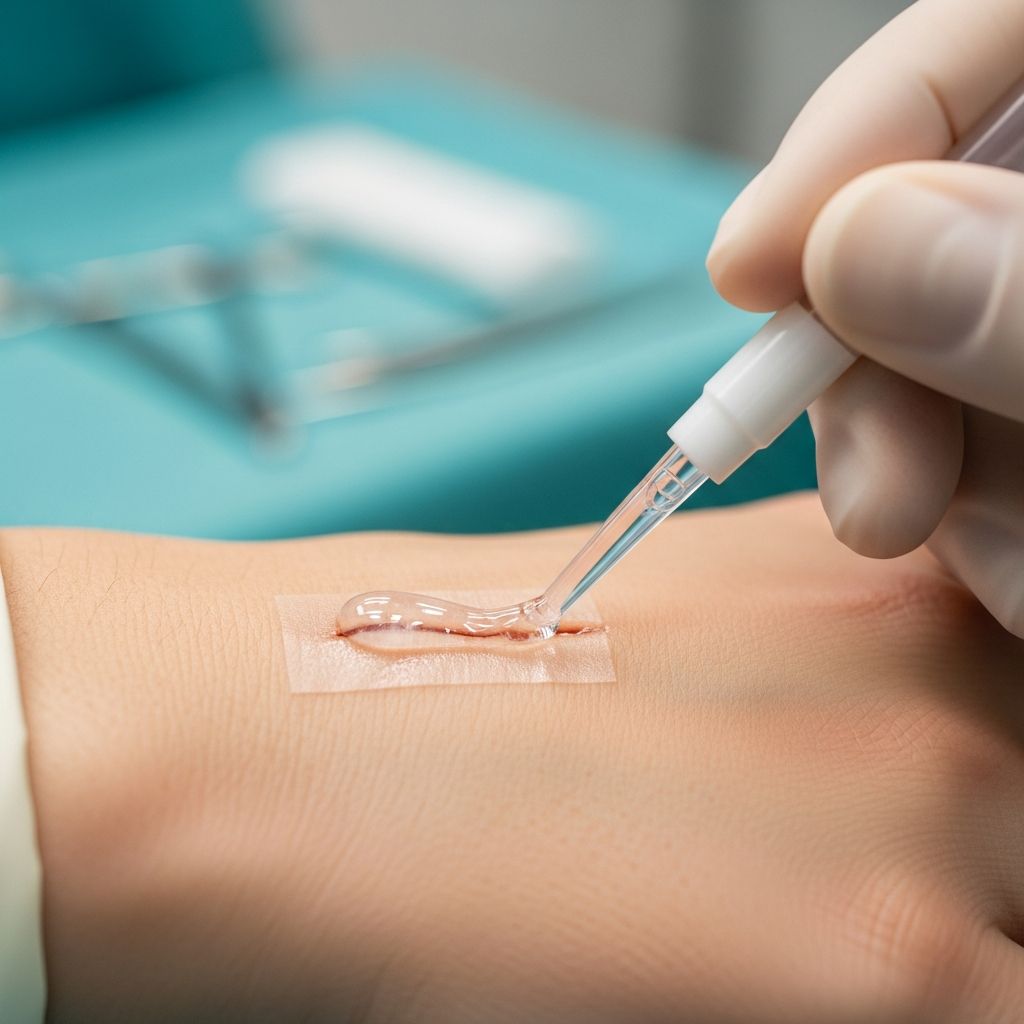
Topical skin adhesives, commonly known as medical glues, represent a revolutionary approach to wound closure in dermatology and general medicine. These liquid cyanoacrylate monomers polymerize rapidly upon contact with moisture, blood, or wound surfaces, forming long solid chains that hold wound edges together securely.
Introduction
Topical skin adhesives have transformed wound management since their introduction, providing a needle-free, suture-less option for closing superficial wounds. Unlike traditional suturing, which requires local anesthesia and follow-up removal, these glues offer immediate closure with minimal patient discomfort. They are particularly valuable in outpatient settings, pediatric care, and minor surgical procedures.
The adhesives work through anionic polymerization triggered by water molecules on the skin or in tissues. This process creates a strong, flexible film that bonds the skin edges without penetrating deeply. Common applications include lacerations from trauma, punctures from minimally invasive surgeries like hair transplantation, and skin graft donor sites.
These products are FDA-approved for specific uses and have been extensively studied for safety and efficacy, showing comparable cosmetic outcomes to sutures in many cases.
Types of Topical Skin Adhesives
Several formulations of cyanoacrylate exist, each with unique properties suited to different clinical needs. The table below summarizes the main types and their trade names:
| Type | Trade Name | Key Properties |
|---|---|---|
| 2-Octyl-cyanoacrylate | Dermabond® | More flexible, higher tensile strength (4x butyl), ideal for areas under moderate tension |
| n-2-Butyl-cyanoacrylate | Histoacryl® | Standard strength, widely used for simple lacerations |
| 2-Ethyl-cyanoacrylate | Epiglu® | Intermediate flexibility, suitable for cosmetic areas |
Octyl variants like Dermabond® are preferred for their elasticity, making them suitable for joints or mobile areas when immobilized. Butyl types provide reliable closure for low-tension sites.
How to Use Topical Skin Adhesives
Proper application ensures optimal outcomes and minimizes complications. Follow these steps meticulously:
- Preparation: Thoroughly clean and irrigate the wound with saline to remove debris. Debride jagged edges if necessary. Ensure hemostasis without excessive pressure.
- Anesthesia: Often unnecessary, but topical anesthetics can be used for sensitive areas.
- Approximation: Manually align wound edges precisely using gloved fingers or forceps. Hold edges everted under slight tension.
- Application: Apply 1-2 continuous layers of adhesive from 2-3 mm above the wound to the same distance below, rolling edges together. Avoid pooling, which can cause heat or weakness. Allow 60 seconds to polymerize before releasing.
- Post-care: Advise keeping dry for 24-48 hours (octyl variants allow brief showering). No suture removal needed.
Application is quick, often under 1 minute, and easy to learn even for novices.
Ideal Uses for Topical Skin Adhesives
These glues excel in specific scenarios:
- Simple, linear lacerations 1-4 cm long, superficial (<4-8 mm deep).
- Punctures from minimally invasive procedures (e.g., hair transplants).
- Skin graft sites and donor areas.
- Low-tension areas: forehead (29%), scalp (23%), chin (18%).
- Pediatric facial lacerations (88% suitable in one study).
- Low-tension torso/extremity wounds if immobilized.
Mean wound width in successful closures: 3.5 mm.
Wounds Not Suitable for Topical Skin Adhesives
Contraindications prevent poor outcomes:
- High-tension or mobile areas (joints, nose, mouth, eyelids unless immobilized).
- Jagged, stellate, or crush injuries.
- Bites (animal/human), punctures, infected wounds.
- Deep wounds requiring layered closure (>8 mm).
- High-infection-risk patients (diabetes, immunodeficiency).
- Bloody fields or areas needing prolonged hemostasis.
Related Stories



Benefits
Topical skin adhesives offer significant advantages:
- Painless: No needles or anesthesia injections, reducing anxiety especially in children.
- Rapid: Closure in seconds vs. minutes for sutures; saves time.
- Convenient: No follow-up for removal; bactericidal properties reduce infection risk.
- Cosmetic: Equivalent scarring to sutures at 3 months; flexible film allows natural movement.
- Cost-effective: Eliminates removal visits; high patient satisfaction.
In pediatrics, 88% of facial lacerations were closed with TSAs successfully.
Disadvantages
Despite benefits, limitations exist:
- Lower tensile strength than sutures for high-tension wounds (dehiscence risk 3-5%).
- Not for deep or complex wounds needing layered repair.
- Potential exothermic reaction (mild heat sensation).
- Exudative wounds may prevent polymerization.
- Higher cost per unit vs. sutures, though overall savings from no removal.
Side Effects
Most are mild and transient:
- Immediate: Heat, stinging, or minor discomfort during polymerization.
- Post-treatment: Erythema, swelling, tenderness (resolves 1-2 weeks).
- Rare (0.1-1%): Wound dehiscence, infection.
- Allergic: Contact dermatitis (rash, vesicles, itching) after 10+ days, especially to octyl cyanoacrylate. Clears in days to months; patch testing confirms.
Avoid eyes/mouth in infants to prevent accidental closure; use barriers if needed.
Treatment of Complications
Manage issues promptly:
- Dehiscence: Reapply adhesive or use sutures/tape.
- Infection: Antibiotics, debridement.
- Allergic reaction: Topical steroids (e.g., hydrocortisone), oral antihistamines. Severe cases: systemic steroids. Removal with acetone-soaked gauze (avoid if polymerized).
- Persistent symptoms: Consult physician if lasting >2 weeks.
Safety in animals unestablished; veterinary alternatives exist.
Frequently Asked Questions (FAQs)
Are topical skin adhesives stronger than sutures?
No, they have lower tensile strength but suffice for low-tension wounds with equivalent cosmetics.
Can I shower after application?
Octyl types allow brief showering after 24 hours; avoid soaking. Pat dry.
How long does the glue last?
5-10 days, sloughs off naturally as epithelium regenerates.
Is it safe for children?
Yes, preferred for pediatric lacerations due to less pain and no removal.
What if I’m allergic?
Rare; symptoms include rash/itching. Seek medical removal and alternatives.
Conclusion
Topical skin adhesives provide a safe, efficient closure method for select wounds, balancing speed, cosmetics, and convenience against specific limitations. Proper patient selection yields outcomes rivaling traditional methods.
References
- Topical skin adhesives — DermNet NZ. 2010 (updated). https://dermnetnz.org/topics/topical-skin-adhesives
- Topical skin adhesives for laceration repair in children — Can Fam Physician (PMC – NIH). 2021-04-01. https://pmc.ncbi.nlm.nih.gov/articles/PMC8324167/
- Topical skin adhesives image — DermNet NZ. Accessed 2026. https://dermnetnz.org/imagedetail/6909-topical-skin-adhesives
- Allergic Contact Dermatitis to Octyl Cyanoacrylate Skin Glue — SAGE Journals (Dermatology). 2023. https://journals.sagepub.com/doi/10.1089/derm.2023.0342
Similar Articles








Read full bio of medha deb