Trichilemmal Carcinoma: Diagnosis, Treatment, And Prevention
Rare hair follicle malignancy with low metastatic potential, primarily affecting sun-exposed skin in elderly patients.
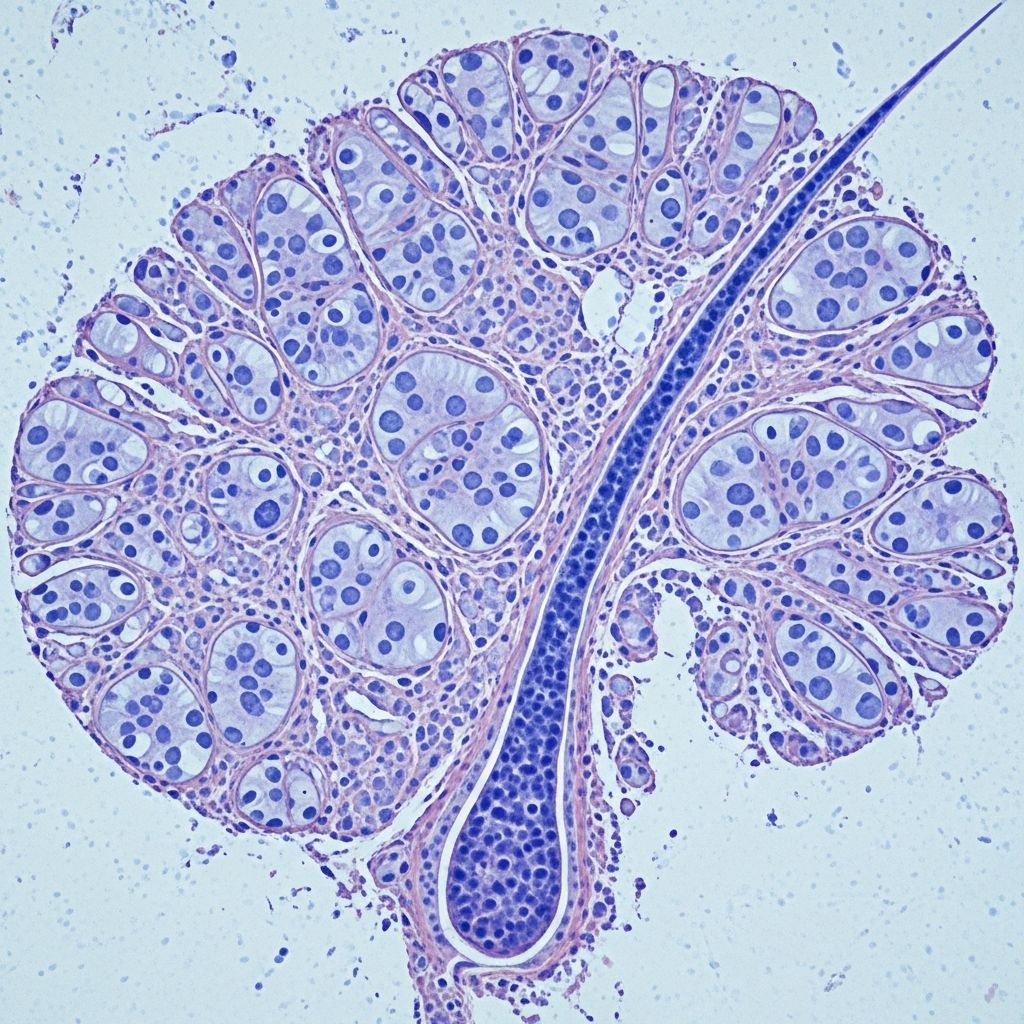
Trichilemmal carcinoma is a rare malignant hair follicle tumour arising from the outer root sheath of the hair follicle, typically on sun-exposed skin in elderly individuals. It is considered a low-grade malignancy with minimal metastatic potential despite aggressive histological features.
What is trichilemmal carcinoma?
Trichilemmal carcinoma, also known as tricholemmal carcinoma, originates from malignant transformation of a benign trichilemmoma. This adnexal neoplasm primarily affects the external root sheath cells, exhibiting clear cell morphology and palisading at lobule peripheries. It predominantly occurs in women over 40 years, with lesions on the scalp, forehead, ears, or neck—areas prone to chronic sun exposure.
Clinically, it presents as a tan or flesh-coloured papule, nodule, or wart-like exophytic growth, often asymptomatic until growth prompts concern. Lesions are usually solitary, slowly enlarging, and measure 0.5–2 cm, though larger sizes occur. Histologically aggressive features like pleomorphism and mitoses do not correlate with high metastatic risk, distinguishing it from higher-grade carcinomas.
Who gets trichilemmal carcinoma?
Elderly women represent the typical demographic, with peak incidence after age 50–70 years. Sun-exposed sites like the face (especially ears), scalp, and neck predominate, reflecting UV radiation’s role. Both genders are affected equally in some series, but female predominance is noted.
Risk factors include:
- Chronic sun exposure or actinic damage
- Previous ionizing radiation or skin trauma
- Immunosuppression
- Possible genetic predisposition, though not well-defined
Rarely, multiple lesions associate with syndromes like Cowden disease, linked to trichilemmomas.
What causes trichilemmal carcinoma?
The exact etiology remains unclear, but malignant progression from benign trichilemmoma is hypothesized. UV radiation likely drives transformation in sun-exposed skin, with histological evidence of actinic damage. Trauma or inflammation may contribute, analogous to proliferating trichilemmal cysts.
Genetic alterations in follicular keratinocyte differentiation pathways are implicated, but specific mutations are understudied due to rarity. Unlike squamous cell carcinoma, p53 overexpression is less prominent.
Clinical features
Lesions appear as firm, well-circumscribed nodules or plaques, tan to red, on actinically damaged skin. Growth is gradual, with rare ulceration or bleeding. Size varies from small papules to >5 cm in neglected cases.
Symptoms are minimal; patients often seek evaluation for cosmetic reasons or rapid change. No pruritus or pain typically. Advanced lesions may show pushing invasion without deep infiltration.
Diagnosis
Diagnosis requires skin biopsy with histopathological confirmation, as clinical features mimic benign or other malignant tumours. Incisional or excisional biopsy is ideal for full assessment.
Histology
Tumour comprises lobules of atypical clear keratinocytes with peripheral palisading and thickened basement membrane. Features include:
- Clear cell change and glycogen-rich cytoplasm
- Pleomorphism, atypical mitoses, and hyperchromasia
- Broad pushing invasion front, rarely infiltrative
- Pilar-type keratinization, subnuclear vacuoles
Immunohistochemistry: Positive for cytokeratins (CK1/5/10/14), CD34; negative for CEA, EMA, mucin.
Related Stories



Differential diagnosis
| Condition | Key Differentiators |
|---|---|
| Squamous cell carcinoma (SCC) | Greater atypia, keratin pearls, parakeratosis; CK5/6+, p63+; desmoplastic stroma absent |
| Basal cell carcinoma | Basaloid cells, peripheral retraction artifact, high mitotic rate |
| Trichilemmoma | Benign, no invasion, uniform cells |
| Proliferating trichilemmal cyst | Cystic, scalp-based, benign growth; no metastases |
| Malignant proliferating trichilemmal cyst | Large scalp nodules >5 cm, high recurrence (30%), metastases; more infiltrative |
| Cylindroma/Dermoid cyst | Ductal structures, jigsaw pattern; no clear cells |
Treatment
Complete surgical excision with 2–3 cm margins is standard, offering cure for most cases given low recurrence. Mohs micrographic surgery ensures margin control, ideal for facial lesions.
Adjunctive radiotherapy or chemotherapy is reserved for rare metastatic disease or incomplete resection. Close follow-up monitors for local recurrence (uncommon) or metastasis (<5%).
Complications
Local recurrence post-incomplete excision; rare regional lymph node or distant metastases despite histological grade. Cosmetic/functional impairment from scalp or ear lesions.
Prevention
- Sun protection: Sunscreen, hats on exposed areas
- Regular skin exams for high-risk individuals (elderly, fair skin)
- Biopsy suspicious lesions promptly
Related conditions
- Trichilemmoma: Benign precursor
- Proliferating trichilemmal cyst: Benign scalp tumour
- Malignant proliferating trichilemmal cyst: Aggressive scalp variant
- Hair follicle tumours: Trichoblastoma, pilomatrixoma
Frequently Asked Questions
Is trichilemmal carcinoma aggressive?
No, it is low-grade with rare metastasis despite histological atypia. Prognosis after excision is excellent.
Can trichilemmal carcinoma spread?
Metastases are exceptional (<5%); local recurrence is the main concern post-inadequate surgery.
How is it different from squamous cell carcinoma?
Clear cells, palisading, no keratin pearls; lower metastatic potential. Histology differentiates.
Does it relate to proliferating trichilemmal cysts?
Distinct: cysts are benign/cystic on scalp; malignant variants are larger, recurrent.
What is the best treatment?
Surgical excision with margins or Mohs surgery.
References
- Malignant proliferating trichilemmal cyst — DermNet NZ. 2023. https://dermnetnz.org/topics/malignant-proliferating-trichilemmal-cyst
- Trichilemmal carcinoma pathology — DermNet NZ. 2023. https://dermnetnz.org/topics/trichilemmal-carcinoma-pathology
- Trichilemmal carcinoma — DermNet NZ. 2023. https://dermnetnz.org/topics/trichilemmal-carcinoma
- Proliferating trichilemmal cyst — DermNet NZ. 2023. https://dermnetnz.org/topics/proliferating-trichilemmal-cyst
- The Atypical Clarification – Trichilemmal Carcinoma — Juniper Publishers (Open Access J Surg). 2023. https://juniperpublishers.com/oajs/pdf/OAJS.MS.ID.555816.pdf
Similar Articles








Read full bio of medha deb