Trichilemmoma Pathology: Diagnosis, Management & Prognosis
Comprehensive guide to the pathology, clinical features, diagnosis, and management of trichilemmoma, a benign hair follicle tumour.
Author: Dr. Harriet Cheng, Dermatopathologist, Reviewed: Dr. Ian Hayden, Dermatopathologist
- Introduction
- Clinical features
- Pathology
- Diagnosis
- Differential diagnosis
- Investigations
- Management
- Prognosis
Introduction
Trichilemmoma, also known as tricholemmoma, is a benign cutaneous tumour originating from the outer root sheath (ORS) cells of the hair follicle. These neoplasms exhibit differentiation towards the external root sheath epithelium, typically presenting as slow-growing, warty papules on the face or neck. Although usually solitary and asymptomatic, multiple trichilemmomas raise suspicion for Cowden syndrome (CS), a PTEN hamartoma tumour syndrome associated with increased malignancy risk.
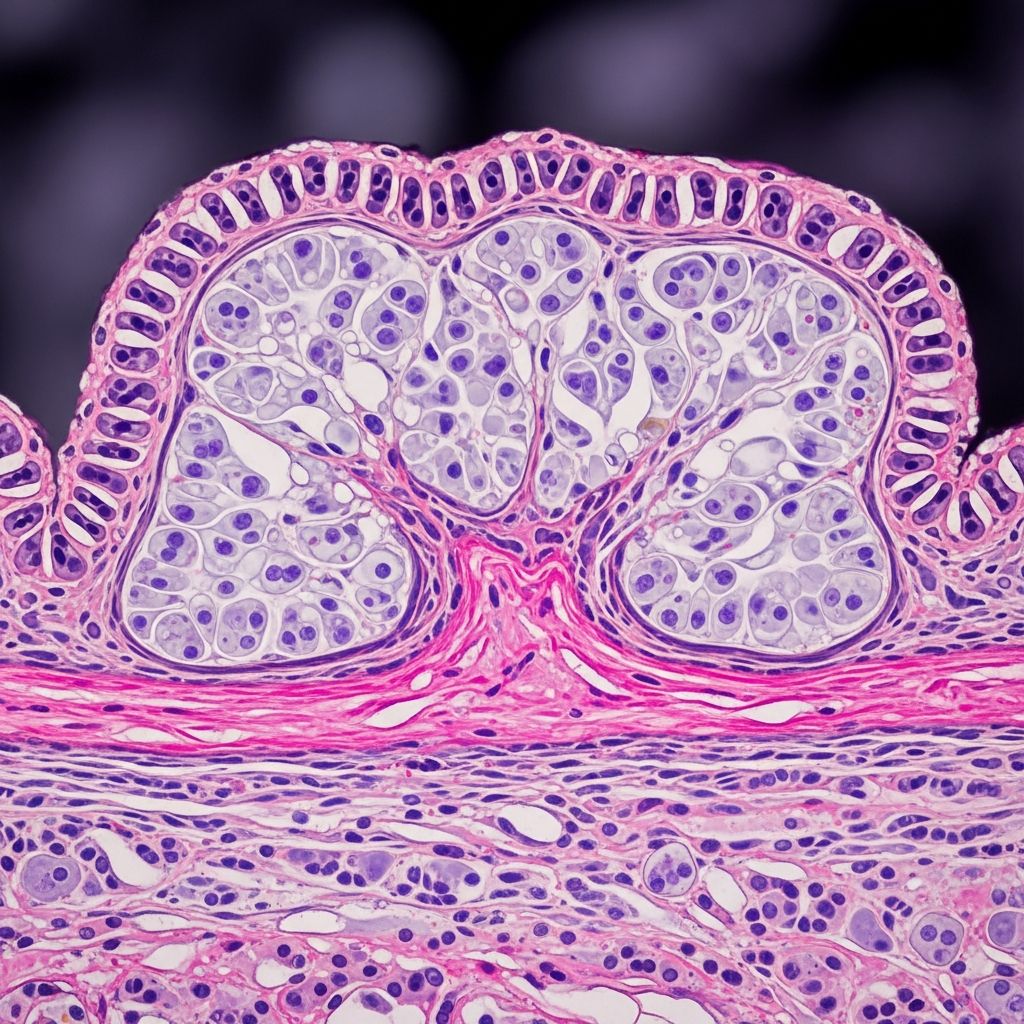
Histologically, trichilemmomas are characterized by lobular proliferations of glycogen-rich clear cells surrounded by a thick PAS-positive basement membrane, with peripheral palisading. This article provides a comprehensive review of trichilemmoma pathology, covering clinical presentation, histopathological features, diagnostic criteria, and management strategies.
Clinical features
Trichilemmomas typically manifest as solitary, skin-coloured to erythematous papules or nodules, measuring 1-5 mm in diameter, most commonly on the central face (nose, cheeks, perioral area), ears, or neck. Lesions exhibit slow, progressive growth over months to years and may develop a hyperkeratotic, verrucous, or papillomatous surface, occasionally forming small plaques or cutaneous horns.
Solitary trichilemmomas occur in older adults and are asymptomatic, though surface ulceration or pearly borders may rarely be observed. Multiple facial trichilemmomas, particularly six or more papules with three histologically confirmed, are pathognomonic for Cowden syndrome, occurring in up to 86% of CS patients. CS features multisystem hamartomas and malignancies including breast (25-50%), thyroid (3-10%), and endometrial cancers.


Pathology
Trichilemmomas present as well-circumscribed, lobular downgrowths of epidermal cells extending into the superficial dermis. Key histopathological features include:
- Lobular architecture: Tumour lobules connect broadly to the epidermis, showing papillomatous or verrucous hyperplasia with hypergranulosis.
- Clear cells: Central lobular cells display pale, glycogen-rich cytoplasm (PAS-positive, diastase-labile), contrasting with basophilic peripheral cells.
- Peripheral palisading: Small, hyperchromatic basaloid cells align at lobule edges.
- Thickened basement membrane: Eosinophilic, PAS-positive hyaline membrane encases lobules.
- Squamous eddies: Common whorled keratinizations without trichilemmal (abrupt) keratinization.
Variants include desmoplastic trichilemmoma (fibrotic stroma) and inverted follicular keratosis-like patterns. Immunohistochemistry shows diffuse CD34 positivity in clear cells, reflecting ORS differentiation, with variable S100 and cytokeratin 15 expression.


Diagnosis
Definitive diagnosis requires skin biopsy demonstrating characteristic histology: lobular clear cell proliferation with glycogen, palisading, and hyaline basement membrane. Clinical suspicion arises from warty facial papules, especially multiples prompting CS evaluation.
Special stains confirm diagnosis:
- PAS (with/without diastase): Highlights glycogen and basement membrane.
- CD34 immunohistochemistry: Positive in tumour cells.
Differential diagnosis
| Condition | Key Distinguishing Features |
|---|---|
| Basal cell carcinoma | Retractile stroma, peripheral clefting, mucin, mitotic activity; translucent pearly border clinically. |
| Seborrhoeic keratosis | Stuck-on appearance, acanthosis/horn cysts, no clear cells/glycogen. |
| Verruca vulgaris | Hypergranulosis, koilocytes, viral inclusions; HPV-positive. |
| Squamous cell carcinoma in situ | Full-thickness atypia, disordered maturation, no lobular pattern. |
| Inverted follicular keratosis | Prominent squamous eddies, less glycogen; may represent trichilemmoma variant. |
Related Stories



Investigations
Solitary trichilemmomas require no further workup beyond biopsy. Multiple lesions necessitate:
- Cowden syndrome screening: PTEN germline testing, mammography/breast MRI (women), thyroid ultrasound, endoscopy/colonoscopy, dermatologic exam for mucocutaneous lesions.
- Exclusion of associated tumours: Trichoblastoma, sebaceous adenoma (may coexist).
Up to 86% of CS patients develop facial trichilemmomas before malignancies, emphasizing early genetic evaluation.
Management
Benign solitary trichilemmomas may be observed or excised for cosmesis/diagnosis. Multiple lesions in CS context require:
- Surgical excision/shave biopsy: Conservative removal with clear margins.
- Cancer surveillance: Annual breast/thyroid/endometrial screening per NCCN guidelines.
- Chemoprevention: Consider rapamycin/NSAIDs in high-risk CS patients.
Recurrence is rare post-excision due to benign nature.
Prognosis
Trichilemmomas are entirely benign with no malignant potential. Prognosis hinges on CS association: untreated CS carries 85-100% lifetime malignancy risk (breast, thyroid, endometrial, colorectal). Early PTEN testing and surveillance improve outcomes dramatically.
Frequently Asked Questions
Q: Is trichilemmoma cancerous?
A: No, trichilemmoma is a benign tumour with no malignant potential. Multiple lesions may indicate Cowden syndrome requiring cancer screening.
Q: How is trichilemmoma diagnosed?
A: Skin biopsy showing lobular clear cell proliferation with PAS-positive glycogen and basement membrane confirms diagnosis.
Q: What causes trichilemmoma?
A: Sporadic cases lack clear aetiology; multiples arise from PTEN germline mutations in Cowden syndrome. HPV association unproven.
Q: Should multiple trichilemmomas be investigated?
A: Yes, ≥6 facial papules (≥3 histologically confirmed) warrant PTEN testing and malignancy screening.
References
- Trichilemmoma — Cutis (MDedge). 2018-10-01. https://mdedge.com/cutis/article/101892/dermatopathology/trichilemmoma
- A rare clinical presentation of Desmoplastic Trichilemmoma — PMC (NCBI). 2014-09-15. https://pmc.ncbi.nlm.nih.gov/articles/PMC4155959/
- Trichilemmoma — DermNet NZ. 2023. https://dermnetnz.org/topics/trichilemmoma
- Trichilemmoma (Tricholemmoma) — Dermatology Advisor. 2023. https://www.dermatologyadvisor.com/home/decision-support-in-medicine/dermatology/trichilemmoma-tricholemmoma/
- Definition of trichilemmoma — National Cancer Institute (cancer.gov). 2024. https://www.cancer.gov/publications/dictionaries/cancer-terms/def/trichilemmoma
- Trichilemmoma — VisualDx. 2023. https://www.visualdx.com/visualdx/diagnosis/trichilemmoma?diagnosisId=52945&moduleId=102
- Trichilemmoma — StatPearls (NCBI Bookshelf). 2023-07-17. https://www.ncbi.nlm.nih.gov/books/NBK603739/
Similar Articles








Read full bio of medha deb