Trichilemmoma: Essential Guide To Diagnosis And Management
Benign hair follicle tumour linked to Cowden syndrome: clinical features, diagnosis and management.
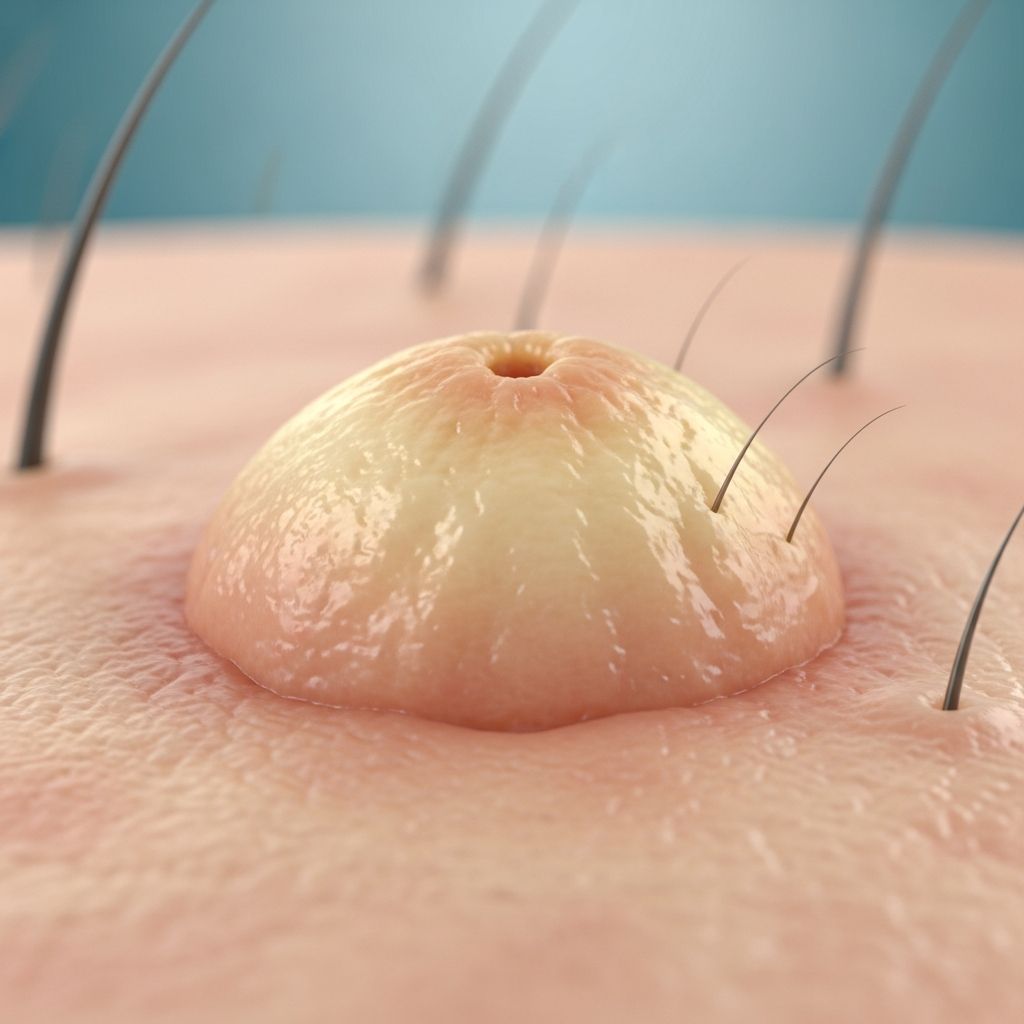
Trichilemmoma, also known as tricholemmoma, is a rare benign tumour originating from the cells of the outer root sheath of the hair follicle. These tumours exhibit differentiation towards the external root sheath epithelium and typically present as small, warty papules on the face or neck. Although usually solitary and asymptomatic, multiple trichilemmomas are a hallmark mucocutaneous feature of Cowden syndrome, a genetic condition associated with increased cancer risk.
This article explores the clinical features, histopathology, differential diagnosis, associations, and management of trichilemmoma, drawing from authoritative dermatopathology sources.
What is trichilemmoma?
Trichilemmoma is a benign neoplasm arising from the outer root sheath (ORS) of the pilosebaceous follicle unit. The ORS cells are glycogen-rich clear cells that form the protective layer around the hair shaft during its growth phase. These tumours are characterised by slow growth and a distinctive lobular architecture on histology.
They may occur sporadically or as part of genetic syndromes. Solitary lesions are common in older adults, while multiple facial papules strongly suggest Cowden syndrome (CS), an autosomal dominant disorder caused by germline mutations in the PTEN tumour suppressor gene. PTEN regulates cell growth and division; its loss leads to hamartomatous proliferations and heightened malignancy risk across multiple organ systems.
Who gets trichilemmoma?
Trichilemmoma most commonly affects adults over 40 years, with no strong gender predilection reported. Solitary lesions occur in the general population, while multiple trichilemmomas are pathognomonic for Cowden syndrome, affecting approximately 1 in 200,000 individuals.
- Sporadic cases: Older adults, often presenting with a single lesion on sun-exposed areas.
- Cowden syndrome: Onset typically in the 20s-30s; nearly all patients develop mucocutaneous lesions, including 83-86% with facial trichilemmomas.
In CS, trichilemmomas often accompany other skin findings such as oral papillomas, acral keratoses, and palmoplantar keratoses. Family history of breast, thyroid, or endometrial cancers raises suspicion for this syndrome.
What causes trichilemmoma?
The exact aetiology of sporadic trichilemmoma remains unclear, though human papillomavirus (HPV) DNA—particularly from epidermodysplasia verruciformis-associated types—has been detected in some lesions, suggesting a possible viral trigger. Chronic sun exposure may contribute to development on facial sites.
In Cowden syndrome, germline PTEN mutations disrupt phosphoinositide 3-kinase/AKT signalling, promoting uncontrolled cell proliferation and hamartoma formation. Histologically identical lesions arise due to this somatic loss of tumour suppression.
Trichilemmoma often coexists with other adnexal tumours:
- Trichoblastoma
- Sebaceous adenoma
- Lesions within sebaceous naevus
What are the clinical features of trichilemmoma?
Solitary trichilemmoma presents as a small (1-5 mm), firm, skin-coloured to pink papule with a smooth, verrucous, or keratotic surface. Lesions grow slowly over months to years and may develop a central dell, pearly border, or horn-like projection.
| Feature | Description |
|---|---|
| Size | 1-5 mm diameter, rarely >1 cm |
| Shape | Dome-shaped papule or plaque; may coalesce |
| Surface | Smooth, verrucous, hyperkeratotic, or warty |
| Colour | Skin-coloured, pink, or erythematous |
| Symptoms | Asymptomatic; rarely pruritic |
Related Stories



Common locations include the central face (nose, cheeks, lips), ears, neck, and scalp. Less frequent sites: extremities, trunk, genitals, vulva. In Cowden syndrome, patients exhibit six or more facial papules, with at least three histologically confirmed as trichilemmomas.
Diagnosis
Diagnosis requires skin biopsy for histopathological confirmation, as clinical appearance overlaps with malignant and benign mimics.
Histology
Trichilemmoma shows well-circumscribed lobular downgrowths from the epidermis into the dermis. Key features include:
- Tumour cells: Central pale/glycogen-rich clear cells (PAS-positive, diastase-labile); peripheral basophilic cells with palisading
- Stroma: Thick eosinophilic hyaline basement membrane (PAS-positive)
- Surface: Papillomatous epidermis with hypergranulosis; epidermoid keratinisation (not trichilemmal)
- Other: Squamous eddies, CD34 positivity around lobules
Desmoplastic variant features dense fibrous stroma surrounding tumour islands. Immunohistochemistry supports ORS differentiation: positive for CK15, CK10/13 (epidermoid surface).
Differential diagnosis
Clinical mimics:
- Verruca vulgaris: More irregular surface; HPV subtypes differ
- Seborrhoeic keratosis: Stuck-on appearance; lacks glycogen cells
- Basal cell carcinoma: Pearly rolled edge, telangiectasia; translucent
- Squamous cell carcinoma in situ: Erythematous plaque; full-thickness atypia
Histological distinction from clear cell acanthoma, hidroacanthoma simplex, and proliferating trichilemmal tumours relies on glycogen content, palisading, and basement membrane.
Cowden syndrome association
Multiple facial trichilemmomas are a major criterion for Cowden syndrome diagnosis (NCCN guidelines). CS confers lifetime risks: breast cancer 25-50%, thyroid 3-10%, endometrial 5-10%. Mucocutaneous lesions precede malignancies in most cases, making early recognition critical.
Screening protocol for suspected CS:
- Genetic testing for PTEN mutations
- Breast MRI/mammography (women)
- Thyroid ultrasound
- Dermatologic surveillance for skin cancers
- GI endoscopy for hamartomas
Treatment of trichilemmoma
Solitary lesions require excision only if symptomatic, cosmetically bothersome, or diagnostically uncertain. Options include:
- Shave excision or curettage: Simple, office-based
- Conservative excision: Preferred to confirm diagnosis
No role for medical therapy. In Cowden syndrome, lesions are monitored rather than routinely removed unless suspicious. Multidisciplinary cancer screening is paramount.
What is the outcome for trichilemmoma?
Trichilemmoma is entirely benign with no malignant potential. Complete excision is curative for solitary lesions, with negligible recurrence. In Cowden syndrome, prognosis depends on associated malignancy surveillance and early detection. Regular follow-up improves outcomes significantly.
FAQ
Is trichilemmoma cancerous?
No, trichilemmoma is a benign tumour with no propensity for malignant transformation.
Does multiple trichilemmoma mean I have Cowden syndrome?
Six or more facial papules (≥3 histologically confirmed trichilemmomas) is pathognomonic for CS; genetic counselling is recommended.
How is trichilemmoma diagnosed?
Skin biopsy showing lobular architecture, glycogen-rich cells, palisading, and thick basement membrane.
Can trichilemmoma be treated without surgery?
Asymptomatic lesions can be observed; excision is for cosmetic or diagnostic purposes.
What cancers are linked to Cowden syndrome?
Breast (25-50%), thyroid (3-10%), endometrial (5-10%), colorectal, and others.
References
- Trichilemmoma — MDedge Cutis. 2019-10-01. https://mdedge.com/cutis/article/101892/dermatopathology/trichilemmoma
- A rare clinical presentation of Desmoplastic Trichilemmoma — PMC (NCBI). 2014-09-15. https://pmc.ncbi.nlm.nih.gov/articles/PMC4155959/
- Trichilemmoma — DermNet NZ. 2023-01-01. https://dermnetnz.org/topics/trichilemmoma
- Trichilemmoma (Tricholemmoma) — Dermatology Advisor. 2024-06-15. https://www.dermatologyadvisor.com/home/decision-support-in-medicine/dermatology/trichilemmoma-tricholemmoma/
- Definition of trichilemmoma — National Cancer Institute (cancer.gov). 2025-01-01. https://www.cancer.gov/publications/dictionaries/cancer-terms/def/trichilemmoma
- Trichilemmoma — VisualDx. 2024-01-01. https://www.visualdx.com/visualdx/diagnosis/trichilemmoma?diagnosisId=52945&moduleId=102
- Trichilemmoma — StatPearls (NCBI Bookshelf). 2024-11-15. https://www.ncbi.nlm.nih.gov/books/NBK603739/
Similar Articles








Read full bio of Sneha Tete