Trichoadenoma Pathology: Essential Histology Guide For Clinicians
Comprehensive guide to the pathology, clinical features, diagnosis, and management of trichoadenoma, a rare benign hair follicle tumour.
Trichoadenoma is a rare benign tumour showing follicular differentiation towards the infundibulum of the hair follicle. It typically presents as a solitary, skin-coloured to greyish nodule, most commonly on the face, and is diagnosed through characteristic histopathological features.
Introduction
Trichoadenoma, first described by Nikolowski in 1958, represents a distinctive benign adnexal neoplasm originating from the infundibular portion of the pilosebaceous unit. This slow-growing tumour is asymptomatic and often overlooked clinically due to its non-specific appearance resembling common lesions like seborrheic keratosis or basal cell carcinoma. Histologically, it is defined by numerous infundibulocystic structures filled with laminated keratin, lacking mature hair shaft formation, distinguishing it from related follicular tumours such as trichofolliculoma and trichoepithelioma.
The lesion measures typically 0.5–1.5 cm in diameter and exhibits a well-circumscribed dermal mass composed of epithelial strands, islands, and cysts lined by squamous epithelium resembling the infundibulum. While most cases occur in adults with a mean age of 43 years, paediatric presentations have been documented, highlighting its occurrence across age groups without sex predilection. Awareness of atypical sites including the vulva, neck, thigh, and penile shaft is crucial for accurate diagnosis.
Clinical features
Trichoadenoma manifests as a solitary, firm, skin-coloured or greyish-white papule or nodule, often with a scaly or warty surface mimicking seborrheic keratosis. Common locations include the central face (57.5% of cases), particularly the nose, cheek, and forehead, followed by the buttocks (24%). Less frequent sites encompass the trunk, extremities, and anogenital region, with rare reports on the vulva, upper arm, shoulder, thigh, and penile shaft.
- Size: Usually 5–15 mm diameter, rarely exceeding 2 cm.
- Surface: Smooth, verrucous, or eroded; may discharge chronically if cystic.
- Duration: Slow-growing over months to years; asymptomatic unless traumatized.
- Associations: Typically sporadic; no syndromic links established unlike trichoepithelioma in Brooke-Spiegler syndrome.
Multiple lesions are exceptional and may suggest diagnostic overlap with folliculosebaceous cystic hamartoma or other adnexal proliferations. Dermoscopy may reveal comedo-like openings or keratin pseudocysts, but lacks specificity.
Pathology
Microscopic features
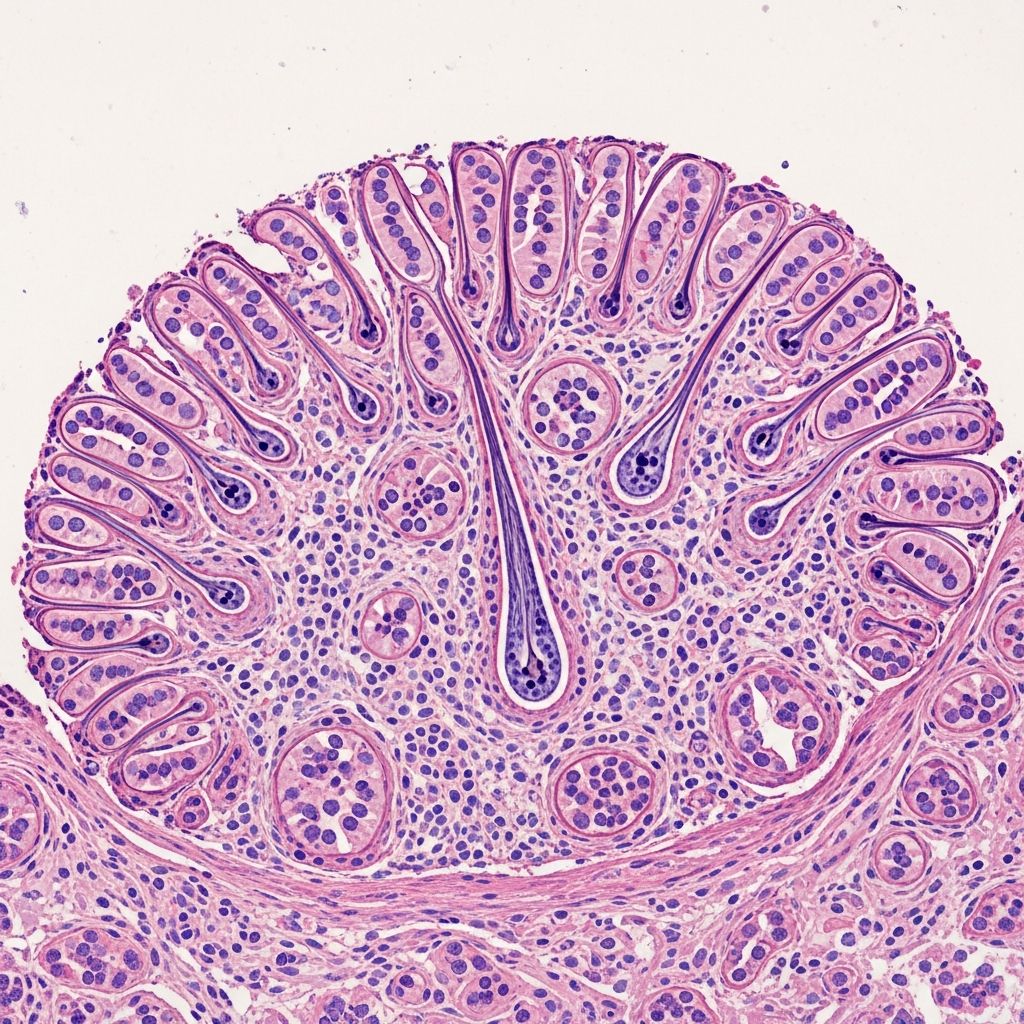
Low-power examination reveals a well-defined, symmetrical dermal nodule extending from the superficial to mid-reticular dermis, sparing the epidermis. The tumour comprises:
- Numerous infundibulocystic structures (keratinous cysts) distributed uniformly throughout the lesion, containing laminated orthokeratin without hair shafts.
- Epithelial islands and strands of eosinophilic squamous cells radiating from cysts, forming a lace-like pattern.
- Stroma: Fibrotic, hyalinized, or mucinous, encasing epithelial elements without clefting.
Cyst walls are lined by stratified squamous epithelium identical to infundibular epidermis, featuring granular layer and keratohyaline granules. Peripheral palisading is absent, and no mitotic activity or atypia is observed. Cyst rupture may induce granulomatous inflammation with foreign body giant cells and calcification. Higher magnification highlights eosinophilic cells resembling those in trichoepithelioma, but lacking basaloid morphology or retraction artefacts.
Cytological features
Epithelial cells display abundant eosinophilic cytoplasm, oval nuclei, and minimal pleomorphism. Keratin debris within cysts provokes no significant desmoplastic response unless ruptured. Absence of matrical cells, shadow cells, or trichohyalin granules differentiates it from pilomatricoma.
Histopathology images
(Images would depict: scanning magnification of dermal nodule; intermediate view of cysts and epithelial cords; high-power of infundibular lining and laminated keratin.)
- Figure 1: Low-power view showing well-circumscribed dermal mass with uniform cysts.
- Figure 2: Epithelial strands interconnecting infundibulocystic structures amid fibrotic stroma.
- Figure 3: Cyst lined by eosinophilic squamous epithelium containing laminated keratin.
Immunohistochemistry
Trichoadenoma exhibits an infundibular immunoprofile:
| Marker | Pattern | Significance |
|---|---|---|
| AE15 (infundibular) | Strong positivity in cyst lining | Confirms infundibular differentiation |
| CK10 | Suprabasal expression | Maturation towards epidermis |
| CK17 | Peripheral cells | Follicular sheath origin |
| p63 | Basal/myoepithelial | Reserve cells present |
| Factor XIIIa | Stromal positivity | Discriminates from sebaceous lesions |
Related Stories



Negativity for BerEP4, EMA, and GCDFP-15 excludes microcystic adnexal carcinoma and sebaceous differentiation. Ki67 proliferation index remains low (<5%), affirming benignity.
Differential diagnosis
Histological mimics require careful distinction:
| Diagnosis | Key Discriminating Features |
|---|---|
| Trichoepithelioma | Basaloid islands, hair germs, fibroblastic stroma; fewer cysts |
| Trichofolliculoma | Central hair follicle with radiating secondary follicles; vellus hairs |
| Desmoplastic trichoepithelioma | Thin cords in dense stroma, horn cysts rare; CK20-negative |
| Epidermoid cyst | Single large cyst, epidermal connection; no epithelial proliferation |
| Dilated pore of Winer | Sinuous epidermal invagination, parakeratosis; surface pit |
| Microcystic adnexal carcinoma | Infiltrative growth, perineural invasion, atypia; BerEP4+ |
Clinical correlation and deep biopsies aid resolution, as superficial sampling may mimic cyst or keratosis.
Management
Complete surgical excision suffices, with negligible recurrence risk. Mohs micrographic surgery is reserved for recurrent or high-risk sites. Observation suits asymptomatic, non-cosmetically significant lesions, though biopsy confirms diagnosis. No malignant potential is reported.
- Excisional biopsy: Preferred for diagnosis and cure.
- Shave excision: Cosmetic removal if superficial.
- Follow-up: Annual if multiple lesions or syndromic concern.
Frequently asked questions
Q: Is trichoadenoma cancerous?
A: No, trichoadenoma is entirely benign with no reported malignant transformation.
Q: What causes trichoadenoma?
A: The aetiology is unknown; likely hamartomatous malformation or neoplasm of infundibular keratinocytes.
Q: Can trichoadenoma recur?
A: Recurrence is rare post-complete excision; incomplete removal may lead to regrowth.
Q: How is trichoadenoma diagnosed?
A: Primarily by histopathology; clinical suspicion prompts biopsy.
Q: Does trichoadenoma require treatment?
A: Only if symptomatic, enlarging, or cosmetic concern; excision is curative.
References
- Trichoadenoma of Nikolowski- A Rare Tumour with Unusual Presentation Over Vulva — Nikam BP et al. Journal of Clinical and Diagnostic Research. 2017-02-01. https://pmc.ncbi.nlm.nih.gov/articles/PMC5324421/
- Trichoadenoma pathology image — DermNet NZ. Accessed 2026. https://dermnetnz.org/imagedetail/18714-trichoadenoma-pathology
- Trichoadenoma — Pampena R. Taylor & Francis (book chapter). 2018. https://www.taylorfrancis.com/chapters/edit/10.1201/9781315100555-15/trichoadenoma-riccardo-pampena
- Hair Follicle Neoplasms – Trichoadenoma — Perri Dermatology. 2011-07-02. https://perridermatology.com/dr-perris-blog/hair-follicle-neoplasms-trichoadenoma/
- Hair follicle tumours — DermNet NZ. Accessed 2026. https://dermnetnz.org/topics/hair-follicle-tumours
- Trichoadenoma: 5-Minute Pathology Pearls — YouTube (educational video). Accessed 2026. https://www.youtube.com/watch?v=Gyxt5NyX8Ss
Similar Articles








Read full bio of medha deb