Trichoblastic Carcinoma: Rare Hair Follicle Malignancy
Understanding trichoblastic carcinoma: a rare but aggressive hair follicle malignancy requiring specialized diagnosis and treatment.
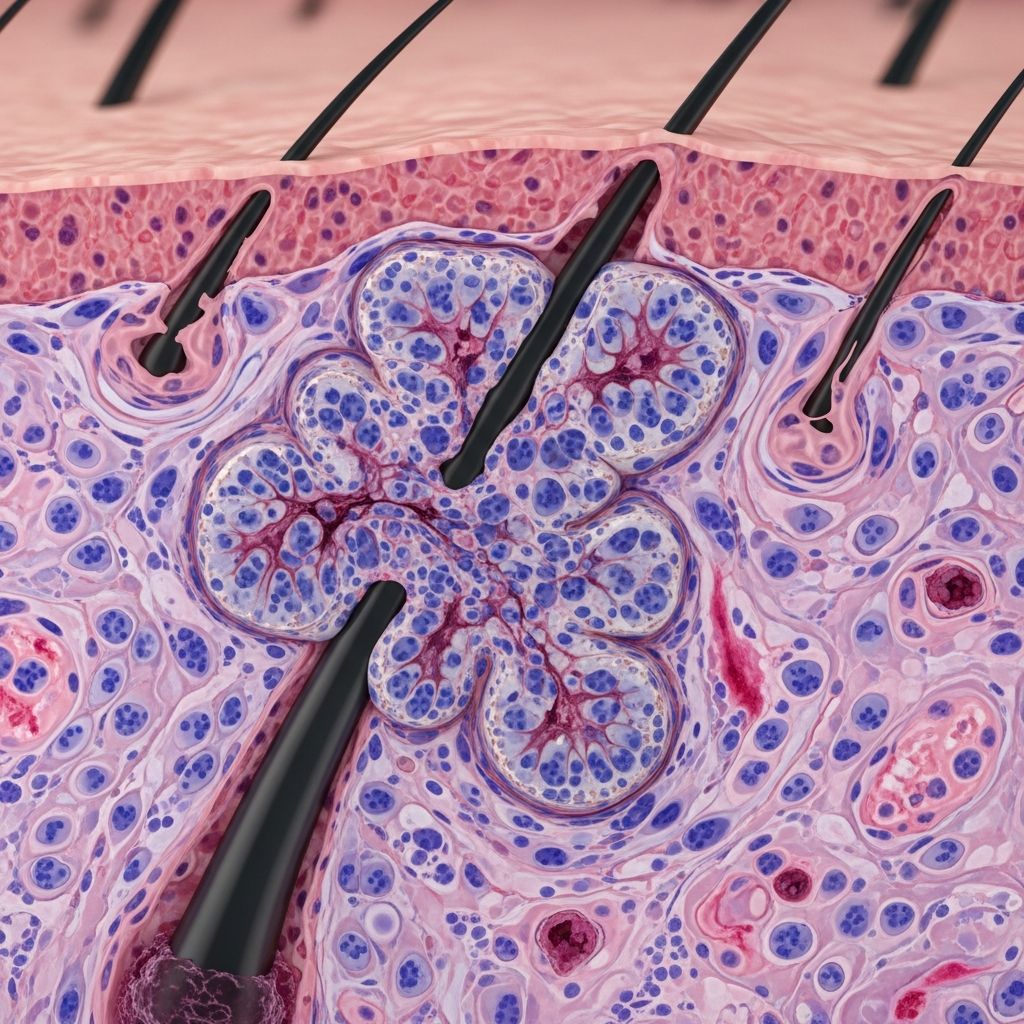
What is Trichoblastic Carcinoma?
Trichoblastic carcinoma is a rare hair follicle tumor that is thought to occur from a malignant transformation of a benign trichoblastoma. This uncommon malignancy arises from follicular germinative cells and develops dermal or subcutaneous fat invasion. With fewer than 105 previously published cases, trichoblastic carcinoma represents an exceptionally rare entity in dermatologic oncology. The tumor has the potential to be highly aggressive, with a significant capacity for metastasis, making it distinct from more common skin malignancies like basal cell carcinoma.
The transformation from benign trichoblastoma to malignant carcinoma typically occurs after years or decades of the lesion remaining stable. In documented cases, the primary trichoblastoma lesion presented as a painless mass that grew slowly over extended periods. Remarkably, in one reported instance, a tumor had remained present and unchanged for as long as 40 years before suddenly enlarging, becoming inflamed, and causing pain. This delayed malignant transformation underscores the importance of monitoring benign hair follicle tumors and considering surgical management to prevent potential progression.
Clinical Presentation and Epidemiology
Trichoblastic carcinoma most commonly presents on the face and scalp, with the face being the primary site in 48.4% of cases. The tumor typically affects middle-aged to older individuals, with lesions most frequently found in adults around 40-50 years of age. The condition shows a slight female predominance in high-grade presentations, with a 3:1 ratio reported in certain case series.
Clinically, trichoblastic carcinoma typically manifests as a single nodular lesion that may be smooth or ulcerated. Patients often report a long-standing history of a slowly growing lesion, frequently located on cosmetically sensitive areas such as the face and scalp. Recent changes in an established lesion—including sudden growth acceleration, inflammation, bleeding, or pain—may signal malignant transformation. The characteristic presentation as a firm, rubbery nodule with potential for ulceration helps distinguish it from other benign skin lesions during initial clinical assessment.
Importantly, in the majority of documented cases (87.1%), trichoblastic carcinoma develops de novo rather than from a pre-existing benign trichoblastoma. However, in instances where the original trichoblastoma has been excised, a recurring lesion with high metastatic potential may develop at the same site years later. This recurrence pattern necessitates careful long-term follow-up of patients with excised trichoblastomas.
Etiology and Risk Factors
The pathogenesis of trichoblastic carcinoma is considered multifactorial, involving several interconnected mechanisms. Key contributing factors include ultraviolet (UV) radiation exposure, chronic skin irritation, and specific genetic mutations that induce malignant transformation of germinative cells within a pre-existing trichoblastoma. The primary genetic alterations implicated in the development of trichoblastic carcinoma involve mutations in the TP53, Wnt, and β-catenin genes. These mutations disrupt normal cell cycle regulation and cellular differentiation pathways, leading to uncontrolled proliferation of follicular germinative cells.
The cumulative nature of these risk factors suggests that trichoblastic carcinoma develops through a multi-hit model of carcinogenesis. Individuals with significant sun exposure, particularly those living in sunny climates or with occupational UV exposure, may face elevated risk. Additionally, those with pre-existing benign trichoblastomas should be counseled regarding the potential for malignant transformation and the importance of surveillance or preventive surgical intervention.
Histopathological Features and Diagnosis
Skin biopsy is the only definitive method for diagnosing trichoblastic carcinoma. Ideally, the entire tumor should be excised and submitted for comprehensive histological examination. The histological features of trichoblastic carcinoma are highly distinctive yet can superficially resemble basal cell carcinoma, necessitating careful microscopic analysis for accurate diagnosis.
Microscopically, trichoblastic carcinoma is characterized by several key features:
- Basaloid islands or sheets of cells arranged in poorly defined clusters within the dermis
- Infiltration of neoplastic cells into a fibroblastic stroma
- High nuclear-to-cytoplasmic ratio with back-to-back crowding of cells
- Heterogeneity in nuclear size and shape (nuclear pleomorphism)
- Lack of peripheral palisading, distinguishing it from basal cell carcinoma
- Lack of keratinization
- Central comedo-type necrosis
- Conspicuous mitotic activity with high mitotic index
- Deep, infiltrative growth patterns without well-developed epidermal connection
A particularly useful diagnostic clue is the presence of areas of benign-appearing trichoblastoma merging with malignant areas, often referred to as the “collision” appearance. This transition from benign to malignant components helps pathologists recognize the malignant transformation and confirm the diagnosis.
Differential Diagnosis
Accurate diagnosis of trichoblastic carcinoma is crucial because it differs significantly in behavior and prognosis from morphologically similar lesions. The primary differential diagnoses include basal cell carcinoma, benign trichoblastoma, trichilemmal carcinoma, and malignant pilomatricoma.
Trichoblastic Carcinoma vs. Basal Cell Carcinoma: This is the most clinically important distinction, as basal cell carcinoma rarely metastasizes and becomes life-threatening, whereas trichoblastic carcinoma can be aggressive and potentially fatal. Key histological differences include the absence of peripheral palisading in trichoblastic carcinoma, lack of keratinization, marked nuclear pleomorphism, presence of necrosis, and conspicuous mitotic figures.
Trichoblastic Carcinoma vs. Benign Trichoblastoma: The malignant variant can be distinguished by the presence of necrosis, cytologic atypia, and a brisk mitotic index, features absent in benign trichoblastoma.
Trichoblastic Carcinoma vs. Trichilemmal Carcinoma: Trichilemmal carcinoma presents with clear and polygonal neoplastic cells with peripheral palisading of cylindric cells, features not observed in trichoblastic carcinoma.
Trichoblastic Carcinoma vs. Malignant Pilomatricoma: Malignant pilomatricoma typically demonstrates marked pleomorphism, infiltrative growth pattern, and characteristic “ghost cells” resulting from aberrant keratinization.
Treatment Approaches
Complete surgical excision with a margin of normal tissue remains the primary and most effective treatment for trichoblastic carcinoma. Current literature recommends surgical resection to obtain clear margins, with adjuvant radiation or chemotherapy reserved for metastatic or unresectable tumors.
Mohs Micrographic Surgery (MMS): Mohs micrographic surgery has emerged as a particularly valuable treatment option for trichoblastic carcinoma. This technique offers superior margin control compared to conventional wide local excision (WLE), which frequently results in positive margins. MMS is particularly advantageous for tumors located in cosmetically sensitive areas such as the face and scalp, where tissue preservation is important. The systematic assessment of margins during MMS allows surgeons to ensure complete tumor removal while minimizing damage to surrounding normal tissue.
Conventional Wide Local Excision: While standard surgical excision can be curative, WLE of trichoblastic carcinoma frequently results in positive margins, necessitating re-excision or additional treatment. For this reason, MMS is now recommended as a strong consideration for treatment, particularly given the tumor’s contiguous nature and distinct appearance on histological examination.
Adjuvant Therapies: Additional radiotherapy and/or chemotherapy may be employed to treat metastases and for locally aggressive tumors. However, the lack of standardized management guidelines means that treatment decisions should be individualized and made in consultation with a multidisciplinary tumor board.
Emerging Therapeutic Options: Targeted treatments and immunotherapy have shown potential in select cases, though further research is needed to define their optimal role in trichoblastic carcinoma management.
Prognosis and Clinical Outcomes
Information regarding the long-term prognosis of trichoblastic carcinoma remains limited due to the rarity of the condition. However, several important prognostic considerations have emerged from case series and systematic reviews.
In most documented cases (82.8%), patients were successfully treated with surgery alone. However, a subset of patients experienced more aggressive disease, including local progression or recurrence in 5 cases, nodal metastases in 5 cases, and distant metastases in 3 cases within reported literature. The lymph node metastasis rate exceeds 5%, which is substantially higher than that of basal cell carcinoma, underscoring the aggressive potential of this malignancy.
When the tumor is diagnosed early and completely excised with clear margins, the prognosis can be favorable, with complete surgical excision potentially being curative. However, prognosis can be poor in cases of metastatic disease, particularly in immunocompromised patients. The propensity for trichoblastic carcinoma to arise and expand deeply in the dermis suggests it may have a more aggressive course than basal cell carcinoma.
Recent evidence from high-grade trichoblastic carcinoma cases suggests the tumors may be less aggressive than previously anticipated, with all patients in one case series remaining alive with no evidence of recurrence or metastasis following complete excision after a median follow-up of 96 months. This favorable outcome emphasizes the importance of early diagnosis and complete surgical treatment.
Recommended Clinical Management
Given the rarity of trichoblastic carcinoma and the absence of National Comprehensive Cancer Network guidelines, comprehensive management is essential. The following approach is recommended:
- Perform complete clinical examination and obtain high-quality biopsy for definitive diagnosis
- Conduct PET/CT imaging to assess for occult metastatic disease
- Refer to surgical oncology for specialized treatment planning
- Discuss the case at a multidisciplinary tumor board involving dermatology, surgical oncology, pathology, and other relevant specialists
- Consider Mohs micrographic surgery for primary tumor treatment, particularly for lesions on the face or scalp
- Ensure adequate margins and complete histological examination of excised tissue
- Implement long-term surveillance for recurrence and metastatic disease
- Consider adjuvant radiation or chemotherapy for aggressive or incompletely excised tumors
Frequently Asked Questions
Q: What is the difference between trichoblastoma and trichoblastic carcinoma?
A: Trichoblastoma is a benign hair follicle tumor, while trichoblastic carcinoma is its malignant counterpart. Trichoblastic carcinoma can develop from malignant transformation of a pre-existing trichoblastoma, though in most cases (87.1%) it develops de novo. The malignant form has the capacity to metastasize and cause death, whereas benign trichoblastoma does not.
Q: Why is it important to distinguish trichoblastic carcinoma from basal cell carcinoma?
A: This distinction is critical because basal cell carcinoma rarely metastasizes and becomes life-threatening, while trichoblastic carcinoma can be aggressive and potentially fatal. The treatment approaches and follow-up protocols differ significantly, making accurate diagnosis essential for appropriate patient management.
Q: What is Mohs micrographic surgery and why is it preferred for trichoblastic carcinoma?
A: Mohs micrographic surgery is a specialized surgical technique that allows real-time microscopic examination of tissue margins during tumor removal. It is preferred for trichoblastic carcinoma because conventional wide local excision frequently results in positive margins. MMS offers superior margin control and is particularly valuable for cosmetically sensitive areas like the face and scalp.
Q: What is the metastatic potential of trichoblastic carcinoma?
A: Trichoblastic carcinoma has significant metastatic potential, with lymph node metastasis rates exceeding 5%. Documented cases have shown nodal metastases in 5 cases and distant metastases in 3 cases within the published literature, though the majority of patients (82.8%) are successfully treated with surgery alone.
Q: How long can trichoblastoma remain stable before malignant transformation?
A: Trichoblastomas can remain benign and unchanged for extended periods. In one documented case, a trichoblastoma remained stable for 40 years before suddenly enlarging and becoming inflamed. This extended latency period underscores the importance of monitoring these lesions and considering surgical management.
Q: What imaging studies are recommended for newly diagnosed trichoblastic carcinoma?
A: PET/CT imaging is recommended to assess for occult metastatic disease in patients with newly diagnosed trichoblastic carcinoma. This comprehensive imaging evaluation helps determine disease stage and guides treatment planning.
References
- Mohs micrographic surgery for the treatment of trichoblastic carcinoma — National Center for Biotechnology Information (NCBI). 2024. https://pmc.ncbi.nlm.nih.gov/articles/PMC12800429/
- Trichoblastic carcinoma: a systematic review of an aggressive adnexal tumor — PubMed. 2024. https://pubmed.ncbi.nlm.nih.gov/40413695/
- Trichoblastic carcinoma — DermNet New Zealand. 2024. https://dermnetnz.org/topics/trichoblastic-carcinoma
- Trichoblastic Carcinoma — Plastic Surgery Key. 2024. https://plasticsurgerykey.com/trichoblastic-carcinoma/
- Trichoblastic carcinoma: a comprehensive review of the literature — PubMed. 2021. https://pubmed.ncbi.nlm.nih.gov/33993349/
- Morphologically high-grade trichoblastic carcinoma: a case series — Wiley Online Library. 2024. https://onlinelibrary.wiley.com/doi/abs/10.1111/his.14325
Similar Articles








Read full bio of Sneha Tete