Trichoepithelioma: Benign Hair Follicle Tumors
Understanding trichoepitheliomas: rare benign skin tumors arising from hair follicles.
Introduction
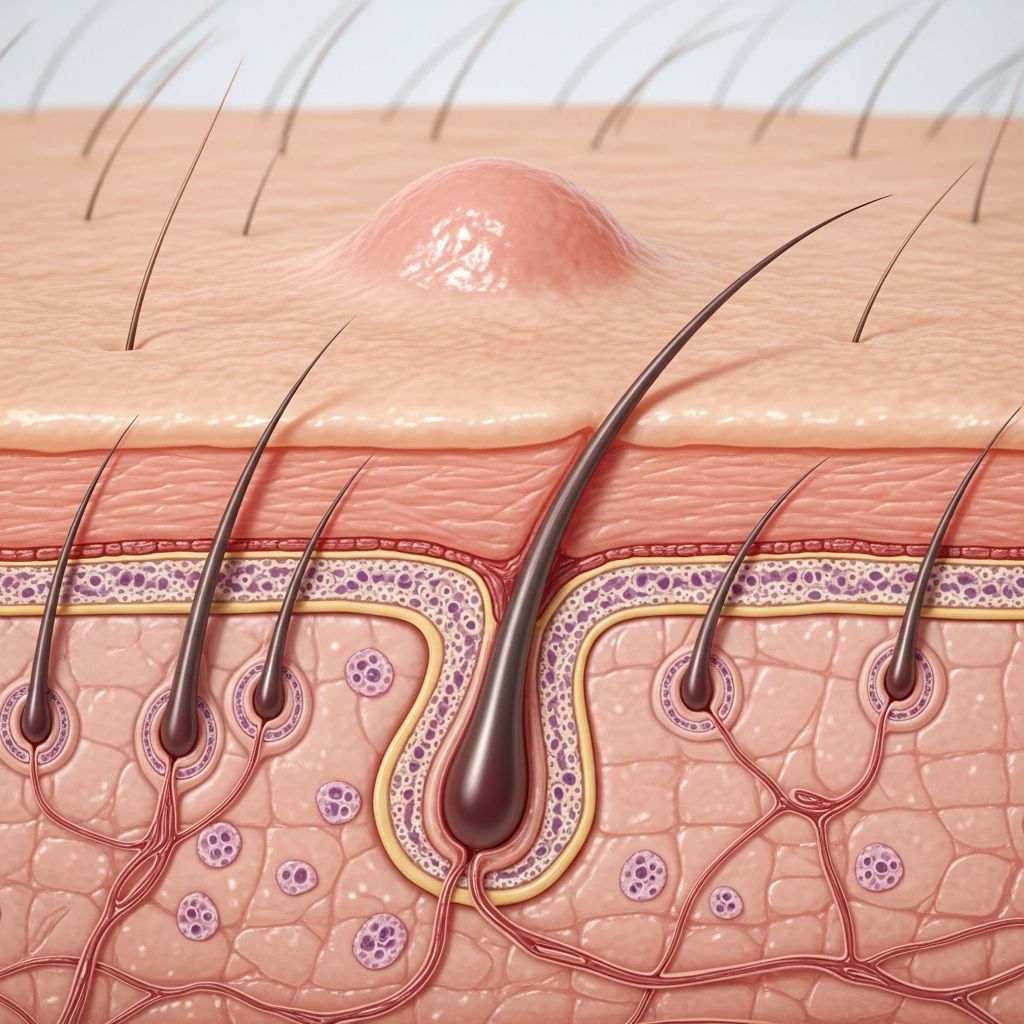
Trichoepithelioma is a rare benign skin neoplasm that arises from hair follicles. It is classified as a benign adnexal tumor and most commonly appears as either a solitary lesion or multiple nodules on the face. These growths are entirely non-cancerous and do not cause ulceration or itching, making them generally considered harmless from a medical perspective. However, the cosmetic appearance often prompts patients to seek treatment, particularly when lesions develop in visible areas of the face.
Unlike other skin conditions that present with pain or functional impairment, trichoepitheliomas are primarily a cosmetic concern. Most people with trichoepithelioma experience no physical symptoms beyond the visible growth, and the tumors typically don’t cause itching, pain, or discharge.
Demographics and Epidemiology
Trichoepitheliomas are benign tumors of follicular origin that often appear in childhood or early adolescence. While the exact prevalence is unknown, studies from dermatopathology laboratories provide insight into their frequency. A dermatopathology laboratory in the United States found 2.14 to 2.75 cases of trichoepithelioma out of 9,000 biopsies per year, indicating they represent a relatively rare finding in clinical practice.
These lesions can develop in any age group but are particularly common when they present as multiple familial forms, which are usually inherited. Single lesions may occur sporadically without a family history component.
Causes and Risk Factors
Trichoepitheliomas develop from the cells of hair follicles and are part of a larger family of skin tumors called follicular tumors. These originate from the structures in your skin responsible for hair growth. While the exact etiology remains not fully understood, the genetic component is significant for multiple familial trichoepitheliomas and related syndromes.
Multiple trichoepitheliomas are usually inherited, suggesting a genetic predisposition for these lesions. Patients with multiple-familial trichoepitheliomas may have a hereditary pattern of inheritance, and some cases are associated with Brooke-Spiegler syndrome, a condition that features the triad of trichoepitheliomas, cylindromas, and spiradenomas.
Clinical Features and Presentation
Appearance and Morphology
Trichoepitheliomas are typically small tumors, usually 1 cm in diameter, presenting as firm, round, flesh-colored papules. Clinically, they present as small, firm, papulonodular lesions of normal or translucent color, sometimes covered with telangiectasias (small dilated blood vessels). The lesions gradually increase in size and then stabilize, typically not growing beyond certain dimensions.
These tumors can be pink-blue in color with a symmetrical distribution. Most people with trichoepithelioma experience no physical symptoms beyond the visible growth, making them asymptomatic in terms of sensation and function.
Anatomical Distribution
While trichoepitheliomas most commonly appear on the face, they can develop in various locations on the body. The characteristic sites include:
- Face (most common location)
- Nasolabial folds
- Upper lip
- Nose
- Eyelids and periorbital region
- Forehead
- Cheeks and chin
- Scalp and neck
- Upper torso
- External auditory canal (in some cases)
Patients with multiple-familial trichoepitheliomas or Brooke-Spiegler syndrome have trichoepitheliomas predominantly in the nasolabial folds, but lesions can also be found on the nose, forehead, upper lip, external auditory canal, periorbital region, and sometimes on the scalp, neck, and upper trunk.
Related Stories



Growth Pattern
The growth pattern of trichoepitheliomas is characteristically slow and self-limited. The lesions gradually increase in size during a growth phase and then stabilize. This growth pattern differs from more aggressive skin lesions and contributes to their benign classification. Size range typically varies from a few millimeters to 2 centimeters in diameter.
Variations in Skin Types
While most documented cases of trichoepithelioma appear in individuals with lighter skin types, these lesions can affect individuals of various skin types. The visual presentation may vary slightly depending on skin tone, with lesions appearing more prominent or less visible depending on the individual’s natural complexion. However, the underlying pathophysiology remains consistent across different skin types.
Complications and Associated Conditions
Trichoepitheliomas do not cause ulceration or itching and are generally considered harmless. Unlike some skin conditions, they do not lead to secondary infections or serious complications. However, patients may develop complications related to cosmetic concerns and psychological impact if multiple lesions are present in visible areas.
In cases of Brooke-Spiegler syndrome, trichoepitheliomas may coexist with other adnexal tumors:
- Cylindromas: Typically found on the scalp as nodules ranging 0.5-6 cm in size
- Spiradenomas: Can be painful and have a bluish appearance
The presence of these associated lesions may complicate the clinical presentation and require comprehensive management strategies.
Diagnosis
Clinical Examination
Characteristic findings on physical examination include small pearly skin-colored papules or nodules that are generally less than 2 cm in size. Trichoepitheliomas are typically found on the face, but can also be found on other sites such as the neck. The appearance is often distinctive enough to raise clinical suspicion, particularly when multiple lesions are present with a characteristic distribution.
Histological Examination
A histological examination of trichoepithelioma confirms the diagnosis. It shows a well-defined lesion comprising epithelial bands and small cords of basophilic cells, often centered or terminated by horny cysts forming the characteristic “tadpole tail” appearance. The basaloid cells may assume a palisade arrangement around the periphery of the lobules and islets. The perilesional stroma is dense and fibrous.
Trichoepitheliomas mostly present papillary-mesenchymal bodies, granulomas, and calcification, while basal cell carcinoma is more likely to present inflammation, retraction, a higher frequency of apoptotic cells, and mitotic figures.
Immunohistochemical Markers
Several immunohistochemical markers help differentiate trichoepitheliomas from similar-appearing lesions, particularly basal cell carcinoma (BCC):
- CD10 expression: Mainly in the peritumoral stroma in trichoepitheliomas, while basal cell carcinoma has staining of the basaloid cells
- CD34: Expressed in all cases of trichoepithelioma, but staining is negative in cases of basal cell carcinoma
- Bcl-2: Limited to the periphery of tumor nests in trichoepitheliomas, while there is diffuse staining throughout the tumor nests in basal cell carcinoma
Differential Diagnosis
Trichoepitheliomas are often mistaken for other skin lesions, particularly basal cell carcinoma (BCC), due to their similar clinical appearance. The differential diagnosis includes:
- Basal Cell Carcinoma (BCC): Presents as solitary lesions with similar morphology but is malignant; requires immunohistochemical markers for definitive differentiation
- Desmoplastic Trichoepithelioma (DTE): A rare variant presenting as solitary, annular, indurated and centrally depressed papules or plaques
- Syringoma: A benign adnexal neoplasm presenting as small, multiple, skin-colored papules over the cheeks and lower eyelids
- Inverted Follicular Keratosis: Can present with similar morphology but has distinct histological features
- Syringocystadenoma Papilliferum: Another adnexal tumor that may require histological examination for differentiation
Treatment Options
Since trichoepitheliomas are benign lesions that do not pose health risks, treatment is entirely optional and driven by cosmetic concerns. The primary concern for most patients is cosmetic—the appearance of the growth, especially when located prominently on the face. Several treatment modalities are available depending on the size, number, and location of lesions:
- Surgical Excision: The most definitive treatment, providing both removal and histological confirmation
- Dermabrasion: May be effective for smaller, superficial lesions
- Laser Therapy: Can be used to reduce the appearance of lesions, particularly in cases of multiple lesions
- Chemical Peeling: May improve the appearance of some lesions
- Cryotherapy: Freezing with liquid nitrogen for selected lesions
- Electrocautery: Burning away the lesion with electrical current
The choice of treatment depends on the patient’s preferences, the extent of the lesions, and the location. Specialized facilities can provide comprehensive evaluation and treatment planning for patients concerned about the cosmetic appearance of these growths.
Prevention
Since trichoepitheliomas are primarily inherited in their multiple forms, prevention is not typically possible for genetically predisposed individuals. However, for sporadic solitary lesions, no specific preventive measures are established.
For patients with family history of multiple familial trichoepitheliomas or Brooke-Spiegler syndrome, genetic counseling may be beneficial for understanding inheritance patterns and the likelihood of developing multiple lesions.
Outcome and Prognosis
The prognosis for trichoepithelioma is excellent from a medical standpoint. These benign lesions do not transform into malignancy and pose no threat to health. The lesions are self-limiting in their growth, typically stabilizing after reaching a certain size.
The primary outcome concern is cosmetic satisfaction following treatment. Most patients who opt for treatment experience good cosmetic results, though multiple lesions may require staged treatments or ongoing management strategies.
Frequently Asked Questions
Q: Are trichoepitheliomas cancerous?
A: No, trichoepitheliomas are benign, non-cancerous skin tumors. They do not transform into malignancy and pose no health threat, though they may be cosmetically bothersome.
Q: Do trichoepitheliomas cause pain or itching?
A: No, trichoepitheliomas are asymptomatic lesions. Most people experience no physical symptoms beyond the visible growth, and the tumors do not cause pain, itching, or discharge.
Q: Can trichoepitheliomas be prevented?
A: Prevention is not typically possible, especially in cases of inherited multiple trichoepitheliomas. However, genetic counseling may help families understand inheritance patterns and risks.
Q: How are trichoepitheliomas treated?
A: Treatment is optional and cosmetically driven. Options include surgical excision, dermabrasion, laser therapy, chemical peeling, cryotherapy, and electrocautery, depending on lesion characteristics and patient preference.
Q: Will trichoepitheliomas grow back after treatment?
A: Recurrence rates are low following proper surgical excision or other definitive treatments. However, patients with inherited multiple forms may develop new lesions in other locations over time.
Q: How common are trichoepitheliomas?
A: Trichoepitheliomas are relatively rare, with dermatopathology laboratories identifying approximately 2.14 to 2.75 cases per 9,000 skin biopsies per year.
References
- Trichoblastoma and Trichoepithelioma: Clinical and Pathological Perspectives — MD Searchlight. 2024. https://mdsearchlight.com/skin-problems-and-treatments/trichoblastoma-and-trichoepithelioma/
- Desmoplastic Trichoepithelioma: A Clinicopathological Study of Three Cases — Spandidos Publications. 2015-09-01. https://www.spandidos-publications.com/10.3892/ol.2015.3517
- Trichoepithelioma: Understanding This Rare Benign Skin Tumor — The Minor Surgery Center. 2024. https://www.theminorsurgerycenter.com/blog/trichoepithelioma-understanding-this-rare-benign-skin-tumor
- Trichoepitheliomas: Clinical and Immunohistochemical Features — Dermatology Advisor. 2024. https://www.dermatologyadvisor.com/home/decision-support-in-medicine/dermatology/trichoepitheliomas/
- Trichoepitheliomas: Clinical and Histopathological Overview — Our Dermatology Online. 2023-03-18. https://www.odermatol.com/issue-in-html/2023-3-18-trichoepitheliomas/
- Trichoepithelioma — DermNet New Zealand. 2024. https://dermnetnz.org/topics/trichoepithelioma
- Trichoepithelioma: A Rare but Crucial Dermatologic Issue — PubMed Central, National Institutes of Health. 2014. https://pmc.ncbi.nlm.nih.gov/articles/PMC4236999/
- Desmoplastic Trichoepithelioma — StatPearls, National Center for Biotechnology Information. 2024. https://www.ncbi.nlm.nih.gov/books/NBK608006/
Similar Articles








Read full bio of Sneha Tete