Trichoepithelioma Pathology: Guide For Diagnosis & Treatment
Comprehensive guide to trichoepithelioma: benign hair follicle tumors, clinical features, pathology, diagnosis, and management options.
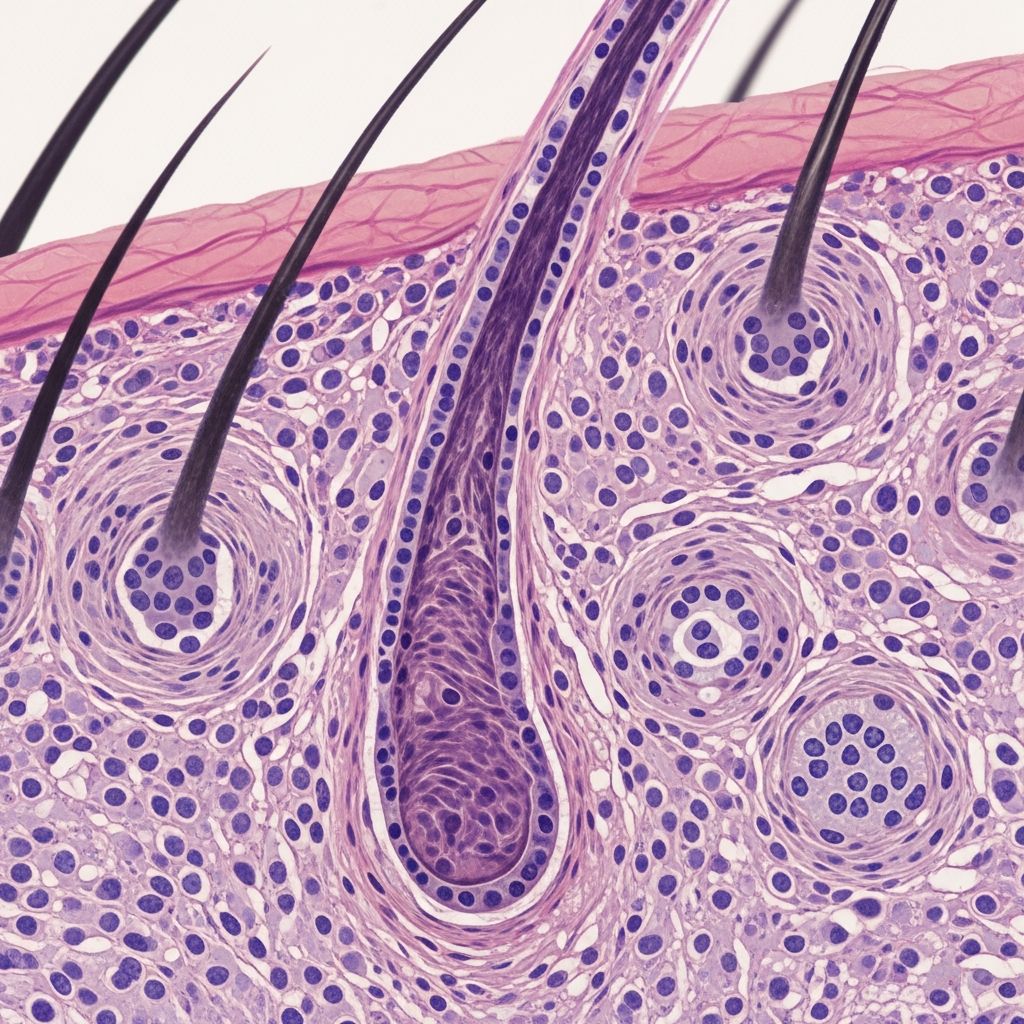
Trichoepithelioma is a rare benign neoplasm originating from hair follicle structures, classified as a benign adnexal tumour. It typically manifests as solitary or multiple firm nodules on the face, without ulceration or itching, and carries an excellent prognosis despite histological similarities to basal cell carcinoma.
Introduction
Trichoepitheliomas represent benign proliferations of hair follicle-derived epithelial and mesenchymal cells. These tumours are superficial dermal lesions, distinguishing them from deeper trichoblastomas. Solitary forms are non-hereditary, while multiple lesions often follow autosomal dominant inheritance, linked to mutations on chromosomes 9p21 and 16q12-q13. They pose no significant health risks but may require removal for cosmetic reasons or to exclude malignancy.
Demographics
Trichoepitheliomas predominantly affect females, with a 2:1 female-to-male ratio observed across variants. Multiple familial trichoepitheliomas emerge in early childhood or puberty, whereas solitary lesions appear in the second or third decade of life. Prevalence data from U.S. dermatopathology labs indicate 2.14 62.75 cases annually, underscoring their rarity. Conditions like Brooke-Spiegler syndrome further cluster cases familially, with higher expression in females due to genetic penetrance differences.
Causes
The aetiology involves benign proliferation of basaloid cells from hair follicles. Key genetic associations include:
- Multiple familial trichoepithelioma: Autosomal dominant, mutations in CYSTIC or HYDIN2 genes on chromosome 16q.
- Brooke-Spiegler syndrome: Mutations in CYLD gene on 16q12-13, leading to trichoepitheliomas alongside cylindromas and spiradenomas.
- Solitary trichoepithelioma: Sporadic, without clear genetic triggers.
Desmoplastic variant shows aggressive stromal fibrosis but remains benign.
Clinical Features
Lesions are small (typically <1 cm), firm, round, flesh- or skin-coloured papules or nodules, symmetrically distributed on the face—especially nasolabial folds, upper lip, nose, eyelids, and forehead. Less common sites include scalp, neck, and upper trunk; colour may vary to pink-blue. In multiple forms, lesions increase in size and number initially, then stabilize.
| Variant | Typical Presentation | Common Sites |
|---|---|---|
| Solitary | Single dome-shaped nodule, 0.5 61 cm | Central face |
| Multiple familial | Numerous papules/nodules, 2 610 mm | Nasolabial folds, periorbital |
| Desmoplastic | Annular plaque with raised border | Cheek, nose; mimics BCC |
Lesions are asymptomatic, non-ulcerative, and non-pruritic.
Variation in Skin Types
Trichoepitheliomas exhibit consistent morphology across skin phototypes, appearing as flesh-coloured or pearly papules without pigmentation variations. No ethnic predispositions are reported, though facial prominence aids diagnosis in all types.
Complications
Rarely, cosmetic disfigurement from multiple lesions prompts intervention. Brooke-Spiegler syndrome may cause scalp cylindromas leading to alopecia. Minimal risk of malignant transformation to basal cell carcinoma exists, necessitating histopathological confirmation post-excision.
Diagnosis
Diagnosis combines clinical suspicion with histopathology. Key microscopic features include:
- Island of basaloid cells in a fibrous stroma.
- Peripheral palisading without retraction artifact.
- Keratin horn cysts (“onion-skin” calcification).
- Absence of myxoid stroma or mucin.
Immunohistochemistry aids differentiation:
- CD34: Positive in tumour stroma.
- CD10: Stromal expression (vs. tumour cells in BCC).
- Bcl-2: Peripheral tumour nests only (diffuse in BCC).
- PHLDA1: Supports trichoepithelioma over BCC.
Desmoplastic variant shows narrow strands of basaloids in dense sclerosis with cysts.
Differential Diagnosis
| Condition | Key Distinguishing Features |
|---|---|
| Basal cell carcinoma (BCC) | Retraction artifact, peripheral palisading with mucin, diffuse Bcl-2/CD10 in tumour; ulcerated/pearly. |
| Trichoblastoma | Deeper dermal location, larger nests, reticulated pattern. |
| Syringoma | Ducts, tadpole cells; periorbital. |
| Sebaceous hyperplasia | Yellowish umbilicated papules. |
Related Stories



Biopsy resolves ambiguities, especially for desmoplastic forms mimicking BCC.
Treatment
Solitary lesions warrant excision if symptomatic or diagnostic uncertainty exists. Multiple lesions require conservative approaches:
| Category | Options |
|---|---|
| Medical | Topical 5-FU, tretinoin, aspirin (limited efficacy)* |
| Surgical | Shave/punch excision, excisional surgery, electrosurgery, cryosurgery |
| Physical | CO2/Er:YAG laser, dermabrasion, radiotherapy (rare) |
| *Topical therapies often fail; surgery preferred for cure. | |
For desmoplastic or facial lesions, Mohs micrographic surgery ensures clear margins despite subclinical extension. Multiple familial cases may use ablative lasers for cosmesis.
Prevention
No established preventive measures exist due to genetic aetiology. Genetic counselling recommended for familial cases. Sun protection may mitigate secondary changes, though UV causation is unproven.
Outcome
Prognosis is excellent; post-excision recurrence is rare (<5%). Malignant transformation is exceptionally uncommon but monitored via histology. Multiple lesions stabilize, allowing cosmetic management without progression.
Frequently Asked Questions (FAQs)
Is trichoepithelioma cancerous?
No, it is a benign tumour, though rare transformation to basal cell carcinoma requires biopsy confirmation.
Can trichoepithelioma be cured?
Solitary lesions are curable via excision; multiple forms managed cosmetically with low recurrence.
Does trichoepithelioma run in families?
Yes, multiple familial form is autosomal dominant; solitary is sporadic.
How is trichoepithelioma diagnosed?
By clinical exam and skin biopsy showing basaloid islands, horn cysts, and specific IHC markers.
What does desmoplastic trichoepithelioma look like?
A solitary annular plaque on the face, often mimicking basal cell carcinoma.
References
- Trichoepithelioma – DermNet 6 DermNet NZ. 2023. https://dermnetnz.org/topics/trichoepithelioma
- Trichoepitheliomas 6 Dermatology Advisor. 2024. https://www.dermatologyadvisor.com/home/decision-support-in-medicine/dermatology/trichoepitheliomas/
- Trichoepithelioma: A Comprehensive Review 6 PubMed (J Cutan Aesthet Surg). 2018-07-01. https://pubmed.ncbi.nlm.nih.gov/29989874/
- Hair Follicle Neoplasms 6 Desmoplastic Trichoepithelioma 6 Perri Dermatology. 2011-06-05. https://perridermatology.com/dr-perris-blog/hair-follicle-neoplasms-desmoplastic-trichoepithelioma/
- Multiple familial trichoepithelioma 6 Cosmoderma. 2023. https://cosmoderma.org/multiple-familial-trichoepithelioma/
Similar Articles








Read full bio of Sneha Tete