Trichoscopy of Generalised Noncicatricial Hair Loss
Non-invasive diagnostic guide to trichoscopy features in reversible generalised hair loss conditions like androgenetic alopecia and telogen effluvium.
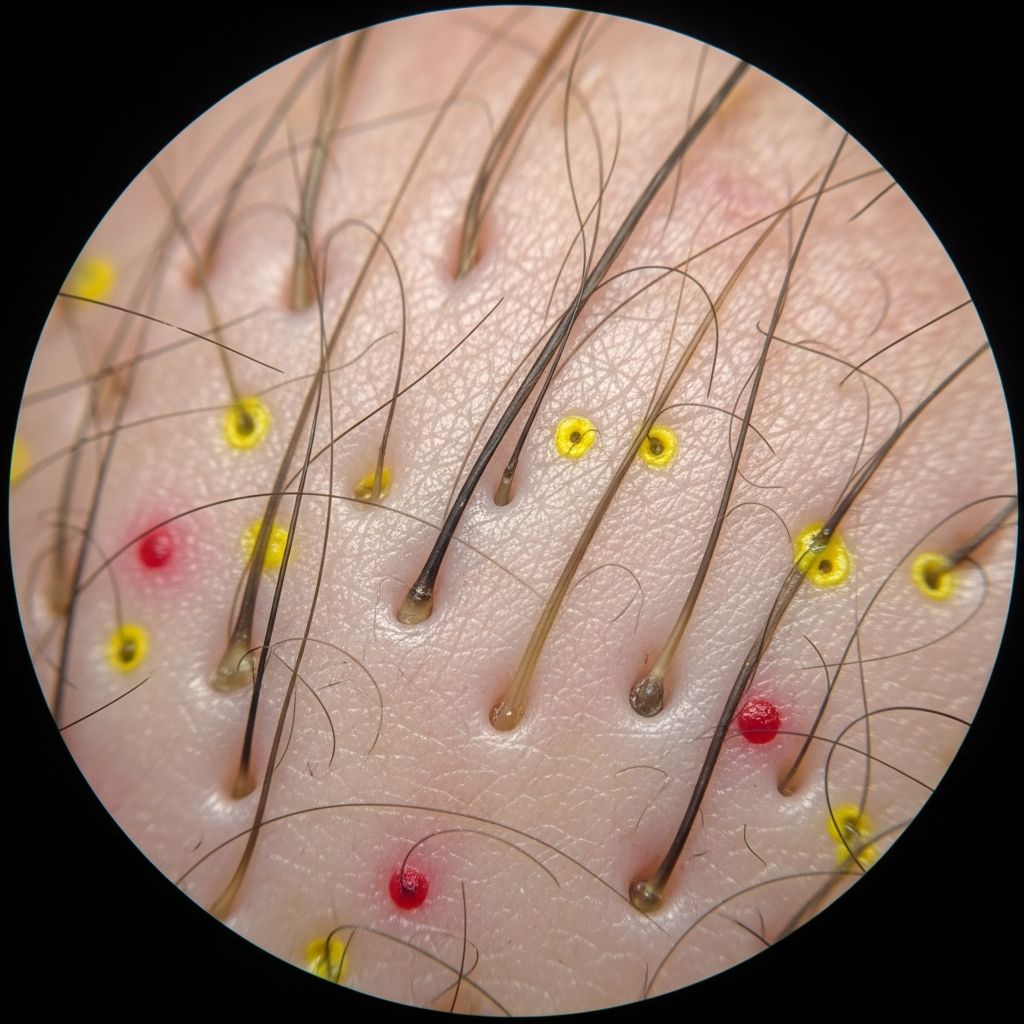
Generalised noncicatricial hair loss refers to diffuse, non-scarring hair thinning that is often reversible. Trichoscopy, a non-invasive dermoscopic examination of the scalp, enables rapid visualisation of hair follicles, shafts, and perifollicular structures to differentiate causes like androgenetic alopecia and telogen effluvium.
Introduction
Trichoscopy is a quick, precise diagnostic method performed outpatient using a handheld or digital dermatoscope. It reveals structures invisible to the naked eye, such as perifollicular epidermis, follicle openings, and hair shaft variations, aiding in alopecia severity assessment, type diagnosis, therapy monitoring, and avoiding biopsies. Generalised noncicatricial alopecia involves no scarring, with main causes including androgenetic alopecia, alopecia areata, diffuse alopecia, telogen effluvium, anagen effluvium, and tractional alopecia. Assessment compares frontal midline (2 cm from hairline) with occipital scalp.
Androgenetic Alopecia
Androgenetic alopecia (AGA), the most common hair loss worldwide, features progressive hair shaft diameter decline, length reduction, and pigmentation loss in a characteristic pattern due to androgen-induced miniaturisation, shortening anagen phase and prolonging telogen in susceptible follicles. Men show frontotemporal recession and vertex loss; women exhibit diffuse central thinning without frontal recession. Multifactorial pathogenesis involves genes, increased dermal dihydrotestosterone, estrogen deficits, and prolactin signalling issues.
Diagnostic Signs:
- Peripilar sign: brown halo around follicles indicating early perifollicular fibrosis.
- Hair diameter variability >20%: coexistence of thick and thin hairs (heterogeneity).
- Dominance of single-hair follicular units.
- Increased vellus hairs (>10% in women).
- Fewer triple-hair units compared to occiput.
Other Signs:
- Yellow dots: empty follicles or keratin plugs.
- Vellus hairs: short, thin, unpigmented.
Trichoscopy confirms AGA, guiding treatments like minoxidil or finasteride. Severity scales (S0-S5) use features like black/yellow dots and broken hairs.
Alopecia Areata
Alopecia areata (AA) is a T-cell mediated autoimmune attack on hair follicles, causing subtypes: patchy, ophiasis, diffuse, totalis, universalis. Nail changes include pitting, ridges, thinning. Trichoscopic features vary by activity, severity, duration.
Active Disease:
- Yellow dots: hyperkeratotic plugs in follicles.
- Short vellus hairs: regrowth sign.
- Exclamation mark hairs: tapered, fractured proximal shafts.
- Black dots: destroyed pigmented hairs.
Regrowth:
- Long regrowing pigmented hairs.
- Black dots decrease.
Chronic/Totalis:
- Yellow dots predominate.
- Vellus hairs abundant.
- Monilethrix-like hairs, angled hairs.
Coudability sign (kinking hair) marks activity.
Diffuse Alopecia
Diffuse alopecia involves uniform thinning without focal patches, often from chronic telogen effluvium (>6 months) or disorders like thyroid disease, iron deficiency, malnutrition. Trichoscopy role is supportive, not specific.
- Decreased hair density.
- Increased empty follicles.
- Short telogen hairs.
Telogen Effluvium
Telogen effluvium (TE) features acute increased shedding 8-12 weeks post-trigger (stress, illness, drugs), lasting 3 months. Chronic TE persists longer due to ongoing factors.
Trichoscopic Features (Nonspecific):
- Increased telogen hairs (>15%).
- Empty follicles.
- Decreased terminal:vellus ratio.
Latency aids timing; trichoscopy monitors resolution.
Anagen Effluvium
Anagen effluvium abruptly halts anagen growth (e.g., chemotherapy), causing dystrophic anagen hairs with fractured roots. Trichoscopy shows:
- Dystrophic hairs.
- Empty follicles.
- Pigtail (trichorrhexis nodosa-like) hairs.
Regrowth appears as straight, round anagen hairs or regularly curled tips.
Tractional Alopecia
Traction alopecia from chronic tension (hairstyles) shows miniaturised follicles along margins. Trichoscopy reveals:
Related Stories



Early detection prevents progression.
Diagnostic Algorithms and Severity Assessment
Trichoscopy differentiates alopecia types via specific features, e.g., yellow dots/black dots for AA vs. peripilar sign for AGA. Severity staging: S0 (none) to S5 (totalis), correlating black dots, yellow dots, broken/tapering hairs with extent. Compare frontal/occipital; examine margins, eyebrows if needed.
| Condition | Key Trichoscopic Features |
|---|---|
| Androgenetic Alopecia | Hair diameter variability >20%, peripilar sign, yellow dots |
| Alopecia Areata | Yellow dots, exclamation marks, black dots |
| Telogen Effluvium | Increased telogen hairs, empty follicles |
| Anagen Effluvium | Dystrophic hairs, pigtail hairs |
Benefits and Limitations
Benefits: Noninvasive, rapid, no biopsies, monitors therapy, universal for non-scarring alopecias.
Limitations: Nonspecific in some (e.g., TE), requires experience, larger scalp areas vs. skin dermoscopy.
Frequently Asked Questions (FAQs)
What is trichoscopy?
Trichoscopy is dermoscopy of scalp/hair for non-invasive alopecia diagnosis, visualising follicles and shafts.
How does trichoscopy diagnose androgenetic alopecia?
Via hair diameter variability >20%, peripilar sign, single-hair units, yellow dots.
What are yellow dots in alopecia areata?
Hyperkeratotic follicular plugs marking disease activity.
Can trichoscopy replace biopsy in hair loss?
Often yes for non-scarring alopecias, avoiding invasive procedures.
Is telogen effluvium trichoscopy-specific?
No, shows nonspecific increased telogen hairs, empty follicles.
This comprehensive review synthesises trichoscopy’s role in generalised noncicatricial hair loss, empowering precise, patient-friendly diagnosis. (Word count: 1624)
References
- TRICHOSCOPY AS A DIAGNOSTIC METHOD IN NON-SCARRING ALOPECIA — Euromedica Journal. 2024-04. https://journal-archiveuromedica.eu/archiv-euromedica-04-2024/17-TRICHOSCOPY-AS-A-DIAGNOSTIC-METHOD-IN-NON-SCARRING-ALOPECIA.html
- Trichoscopy of generalised noncicatricial hair loss — DermNet NZ. 2024. https://dermnetnz.org/topics/trichoscopy-of-generalised-noncicatricial-hair-loss
- Trichoscopy of localised noncicatricial hair loss — DermNet NZ. 2024. https://dermnetnz.org/topics/trichoscopy-of-localised-noncicatricial-hair-loss
- Trichoscopy in Alopecias: Diagnosis Simplified — PMC/NIH. 2014-04-01. https://pmc.ncbi.nlm.nih.gov/articles/PMC3999645/
Similar Articles








Read full bio of Sneha Tete