Trichoscopy of Genetic Hair Shaft Disorders
Non-invasive diagnosis of genetic hair shaft disorders using trichoscopy for accurate identification without hair sampling.
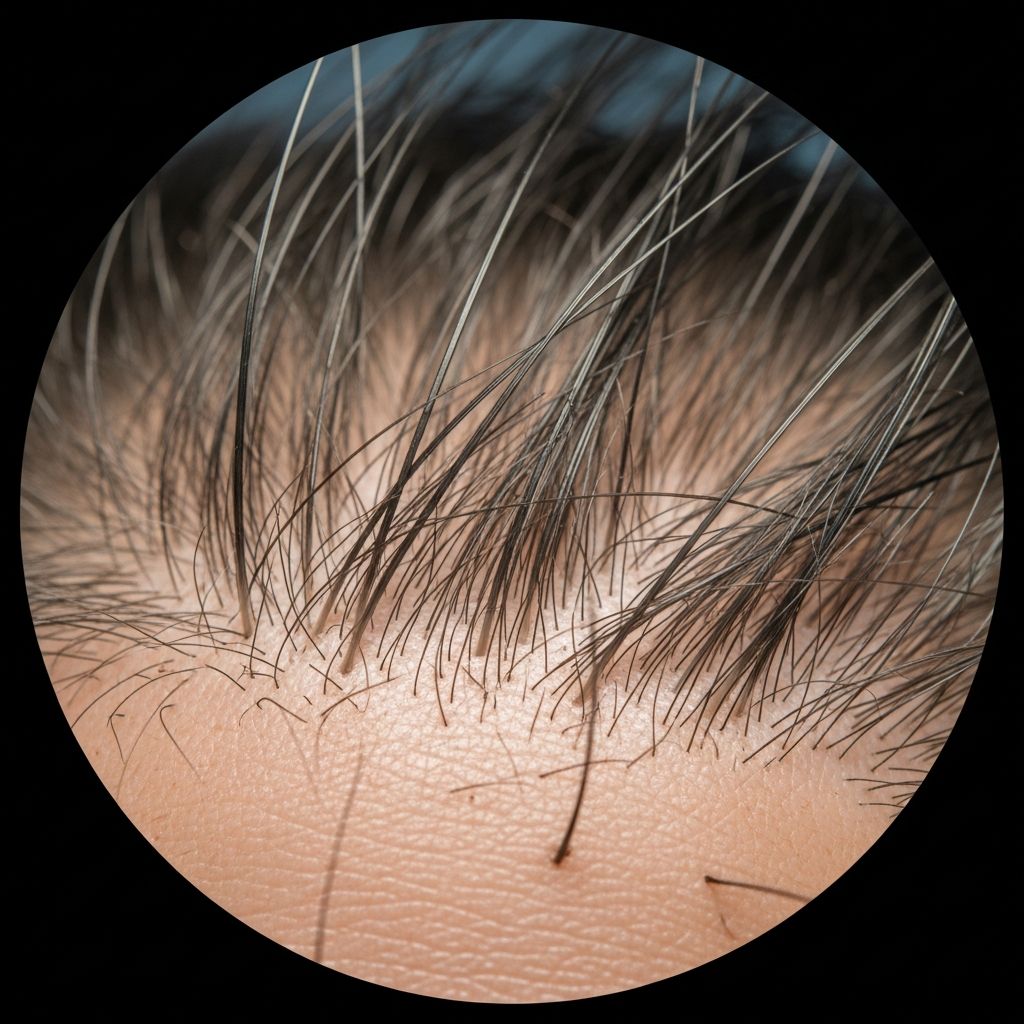
Trichoscopy, also known as dermoscopy of hair and scalp, is a non-invasive diagnostic technique that allows visualization of hair shaft abnormalities at magnifications up to 160-fold without the need for plucking or cutting hairs. Genetic hair shaft disorders are rare conditions characterized by structural defects in the hair fiber, often leading to fragility, breakage, and alopecia. These disorders can be classified based on their association with hair fragility: those with increased fragility (e.g., monilethrix, Netherton syndrome, trichorrhexis nodosa) and those without (e.g., pili annulati, trichothiodystrophy).
Traditional diagnosis relied on light microscopy or scanning electron microscopy, requiring hair sampling, which is invasive and time-consuming. Trichoscopy enables in vivo assessment in a single session, distinguishing pathological hairs from normal variants like curly hair. This article details trichoscopic features of key genetic hair shaft disorders, supported by high-magnification imaging characteristics.
What is Trichoscopy?
Trichoscopy uses a dermoscope with polarized or non-polarized light to examine scalp and hair structures at 10- to 1000-fold magnification. It reveals hair shaft shape, thickness, pigmentation, and perifollicular changes. For genetic disorders, high magnification (70-160x) highlights twisting, nodosities, invaginations, and fractures.
Advantages include non-invasiveness, real-time evaluation, and ability to assess multiple hairs simultaneously. Limitations: lower resolution than electron microscopy for ultra-fine details; polarized mode essential for some conditions like trichothiodystrophy.
Hair Shaft Disorders with Fragility
These disorders feature beaded, twisted, or fractured hairs prone to breakage, often presenting as short, sparse hair or alopecia.
Monilethrix
Monilethrix is an autosomal dominant disorder caused by mutations in keratin genes (e.g., KRT81, KRT86), resulting in elliptical hair nodosities with constrictions, resembling a string of beads. Clinically, it affects scalp hair primarily, with periodic shedding.
Trichoscopy shows uniform elliptical enlargements (nodosities) alternating with thin internodes at 20x magnification. Constrictions appear as dark, narrow segments. Perinodal halos (keratin casts) may surround nodosities. Hairs fracture at constrictions, leaving tapered stumps. High magnification (70x) confirms regular spacing.
- Key features: Beaded appearance, uniform nodosities 0.05-0.1 mm wide.
- Differential: Pseudomonilethrix (loose anagen hair) lacks true constrictions.
Netherton Syndrome
Netherton syndrome is an autosomal recessive ichthyosis linearis circumflexa with bamboo-like hairs (trichorhexis invaginata). Atopic dermatitis, ichthyosis, and failure to thrive are associated.
Trichoscopy reveals trichorhexis invaginata: invagination of distal shaft into proximal, forming ‘ball-in-cup’ or golf tee-like ends at 20-70x. Nodes appear as small bulges along the shaft; ragged cupped ends indicate fractures. Eyebrow hairs may show identical features. 160x best visualizes fine details.
- Pathognomonic: Ball-in-cup deformity.
- Locations: Scalp, eyebrows, sparse body hair.
Trichorrhexis Nodosa
The most common acquired or genetic hair shaft defect due to cuticle damage, leading to nodal swelling and transverse fractures. Genetic forms link to argininosuccinic aciduria or citrullinemia.
Related Stories



Trichoscopy at low magnification (20x) shows nodular thickenings; high magnification (70x+) or immersion reveals splaying into paintbrush-like fibers. Fractured ends fan out. Dry dermoscopy accentuates nodes.
- Magnification-dependent: Nodes low-mag; splitting high-mag.
- Associated: Woolly hair syndrome, trauma.
Pili Torti
Pili torti involves flattened, twisted hair shafts (3-10 twists per cm along long axis), causing corkscrew appearance and breakage. Associated with Menkes disease, Björnstad syndrome, or isolated.
Trichoscopy at 70x shows regular longitudinal twisting; 20x reveals acute bends at irregular intervals. Twists group in 3-4 per segment. Best with dry dermoscopy.
- Hallmark: Longitudinal axis twists, shaft flattening.
- Syndromic clues: Sparse, light-colored hair in Menkes.
Woolly Hair Syndrome
Autosomal dominant/recessive tight curls due to elliptical shafts with 180° twisting. May include palmoplantar keratoderma or cardiomegaly (Naxos disease).
Trichoscopy displays short-wave undulations (‘crawling snake’), ovoid cross-sections, trichorrhexis nodosa, and pili annulati-like bands. Distal cuticle defects, vacuoles visible at high mag. Differentiates from normal curly hair (no short waves).
- Distinct: Very short twist cycles vs. normal curls.
- Breakage: Due to fragility from grooves.
Hair Shaft Disorders without Fragility
These feature visible anomalies but minimal breakage.
Pili Annulati
Autosomal dominant; air-filled cavities in cortex cause spangled bands, more evident in blonde hair.
Trichoscopy: Alternating light (cavities) and dark bands along shaft. Cavities refract light, creating pearl-like sheen. No fragility.
- Easy detection: In light hair; subtle in dark.
Trichothiodystrophy
Autosomal recessive; sulfur-deficient brittle hair with tiger-tail banding on polarization. Multisystem: photosensitivity (PIBIDS), infections.
Trichoscopy non-specific: heterogeneous shafts like ‘grains of sand’, wavy contour at high mag. Polarized trichoscopy shows bright/dark bands. Flattened, folded shafts.
- Diagnostic: Polarized ‘tiger tail’.
- Limited: Standard trichoscopy less revealing.
Other Genetic Hair Shaft Abnormalities
Trichorrhexis Nodosa in Context
Often overlaps with woolly hair or argininosuccinic aciduria; trichoscopy confirms nodal fractures.
Ectodermal Dysplasias
Hypohidrotic or Clouston types show shaft diameter variation, pigmentation heterogeneity, reduced density.
Diagnostic Approach
Step 1: Clinical exam for fragility, distribution.
Step 2: Trichoscopy at multiple mags (20x scalp survey; 70-160x details).
Step 3: Polarized for banding; immersion for splitting.
Step 4: Biopsy if needed; genetic testing confirmatory.
| Disorder | Key Trichoscopic Feature | Magnification | Polarization Needed? |
|---|---|---|---|
| Monilethrix | Elliptical nodosities | 20-70x | No |
| Netherton | Ball-in-cup | 20-160x | No |
| Pili Torti | Longitudinal twists | 70x | No |
| Woolly Hair | Short-wave twisting | 70x | No |
| Trichothiodystrophy | Tiger-tail bands | 70x+ | Yes |
| Pili Annulati | Light-dark bands | 20x | No |
Frequently Asked Questions (FAQs)
Q: Is trichoscopy sufficient for diagnosing all genetic hair disorders?
A: For most, yes, but polarized trichoscopy or genetic testing confirms trichothiodystrophy or syndromic cases.
Q: How does trichoscopy differentiate pili torti from normal curly hair?
A: Pili torti shows flat, twisted shafts with bends; curls lack longitudinal axis rotation.
Q: Can trichoscopy be used in children?
A: Yes, non-invasive, ideal for pediatric genetic screening.
Q: What if trichoscopy is non-specific?
A: Proceed to light/electron microscopy or molecular testing.
Q: Are there treatment implications from trichoscopy?
A: Guides avoidance of trauma; biotin/minoxidil for some fragility types.
Conclusion
Trichoscopy revolutionizes genetic hair shaft disorder diagnosis, offering rapid, accurate insights into structural anomalies. Early detection aids management of associated syndromes.
References
- Trichoscopy in genetic hair shaft abnormalities — Rakowska A, et al. PMC – NIH. 2011-09-13. https://pmc.ncbi.nlm.nih.gov/articles/PMC3157768/
- Trichoscopy in Hair Shaft Disorders — Rudnicka L, et al. PubMed. 2018-09. https://pubmed.ncbi.nlm.nih.gov/30201151/
- Trichoscopy: A Complete Overview — DermNet NZ. 2023. https://dermnetnz.org/topics/trichoscopy
- Trichoscopy Advances Hair and Scalp Disease Diagnoses — Dermatology Times. 2023. https://www.dermatologytimes.com/view/trichoscopy-advances-hair-and-scalp-disease-diagnoses
- Trichoscopy of Genetic Hair Shaft Disorders — DermNet NZ. 2023. https://dermnetnz.org/topics/trichoscopy-of-genetic-hair-shaft-disorders
Similar Articles








Read full bio of Sneha Tete