Trichoscopy Of Scalp Infestations: 3 Key Diagnostic Signs
Non-invasive trichoscopy reveals key diagnostic features of scalp parasites like lice, scabies, and demodex for accurate diagnosis and treatment.
Trichoscopy, also known as dermoscopy or videodermoscopy of the scalp, is a non-invasive technique that uses a hand-held dermatoscope or videodermoscope to examine the scalp and hair at magnifications of 10–1000×. This method provides detailed in vivo views of scalp structures, including hair shafts, follicles, perifollicular epidermis, and vascular patterns, without the need for biopsies. In the context of scalp infestations, trichoscopy excels at identifying parasites, their eggs (nits), and associated skin changes, enabling rapid diagnosis and differentiation from other causes of scalp itching, scaling, or hair loss like psoriasis, seborrheic dermatitis, or alopecia areata.
Scalp infestations, primarily caused by ectoparasites such as lice, mites, and fungi-mimicking organisms, affect millions worldwide, particularly children and immunocompromised individuals. Trichoscopy offers higher sensitivity than clinical inspection alone, detecting features like nits adherent to hair shafts, burrows in the epidermis, or mite tails protruding from follicles. Key advantages include patient reassurance through thorough examination, objective documentation via digital imaging, and monitoring treatment efficacy by assessing parasite viability. This article details trichoscopic findings in major scalp infestations: pediculosis capitis, scabies, and demodicosis, with clinical correlations and management insights.
What is the role of trichoscopy in scalp infestations?
Trichoscopy plays a pivotal role in diagnosing scalp infestations by:
- Identifying mature insects and eggs: Distinguishes live from empty nits and viable parasites.
- Assessing parasite viability: Features like movement (under videodermoscopy) or structural integrity indicate if treatment has succeeded.
- Differentiating from mimics: Rules out inflammatory conditions (e.g., yellow dots in alopecia areata vs. nits) or infections (e.g., comma hairs in tinea capitis vs. lice eggs).
- Guiding therapy: Monitors response to pediculicides, scabicides, or acaricides, reducing overtreatment.
- Non-invasive and rapid: Performed in outpatient settings, improving diagnostic accuracy up to 95% for certain infestations.
Commonly used devices include manual dermatoscopes (e.g., DermLite) for contact examination or polarized videodermoscopes (e.g., FotoFinder) for non-contact views, revealing subsurface details like vascular changes or follicular ostia.
Pediculosis capitis
Pediculosis capitis, or head lice infestation, is caused by Pediculus humanus capitis, affecting 6–12 million children annually in the US alone. Transmission occurs via head-to-head contact, leading to pruritus, excoriations, and secondary bacterial infections.
Nit morphology and location
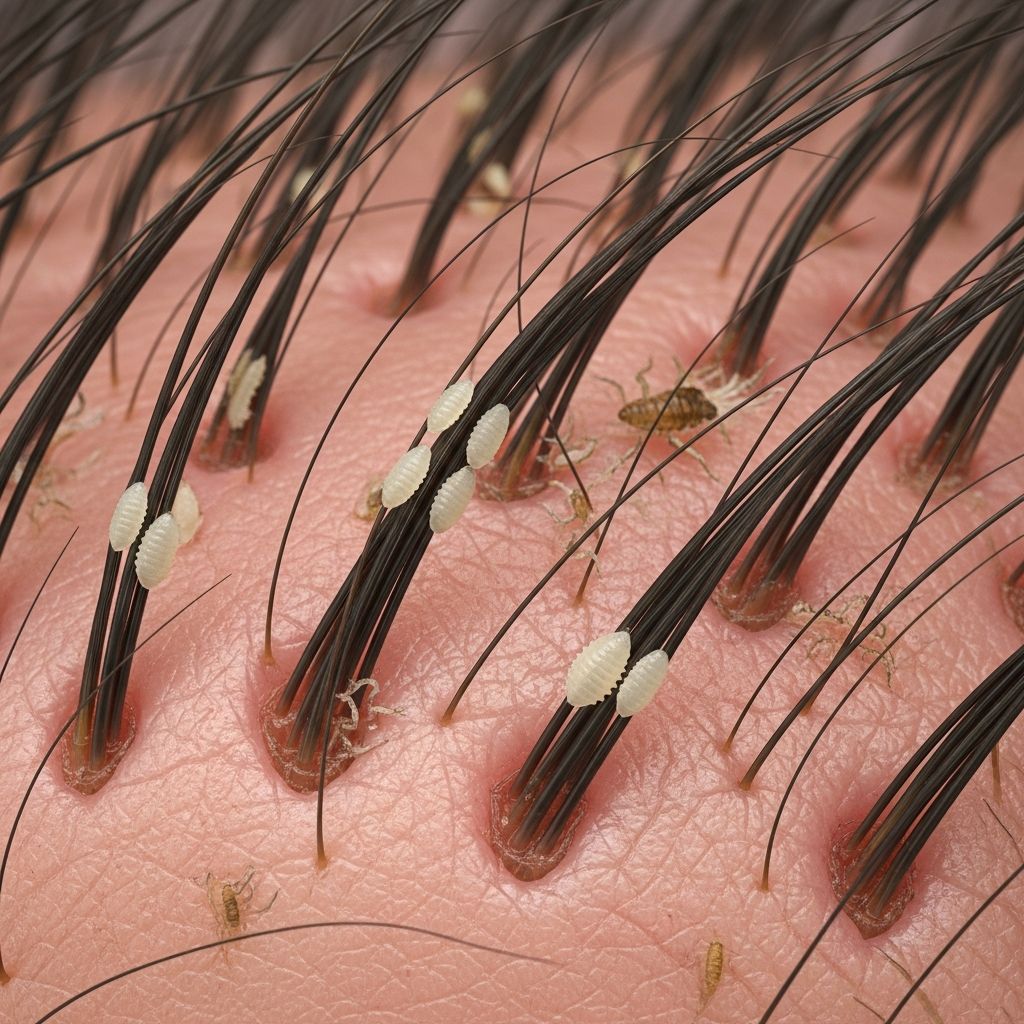
Nits appear as small (0.5–1 mm), oval, translucent eggs glued to the hair shaft base by a chitinous peduncular substance. Trichoscopy shows:
- Empty nits: Air-filled, exhibiting a dark tail-like extension where the nymph has emerged; clustered 1–5 mm from scalp.
- Live nits: Contain a smooth, convex operculum (egg cap) with an internal hexagonal meshwork; no tail, firmly attached 1–3 mm from scalp.
- Nymphs/adults: Brownish, elongated bodies (1–3 mm) gripping hair with claws, visible at ×20–50 magnification.
Key diagnostic sign: Nits resist sliding along the hair shaft, unlike pseudonits (e.g., hair casts, which detach easily). Polarized light highlights birefringence differences.
Post-treatment assessment
Two weeks post-pediculicide (e.g., permethrin, ivermectin), trichoscopy confirms success by showing only empty nits with tails and no live lice. Persistence of viable eggs prompts retreatment. Videodermoscopy detects subtle nymph movements.
Scabies
Scabies results from Sarcoptes scabiei var. hominis mites burrowing in the stratum corneum. Scalp involvement is rare in adults but common in infants, crusted (Norwegian) scabies, or immunocompromised patients, presenting with intense pruritus, papules, and burrows.
Mite burrows and morphology
Trichoscopy at ×50–100 reveals diagnostic burrows: Wavy, winding, S-shaped tunnels (2–15 mm) in the epidermis, often on fingerwebs but visible on scalp in affected cases. Higher magnification shows:
Related Stories



- Delta-wing jet sign: Anterior mite body (0.3–0.4 mm) with triangular scale flaps resembling aircraft wings; scybala (feces) as brown triangles behind.
- Triangular mite fragments: Posterior legs or eggs visible in burrow ends.
- **Head burrows:** Scalp lesions show burrows along hair follicles, with mites at follicular orifices.
In crusted scabies, hyperkeratotic crusts harbor thousands of mites, appearing as white-yellow scales with embedded parasites.
Crusted (Norwegian) scabies
This severe variant features widespread hyperkeratosis, nail dystrophy, and scalp crusting. Trichoscopy discloses dense mite populations (10–100/cm²), burrows obscured by scales, and secondary folliculitis. Videodermoscopy confirms mite motility.
Demodicosis
Demodicosis involves overproliferation of Demodex folliculorum (follicular) or D. brevis (sebaceous) mites in pilosebaceous units, implicated in rosacea, pityriasis folliculorum, and scalp pruritus. Density >5 mites/cm² is pathogenic.
Mite morphology and distribution
At ×100–1000, Demodex appear as cigar-shaped organisms (0.1–0.4 mm) with:
- Head: Transverse striations, four short legs.
- Body: Annulated abdomen, terminal rostrum in D. brevis.
- Tail-like extension: Protruding mite posterior from follicular ostia, surrounded by brown sheaths (follicular cuffs).
Mites align ‘head-up’ in follicles, with eggs/clutches visible. Associated findings: perifollicular scales, erythema, and ‘ Demodex pyoderma’ pustules.
Clinical variants
| Variant | Trichoscopic Features | Common Sites |
|---|---|---|
| Pityriasis folliculorum | White cylindrical perifollicular casts, multiple ‘tail-like’ mites | Face, scalp |
| Occipital demodicosis | Mite tails from occipital follicles, scarring alopecia | Occiput |
| Demodex folliculitis | Pustules with emerging mites, follicular hyperkeratosis | Scalp, beard |
Other scalp infestations
- Tinea capitis (inflammatory): Mimics infestation with ‘comma hairs,’ ‘corkscrew hairs,’ ‘moth-eaten hairs’ from Trichophyton spp.; pustules and abscesses. Trichoscopy shows perforated hairs and spores (95% accuracy).
- Pubic louse (Phthirus pubis): Rare scalp involvement; larger mites (1.5 mm) with crab-like legs gripping hairs.
- Tungiasis: Sand flea embedded in epidermis, forming nodules; trichoscopy shows dark central fleck.
Trichoscopy technique for infestations
- Prepare scalp: Part hair systematically (frontal, parietal, occipital, vertex).
- Use immersion fluid (alcohol) for contact or polarized non-contact mode.
- Magnification: ×10–20 for overview, ×50–100 for nits/burrows, ×200+ for mites.
- Document: Store images for baseline/follow-up; videodermoscopy for motility.
- Interpret: Correlate with history (travel, contacts, immunosuppression).
Frequently asked questions
Can trichoscopy distinguish live from dead lice eggs?
Yes; live nits show a convex operculum and internal embryo, while empty (dead) nits have a dark tail-like extension where the nymph emerged.
Is biopsy needed for scalp demodicosis diagnosis?
No; trichoscopy reliably detects mite tails and densities >5/cm², avoiding invasive sampling.
How does scabies differ trichoscopically from eczema?
Scabies shows delta-wing mites in burrows; eczema lacks parasites, featuring spongiosis and unspecific scaling.
Can trichoscopy monitor pediculosis treatment?
Yes; follow-up reveals only empty nits post-successful therapy, guiding retreatment if live forms persist.
Is videodermoscopy superior for mite detection?
Yes; it captures motility and subsurface burrows at higher magnifications.
References
- Trichoscopy Advances Hair and Scalp Disease Diagnoses — Dermatology Times. 2024. https://www.dermatologytimes.com/view/trichoscopy-advances-hair-and-scalp-disease-diagnoses
- Updates on trichoscopy in diagnosing scalp disorders — British Journal of Dermatology (Oxford Academic). 2025. https://academic.oup.com/bjd/article/193/Supplement_1/ljaf085.105/8162254
- Trichoscopy: A Complete Overview — DermNet NZ. 2024. https://dermnetnz.org/topics/trichoscopy
- Trichoscopy of Scalp Infestations — DermNet NZ. 2024. https://dermnetnz.org/topics/trichoscopy-of-scalp-infestations
- Trichoscopy — SkinDC Dermatology. 2024. https://skindcderm.com/trichoscopy/
- What is Trichoscopy and Who Are Trichologists? — Dermatology NYC. 2024. https://dermatology-nyc.com/blog/what-is-trichoscopy-and-who-are-trichologists/
Similar Articles








Read full bio of medha deb