Trichuriasis: 5 Essential Facts About Whipworm Infection
Authoritative facts about whipworm infection (Trichuris trichiura): symptoms, causes, diagnosis, treatment and prevention.
Authoritative facts about whipworm infection (Trichuris trichiura): symptoms, causes, diagnosis, treatment and prevention.
What is trichuriasis?
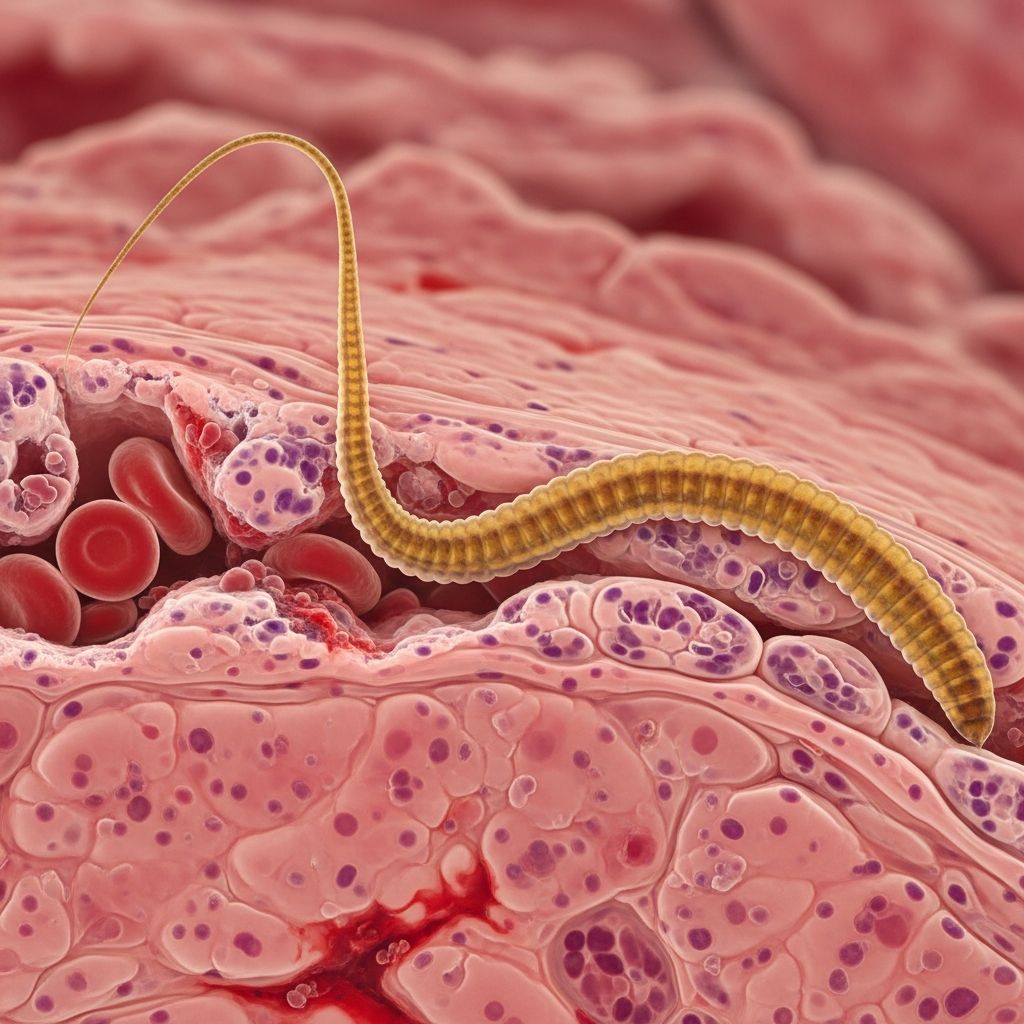
Trichuriasis, commonly known as whipworm infection, is a soil-transmitted helminthiasis caused by the parasitic nematode Trichuris trichiura. The name ‘whipworm’ derives from the worm’s distinctive morphology: a slender, whip-like anterior end (about 3/5 of its body length) and a thicker, barrel-shaped posterior end. Adult worms measure 3-5 cm in length, with females typically larger than males (3-5 cm vs. 3-4.5 cm). These parasites reside primarily in the cecum and ascending colon, where they embed their anterior end into the mucosal lining.
Trichuriasis affects approximately 500-800 million people worldwide, predominantly in tropical and subtropical regions with poor sanitation. It is one of the most prevalent neglected tropical diseases (NTDs), particularly impacting children in developing countries. Light infections are often asymptomatic, but heavy infestations can lead to significant morbidity including anemia, growth stunting, and cognitive impairment.
Who gets trichuriasis?
Trichuriasis predominantly affects individuals in endemic areas with inadequate sanitation and hygiene practices. The highest prevalence occurs in tropical and subtropical regions of Asia, sub-Saharan Africa, Latin America, and the Caribbean. Pockets of infection also exist in the southern United States and other temperate areas with poor sanitation.
- Children: School-aged children (5-15 years) bear the heaviest burden due to their play habits, geophagia (soil-eating), and poor hygiene. Heavy infections in this group can impair physical growth, cognitive development, and school performance.
- Adults: Farmers, agricultural workers, and those with occupational soil exposure are at higher risk. Pregnant women may experience exacerbated anemia.
- Immunocompromised individuals: Those with HIV/AIDS, malnutrition, or co-infections (e.g., malaria, tuberculosis) suffer worse outcomes due to impaired immune responses.
Global estimates indicate over 1 billion people are at risk, with children in endemic areas often harboring the highest worm burdens.
What causes trichuriasis?
Trichuriasis results from ingestion of embryonated T. trichiura eggs present in contaminated soil, food, or water. The eggs are passed unembryonated in human feces and require 2-4 weeks in warm, moist, shaded soil (optimal at 22-26°C) to become infective. Once ingested, eggs hatch in the small intestine, releasing larvae that mature into adults over 2-3 months. Adult worms can live 1-4 years, continuously producing up to 2,000 eggs per female daily.
Life cycle:
- Egg deposition: Unembryonated eggs (50-55 × 22-25 μm, barrel-shaped with polar plugs) excreted in feces.
- Embryonation: Eggs develop larvae inside shell in soil (2-4 weeks).
- Infection: Humans ingest eggs via contaminated hands, vegetables, or water.
- Hatching: Larvae hatch in duodenum, penetrate villi, migrate to cecum/colon.
- Maturation: Adults embed in mucosa; females gravid at 60-90 days post-infection.
Transmission is fecal-oral, thriving in areas with open defecation and inadequate wastewater treatment.
What are the signs and symptoms of trichuriasis?
Most infections (worm burden <100 worms) are asymptomatic. Symptoms correlate with parasite load and host factors.
Light infections
- Often subclinical
- Occasional abdominal discomfort
- Mild eosinophilia (uncommon)
Moderate to heavy infections
- Gastrointestinal: Abdominal pain, distension, anorexia, diarrhea (mucoid, bloody), tenesmus
- Systemic: Fatigue, weight loss, iron-deficiency anemia from chronic blood loss
- Children-specific: Growth retardation, malnutrition, cognitive impairment, rectal prolapse (severe cases)
Trichuris dysentery syndrome (TDS): Occurs in heavily infected children (>1,000 worms); characterized by bloody mucoid stools, tenesmus, prolapse, severe anemia, and stunting.
Related Stories



Rare complications include appendicitis, colitis, and bacterial superinfection due to mucosal damage.
How is trichuriasis diagnosed?
Diagnosis relies on microscopic identification of characteristic eggs in stool samples. Multiple specimens (3 consecutive days) improve sensitivity due to intermittent egg shedding.
| Method | Description | Sensitivity |
|---|---|---|
| Kato-Katz thick smear | WHO-recommended quantitative method; eggs/g feces | High for heavy infections |
| Formalin-ethyl acetate sedimentation | Concentration technique for light infections | Moderate |
| FLOTAC | Advanced flotation; superior sensitivity | Highest (>90%) |
| PCR | Molecular detection of DNA; research use | Very high |
Differential diagnosis: Hookworm, Ascaris, schistosomiasis, inflammatory bowel disease, bacterial dysentery.
Colonoscopy reveals worms embedded in mucosa (cecum/rectum) with erythema, friability.
What is the treatment for trichuriasis?
Anthelmintic therapy targets adult worms; single-dose regimens recommended by WHO.
| Drug | Dose | Cure Rate (CR) | Egg Reduction Rate (ERR) |
|---|---|---|---|
| Albendazole | 400 mg single dose (adults/children >2 yrs) | 27-85% | 78-92% |
| Mebendazole | 500 mg single or 100 mg BID x 3 days | 14-96% | 82-95% |
| Ivermectin | 200 μg/kg single dose | 10-50% | 70-85% |
| Combination (albendazole + oxantel pamoate) | 400 mg + 20 mg/kg | >90% | >95% |
Notes: T. trichiura shows variable benzimidazole resistance. Triple-dose regimens or combinations improve efficacy. Treat heavy infections for 3 days. Supportive care: iron supplementation, nutrition.
What is the outcome for trichuriasis?
With treatment, most patients experience rapid symptom resolution and worm clearance. Untreated heavy infections cause chronic morbidity:
- Children: Stunting (height-for-age Z-score ↓0.4-0.7), cognitive deficits, school absenteeism
- Adults: Reduced work productivity, anemia
- Mortality: Rare, but reported in severe TDS with prolapse/superinfection
Post-treatment monitoring: repeat stool exam at 2-4 weeks. Mass drug administration (MDA) programs achieve community-level control.
How can trichuriasis be prevented?
Prevention combines chemotherapy, WASH (water, sanitation, hygiene), and health education.
Individual measures
- Handwashing with soap before eating/after defecation
- Wash/cook vegetables; drink safe water
- Avoid soil-eating (pica)
- Personal sanitation facilities
Community strategies
- MDA: Annual albendazole (children 1-2x/yr; coverage >75%)
- Sanitation: Latrines reduce soil contamination by 70-90%
- Water treatment and hygiene education
- Vector control (shoe-wearing in endemic areas)
Integrated NTD programs have reduced prevalence by 50% in many areas.
Related topics
- Ascariasis
- Hookworm disease
- Strongyloidiasis
- Soil-transmitted helminths
Frequently Asked Questions (FAQs)
Q: Is trichuriasis contagious?
A: No, trichuriasis is not directly contagious person-to-person. Transmission requires ingestion of embryonated eggs from contaminated soil/food, which takes 2-4 weeks to develop post-excretion.
Q: Can trichuriasis be fatal?
A: Fatalities are rare but can occur in untreated severe pediatric cases with rectal prolapse, sepsis, or extreme malnutrition. Most infections are manageable with anthelmintics.
Q: How long does whipworm live in the body?
A: Adult T. trichiura survive 1-4 years without treatment. Eggs continue production throughout this lifespan.
Q: Does whipworm infection spread to other organs?
A: No, T. trichiura is confined to the intestine (cecum, colon, rectum). Ectopic migration is not reported, unlike Ascaris.
Q: Can animals transmit human whipworm?
A: No, human T. trichiura is host-specific. Animal whipworms (T. suis in pigs) are not zoonotic to humans.
References
- Trichuriasis — Wikipedia. 2024-01-15. https://en.wikipedia.org/wiki/Trichuriasis
- Trichuris trichiura Infection — StatPearls [Internet]. NCBI Bookshelf. 2023-07-17. https://www.ncbi.nlm.nih.gov/books/NBK507843/
- Trichuriasis — Merck Manual Professional Edition. 2024. https://www.merckmanuals.com/professional/infectious-diseases/nematodes-roundworms/trichuriasis
- DPDx – Trichuriasis — Centers for Disease Control and Prevention (CDC). 2024-05-10. https://www.cdc.gov/dpdx/trichuriasis/index.html
- Trichuriasis — Center for Food Security and Public Health, Iowa State University. 2023. https://www.cfsph.iastate.edu/Factsheets/pdfs/trichuriasis.pdf
Similar Articles








Read full bio of Sneha Tete