Trigeminal Nerve: Anatomy, Function & Disorders
Complete guide to the trigeminal nerve: structure, function, and common conditions affecting facial sensation.
Understanding the Trigeminal Nerve
The trigeminal nerve, known scientifically as the fifth cranial nerve (CN V), is the largest of all 12 pairs of cranial nerves in the human body. This prominent nerve plays a crucial role in providing sensation to the face and enabling the muscles involved in chewing. The name “trigeminal” comes from its three main divisions that branch out from the trigeminal ganglion to supply different regions of the face. Understanding the structure and function of the trigeminal nerve is essential for recognizing how facial sensations are transmitted to the brain and how various neurological conditions can affect facial function.
Anatomy and Structure of the Trigeminal Nerve
Overview of the Nerve
The trigeminal nerve arises from the midpontine anterolateral surface of the brainstem with two distinct components: a large sensory root known as the “portio major” and a smaller motor root called the “portio minor.” The nerve travels through the prepontine and cerebellopontine angle cisterns before entering the Meckel cave, a cerebrospinal fluid-filled space within the dura mater. This specialized space contains the trigeminal ganglion and serves as the junction point where the nerve divides into its three primary branches.
The Three Branches of the Trigeminal Nerve
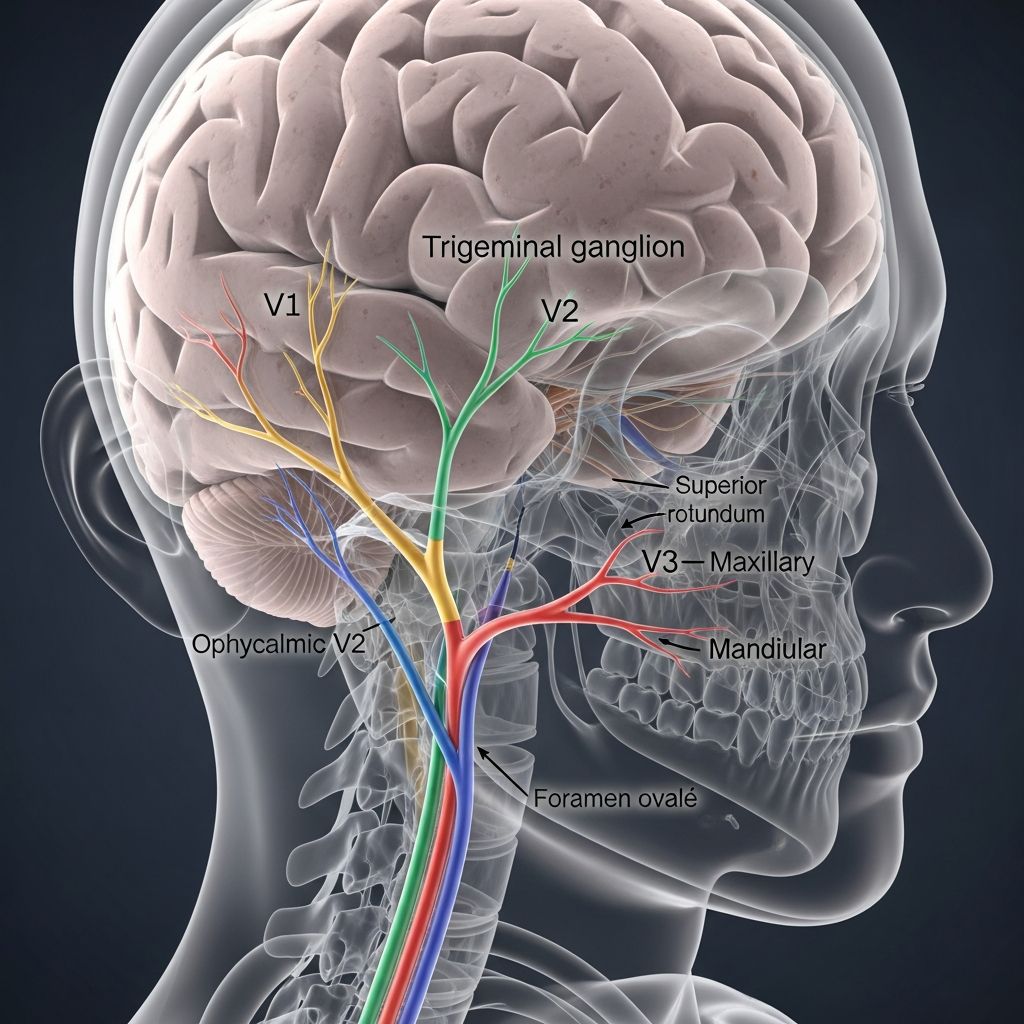
The trigeminal nerve divides into three main branches at the trigeminal ganglion, each responsible for providing sensation to different areas of the face:
– Ophthalmic Branch (V1): Also called the eye branch, the ophthalmic nerve provides sensation to the upper part of the face, including the forehead, upper eyelids, and eyes. This is the most superior branch of the trigeminal nerve.- Maxillary Branch (V2): The maxillary or upper jaw branch supplies sensation to the middle portion of the face, including the cheeks, nose, lower eyelids, upper lips, and upper gums and teeth.- Mandibular Branch (V3): The mandibular or lower jaw branch is the largest of the three divisions and is unique because it carries both sensory and motor components. This branch provides sensation to the lower third of the face, including the jaw, lower gums and teeth, tongue, and floor of the mouth, while also supplying motor innervation to the chewing muscles.
The Trigeminal Ganglion
The trigeminal ganglion, also known as the Gasserion or semilunar ganglion, is a crucial neurological structure that contains the cell bodies of most trigeminal sensory nerve fibers. Located within the Meckel cave on the petrous portion of the temporal bone, this ganglion houses pseudo-unipolar neurons that have two axonal branches. One branch extends proximally toward the brainstem, while the other extends distally toward one of the three trigeminal divisions. This unique arrangement allows trigeminal neurons to conduct electrical signals in both directions, enabling the transmission of pain and temperature sensations toward the brainstem and sensory information outward toward the trigeminal branches.
Sensory and Motor Functions
Sensory Functions
The trigeminal nerve is responsible for providing most of the sensory innervation to the face. It transmits three types of sensory information: touch, pain, and temperature. Sensory fibers carrying fine touch and pressure information synapse in the principal sensory nucleus within the pontine tegmentum’s posterolateral surface. These signals then travel through the trigeminal lemniscus and ascending pathways to the brainstem’s contralateral side before reaching the thalamus’ ventroposteromedial nucleus and ultimately synapsing in the somatosensory cortex. This complex relay system ensures that facial sensations are accurately processed and perceived by the brain.
Motor Functions
While the ophthalmic and maxillary branches are purely sensory, the mandibular division is unique in providing motor innervation. The motor component of the mandibular nerve (portio minor) supplies the muscles of mastication, which include the masseter, temporalis muscle, and lateral and medial pterygoid muscles. Additionally, this branch innervates the tensor veli palatini, mylohyoid, tensor tympani, and anterior digastric belly muscles. These motor functions are essential for proper chewing, swallowing, and opening and closing the mouth.
Related Stories



The Trigeminal Root Entry Zone
The trigeminal root, which carries sensory fibers from the trigeminal ganglion to the pons’ ventrolateral aspect, contains a particularly important anatomical region known as the root entry zone. Located approximately 12 millimeters distal to the pons, this zone marks the transition point where peripheral myelin replaces central myelin. The trigeminal root entry zone is considered the most vulnerable site along the entire trigeminal nerve for neurovascular compression, making it a critical area in the development of various trigeminal nerve disorders.
Common Trigeminal Nerve Disorders
Trigeminal Neuralgia
Trigeminal neuralgia (TN) is a chronic pain disorder characterized by sudden, intense, and often debilitating facial pain. The condition typically manifests as sharp, electrical, shock-like, or stabbing pain within the distribution of one or more trigeminal nerve branches. These pain episodes are often triggered by everyday activities such as eating, drinking, brushing teeth, talking, or light facial touch. Trigeminal neuralgia typically affects individuals over 50 years of age and is rare in people under 40, with a higher prevalence in women than men.
Causes of Trigeminal Neuralgia
The most common cause of classical trigeminal neuralgia is compression of the trigeminal nerve at the root entry zone by the superior cerebellar artery or other blood vessels. In some cases, the compression results from impingement by an adjacent aneurysm, arteriovenous malformation, or tumor. Other potential causes include demyelinated plaques associated with multiple sclerosis, damage from trauma to the face, or injury from previous facial surgery or stroke. However, in some instances, the underlying cause remains unknown.
Treatment Options for Trigeminal Nerve Disorders
Surgical Interventions
Several surgical approaches are available for patients with trigeminal neuralgia who do not respond adequately to medical management:
– Microvascular Decompression (MVD): This invasive procedure is considered the gold standard surgical treatment for classical trigeminal neuralgia caused by arterial contact with the nerve. The surgeon creates an opening behind the ear to access the trigeminal nerve and identifies the blood vessel or other tissue compressing it. A cushion or protective pad is then placed between the vessel and the nerve to alleviate pressure. MVD has demonstrated the best results for long-term, medication-free pain relief, with 62% to 89% of patients remaining pain-free at follow-up periods of 3 to 10.9 years. However, the procedure carries a 0.3% mortality risk and potential complications including cerebrospinal fluid leakage, infection, and stroke, though sensory changes are less common.- Stereotactic Radiosurgery: This non-invasive or minimally invasive procedure delivers a concentrated beam of radiation to the trigeminal nerve root at the point where it meets the brainstem. The radiation creates a lesion that disrupts the nerve’s ability to transmit pain signals. Stereotactic radiosurgery typically provides symptom relief for approximately three years and can be repeated if pain recurs.- Radiofrequency Thermocoagulation: This neuroablative technique uses heat generated by radiofrequency current to selectively damage nerve fibers responsible for transmitting pain signals.- Balloon Compression: This procedure involves inflating a small balloon against the trigeminal nerve to disrupt pain signal transmission.- Glycerol Rhizolysis: This technique involves injecting glycerol near the trigeminal nerve root to interrupt pain signaling.- Internal Neurolysis: When no vascular compression is identified during surgery, the surgeon may gently separate the nerve fibers (fascicles) to relieve compression from surrounding tissues.
Medical Management
Before considering surgical intervention, trigeminal neuralgia is typically managed with medications designed to reduce abnormal nerve firing and pain perception. Patients must be medically fit for any surgical procedure, and the choice of treatment depends on individual factors including symptom severity, duration of illness, patient age, and overall health status.
Clinical Significance and Diagnosis
Diagnostic Criteria
Classical trigeminal neuralgia can be diagnosed when a patient experiences repeated attacks of one-sided facial pain and imaging studies such as MRI reveal evidence of an artery or vein compressing the trigeminal nerve root with associated changes in the nerve itself. Advanced imaging techniques are essential for confirming the diagnosis and identifying the underlying cause of nerve compression.
Symptoms and Presentation
Patients with trigeminal neuralgia typically report electric shock-like or stabbing pain confined to the distribution of one or more trigeminal nerve branches. The pain episodes can be brief, lasting seconds to minutes, or more prolonged. Pain-free periods may separate individual attacks, and the condition can significantly impact quality of life, affecting eating, speaking, and facial hygiene.
Frequently Asked Questions About the Trigeminal Nerve
Q: What does the trigeminal nerve do?
A: The trigeminal nerve provides sensation to most of the face and enables chewing by supplying motor innervation to the muscles of mastication. It transmits sensations of touch, pain, and temperature from the face, eyes, and mouth to the brain.
Q: Why is the trigeminal nerve called “trigeminal”?
A: The term “trigeminal” refers to the three main branches of the nerve: the ophthalmic (V1), maxillary (V2), and mandibular (V3) divisions. “Tri” means three, and “geminal” refers to the paired nature of the nerve.
Q: Is trigeminal neuralgia curable?
A: While trigeminal neuralgia can be effectively managed through medication or surgery, it is not permanently curable in all cases. Surgical procedures like microvascular decompression offer long-term pain relief in many patients, with approximately 62% to 89% remaining pain-free for extended periods.
Q: What triggers trigeminal neuralgia pain?
A: Common triggers include eating, drinking, brushing teeth, talking, smiling, touching the face, or exposure to wind or cold. The severity and frequency of triggers vary among individuals.
Q: How is trigeminal nerve damage diagnosed?
A: Trigeminal nerve disorders are diagnosed through clinical evaluation, patient history, and advanced imaging techniques such as MRI, which can reveal structural abnormalities, vascular compression, or other pathology affecting the nerve.
Q: Can trigeminal neuralgia affect both sides of the face?
A: While trigeminal neuralgia typically affects one side of the face, bilateral cases are rare and may suggest an underlying systemic condition such as multiple sclerosis or other neurological disorders.
References
- Neuroanatomy, Cranial Nerve 5 (Trigeminal) — National Center for Biotechnology Information, U.S. National Library of Medicine. 2024. https://www.ncbi.nlm.nih.gov/books/NBK482283/
- Guidelines for the management of trigeminal neuralgia — Cleveland Clinic Journal of Medicine. 2023. https://www.ccjm.org/content/90/6/355
- Trigeminal Neuralgia — Cleveland Clinic Abu Dhabi Health Hub. 2024. https://www.clevelandclinicabudhabi.ae/en/health-hub/health-resource/diseases-and-conditions/trigeminal-neuralgia
- Cranial Nerves: Function, Anatomy & Location — Cleveland Clinic. 2024. https://my.clevelandclinic.org/health/body/21998-cranial-nerves
Similar Articles








Read full bio of medha deb