Tripe Palms: Causes, Diagnosis, And Treatment Guide
Rare paraneoplastic skin condition linked to internal malignancies, featuring velvety, thickened palms resembling animal tripe.
Author: Expert Dermatologist (synthesized from peer-reviewed sources)
First published: 2026-01-28
Updated: 2026-01-28
What is tripe palms?
Tripe palms, also known as
acanthosis palmaris
oracquired pachydermatoglyphia
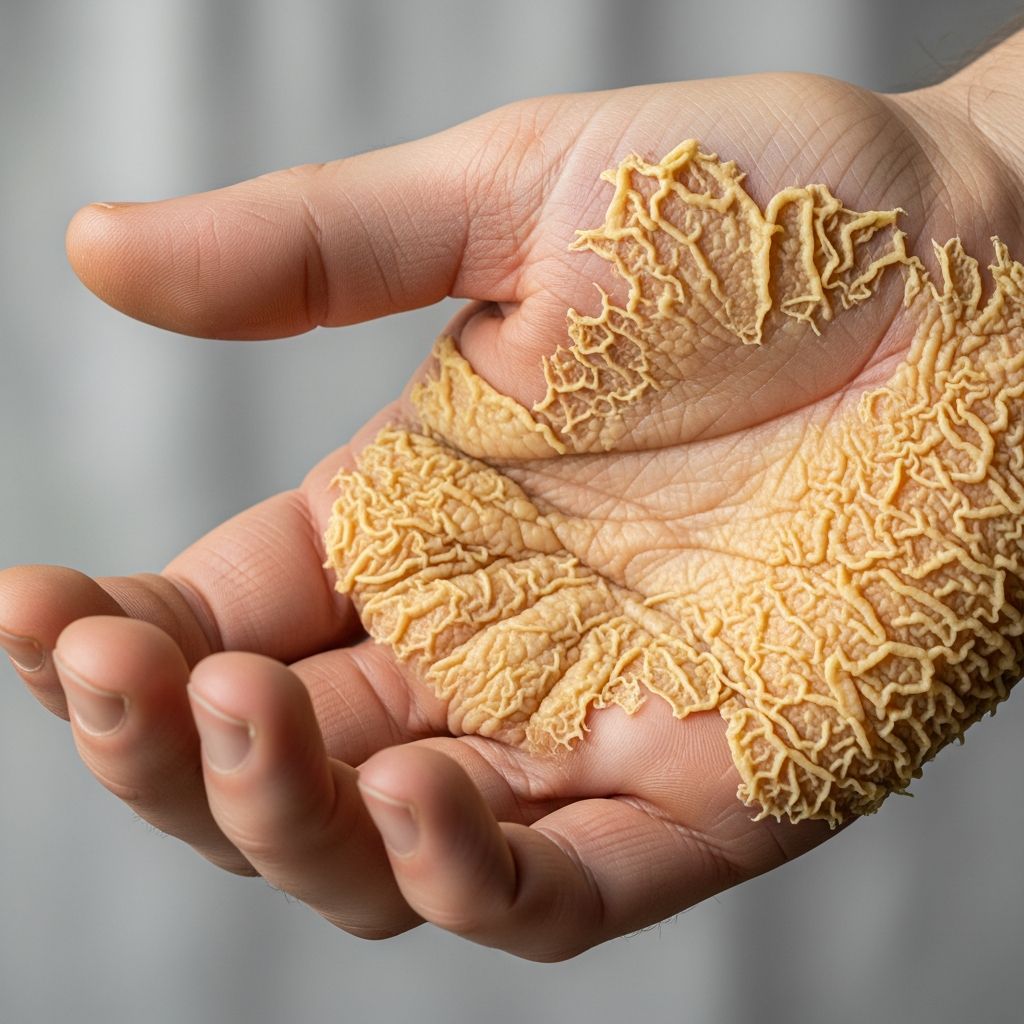
, is a rare cutaneous paraneoplastic syndrome characterised by marked hyperkeratosis and a velvety thickening of the palms, producing exaggerated dermatoglyphics that resemble the corrugated lining of the stomach of a cow or sheep (tripe). This condition falls under paraneoplastic dermatoses, a group of skin disorders triggered by an internal malignancy through indirect mechanisms such as secretion of growth factors or cytokines, sharing underlying genetic pathways with the cancer.The palms develop a rugose (wrinkled), thickened texture with pronounced ridges and sulci, often adopting a yellowish or brownish hue due to hyperpigmentation and hyperkeratosis. While primarily affecting the palms, soles may occasionally be involved, and the condition can coexist with other skin signs like acanthosis nigricans in up to 77% of cases. Tripe palms is exceptionally rare, with over 90% of reported cases associated with underlying malignancies, making it a critical clinical marker prompting thorough oncologic evaluation.
Who gets tripe palms?
Tripe palms predominantly affects adults over 60 years of age, with a mean onset around the seventh decade, though cases in younger individuals have been documented in the context of malignancy. There is no strong gender predilection, though some series report a slight male predominance linked to higher smoking-related lung cancers. Risk factors mirror those of associated malignancies: advanced age, smoking history (as in the case of a 73-year-old smoker with lung adenocarcinoma), and chronic alcohol use (noted in a pancreatic cancer case).
Non-malignant associations are rare (<10%), including bullous pemphigoid, psoriasis, exfoliative dermatitis, interstitial lung disease, and systemic mastocytosis. In malignancy-associated cases, the skin changes often precede cancer diagnosis by months, serving as an early warning in over 40% of undiagnosed patients.
What causes tripe palms?
The precise pathogenesis remains incompletely understood but is attributed to tumour-derived growth factors stimulating epidermal keratinocyte proliferation. Key implicated factors include:
- Transforming growth factor-α (TGF-α): Oversecretion leads to cytokine-mediated signalling via growth factor receptors, driving hyperkeratosis and ridge exaggeration.
- Epidermal growth factor (EGF): Elevated serum levels reported in bronchial carcinoma cases.
Cancer cells are thought to release these factors systemically, inducing skin changes distant from the primary tumour. Genetic sharing between the dermatosis and malignancy supports this paraneoplastic mechanism. Lung cancer predominates when tripe palms occurs alone, while gastric carcinoma is more common with concurrent acanthosis nigricans.
What are the clinical features of tripe palms?
Patients typically present with insidious onset of palm thickening, progressing over weeks to months. Key features include:
- Palmar hyperkeratosis: Velvety, rugose thickening accentuating dermatoglyphic ridges and sulci, resembling tripe.
- Hyperpigmentation: Brownish-yellow or velvety white hue, sharply demarcated along palm creases.
- Symptoms: Often asymptomatic, but pruritus, pain, or tenderness may occur, as in a case with painful hand lesions alongside cough and weight loss.
- Distribution: Bilateral palms (universal); fingers, soles, and occasionally mucosal surfaces in severe cases.
Concurrent signs heighten suspicion:
| Associated Feature | Frequency | Implication |
|---|---|---|
| Acanthosis nigricans | 77% | Gastric cancer more likely |
| Finger clubbing | Occasional | Pulmonary malignancy |
| Leser-Trélat sign | Rare | Multiple eruptive seborrhoeic keratoses |
Related Stories



Skin biopsy reveals compact orthokeratosis, acanthosis, and papillomatosis, confirming the diagnosis histologically.
Diagnosis of tripe palms
Diagnosis is primarily clinical, based on the characteristic velvety, ridged palms. Dermoscopy may highlight exaggerated dermatoglyphics. Biopsy shows non-specific epidermal hyperplasia: hyperkeratosis, acanthosis, and elongated rete ridges. The hallmark is its paraneoplastic context, necessitating:
- Age-appropriate cancer screening: CT chest/abdomen/pelvis, endoscopy, tumour markers (CEA, CA19-9).
- Differential diagnosis: Palmoplantar keratoderma, acanthosis nigricans alone, pachydermoperiostosis, chronic eczema.
In one series, tripe palms prompted malignancy detection in 40% of cases prior to other symptoms.
What is the treatment for tripe palms?
No specific therapy targets tripe palms directly; management focuses on the underlying malignancy. Skin changes may regress post-tumour resection or chemotherapy, though persistence occurs (e.g., no improvement with urea ointment or chemo in lung cancer). Symptomatic relief includes:
- Topical keratolytics (urea 10–40%, salicylic acid).
- Emollients and mild steroids for pruritus.
- Retinoids (systemic acitretin) in refractory cases.
Prognosis ties to the cancer stage; early detection via skin signs improves outcomes.
Paraneoplastic dermatoses
Tripe palms exemplifies paraneoplastic syndromes, where malignancies produce skin changes via humoral or immune mechanisms. Related conditions include:
- Acanthosis nigricans maligna: Velvety hyperpigmentation (neck, axillae); gastric adenocarcinoma.
- Leser-Trélat sign: Sudden seborrhoeic keratoses; GI/breast cancers.
- Sweet syndrome: Painful plaques; haematologic malignancies.
- Dermatomyositis: Heliotrope rash, Gottron papules; ovarian/lung cancers.
These share TGF-α/EGF pathways, underscoring vigilance for occult malignancy.
Frequently asked questions (FAQs) on tripe palms
Q: Is tripe palms always a sign of cancer?
A: Over 90% of cases link to internal malignancy (gastric, lung most common), but rare benign associations exist (psoriasis, pemphigoid).
Q: What does tripe palms look like?
A: Thickened, velvety palms with exaggerated ridges/sulci, yellow-brown hue, resembling animal stomach lining.
Q: How is tripe palms diagnosed?
A: Clinical exam; biopsy for confirmation; urgent cancer workup (CT, endoscopy).
Q: Can tripe palms be treated?
A: Treat underlying cancer; topical keratolytics for symptoms. Resolution variable.
Q: Who is at risk for tripe palms?
A: Elderly adults (>60), smokers; often precedes cancer diagnosis.
Q: Does tripe palms affect soles?
A: Yes, occasionally, with similar velvety hyperkeratosis.
References
- Tripe palms — VisualDx. Accessed 2026. https://www.visualdx.com/visualdx/diagnosis/tripe+palms
- Tripe palms — Wikipedia (background; primary sources cited). Accessed 2026. https://en.wikipedia.org/wiki/Tripe_palms
- This Woman’s Velvety ‘Tripe Palms’ Ended Up Being a Symptom of… — ScienceAlert (NEJM case). 2019-11-19. https://www.sciencealert.com/this-woman-s-velvety-tripe-palms-were-a-sign-of-something-far-worse-inside
- Tripe Palms and Acanthosis Nigricans: A Clue for Diagnosis of… — NIH PMC (peer-reviewed). 2019. https://pmc.ncbi.nlm.nih.gov/articles/PMC6615400/
- Tripe Palms — Stanford Medicine 25 (.edu). 2014 (authoritative clinical reference). https://med.stanford.edu/stanfordmedicine25/blog/archive/2014/Tripe-Palms.html
- Tripe Palms — DermNet (.org clinical resource). Accessed 2026. https://dermnetnz.org/topics/tripe-palms
Similar Articles








Read full bio of Sneha Tete