Trochlear Nerve: Structure, Function & Disorders
Understanding the fourth cranial nerve: anatomy, function, and clinical significance.
Understanding the Trochlear Nerve: An Overview
The trochlear nerve, also known as the fourth cranial nerve (CN IV), is one of the most fascinating yet often overlooked components of the cranial nervous system. The name “trochlear” derives from the Latin word “trochlea,” meaning pulley, which perfectly describes the pulley-like structure through which this nerve’s target muscle operates. Despite being the smallest cranial nerve by the number of axons it contains, the trochlear nerve has the longest intracranial course of all cranial nerves, making it unique in several anatomical respects.
The trochlear nerve functions exclusively as a motor nerve, specifically a somatic efferent nerve, responsible for controlling a single muscle—the superior oblique muscle of the eye. This singular focus belies the critical importance of this nerve in maintaining proper eye alignment, depth perception, and coordinated eye movements. Understanding the trochlear nerve is essential for healthcare professionals, anatomy students, and anyone interested in neurological health.
Anatomical Structure and Origin
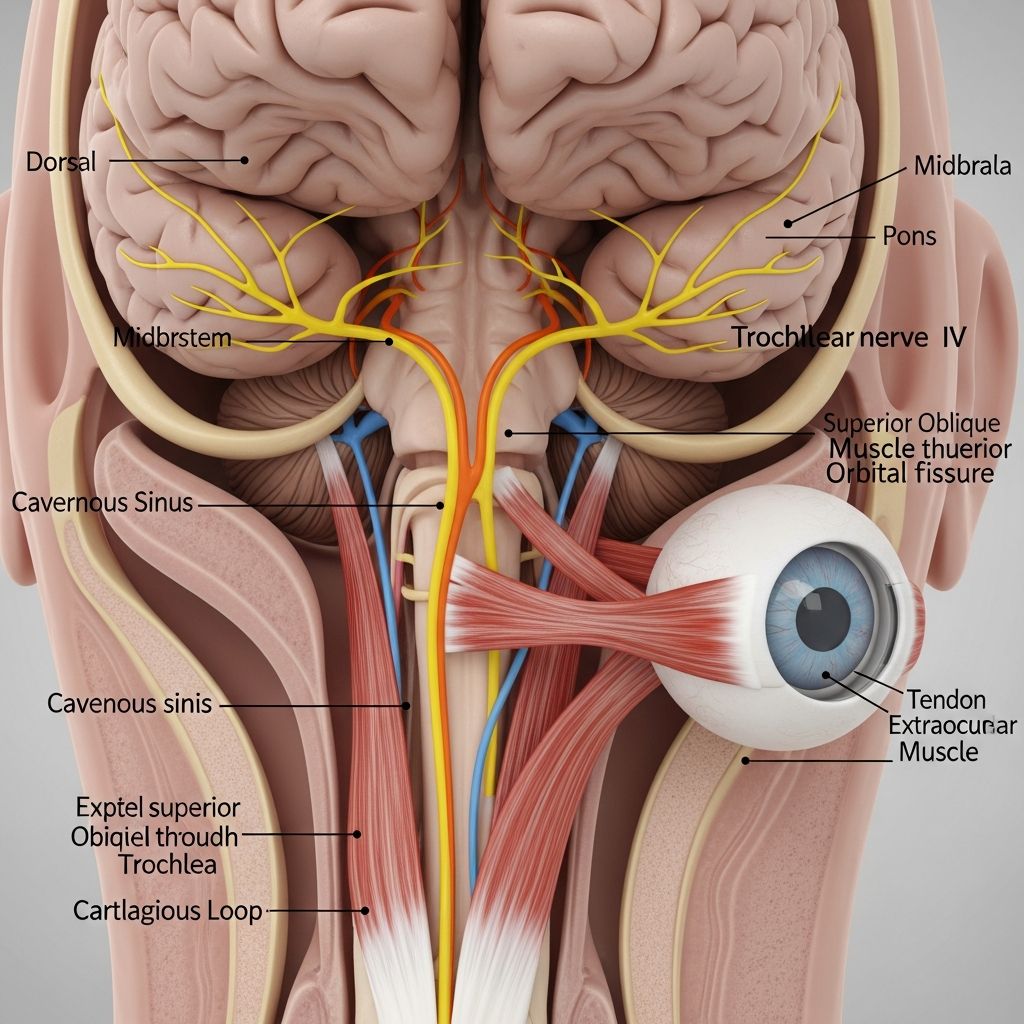
The trochlear nerve originates from a pair of symmetrical trochlear nuclei located within the medial midbrain at the level of the inferior colliculus. What makes the trochlear nerve distinctly unique among all cranial nerves is that it is the only cranial nerve to exit the brainstem from its dorsal (posterior) surface. This characteristic exit pattern is crucial to understanding the nerve’s clinical significance, particularly in cases of trauma or compression.
Decussation and Contralateral Innervation
One of the most distinctive features of the trochlear nerve is that its fibers decussate—or cross over—within the brainstem before exiting. This means that the left trochlear nucleus innervates the right superior oblique muscle, and the right trochlear nucleus innervates the left superior oblique muscle. This complete contralateral innervation is unique among cranial nerves and has important clinical implications. An injury to the trochlear nucleus in the brainstem results in contralateral superior oblique muscle palsy, whereas an injury to the trochlear nerve after it emerges from the brainstem causes ipsilateral superior oblique muscle palsy.
Course and Pathway
After exiting from the dorsal midbrain just inferior to the inferior colliculus, the trochlear nerve takes a circuitous route to reach the eye. The nerve initially travels dorsally and then winds ventrally around the brainstem, passing laterally and anteriorly around the pons. It extends forward through the subarachnoid space, where it passes between the posterior cerebral artery and the superior cerebellar artery.
Passage Through Cranial Structures
The trochlear nerve pierces the dura mater at the inferior margin of the tentorium cerebelli, a region particularly vulnerable to shearing forces during traumatic brain injury. Once it pierces the dura, the nerve enters the cavernous sinus, where it courses along the lateral wall. In the cavernous sinus, the trochlear nerve travels alongside three other cranial nerves: the oculomotor nerve (CN III), the abducens nerve (CN VI), and the ophthalmic and maxillary branches of the trigeminal nerve (CN V1 and V2). At this location, some sympathetic fibers may join the trochlear nerve, and it may receive sensory contributions from the trigeminal nerve.
Related Stories



The nerve then enters the orbit through the superior orbital fissure and continues anteriorly to reach the superior oblique muscle. This entire pathway, from the brainstem to the eye, represents the longest intracranial course of any cranial nerve, making it susceptible to injury at multiple points along its trajectory.
Function and Motor Control
The trochlear nerve is a purely motor nerve that transmits general somatic efferent impulses to the superior oblique muscle, controlling its contractions and the resulting eye movements. The superior oblique muscle functions through the trochlea, a cartilaginous pulley-like structure that guides the muscle’s tendon. This unique pulley system is what distinguishes the superior oblique from other extraocular muscles.
Eye Movements Controlled by the Trochlear Nerve
The superior oblique muscle, innervated by the trochlear nerve, enables three primary movements of the eyeball:
- Depression: The muscle pulls the eyeball downward, allowing you to look down when reading or descending stairs
- Abduction: The muscle moves the pupil away from the nose, enabling outward eye rotation
- Intorsion: The muscle rotates the eye such that the top of the eyeball turns toward the nose, or medial rotation
The superior oblique muscle’s unique anatomy contributes to these diverse functions. The muscle body is located behind the eyeball, but its tendon approaches from the front, passing through the trochlea and attaching to the superior aspect of the eyeball at approximately a 51-degree angle to the eyeball’s primary position. This angled attachment means the force exerted by the tendon has two components: a forward component that depresses the eye and a medial component that causes intorsion. Depending on where the eye is looking, the relative intensity of these two forces changes, allowing for coordinated eye movement during activities like reading and climbing stairs.
Clinical Anatomy and Relationships
The trochlear nerve works in coordination with other ocular motor nerves to maintain eye movement and alignment. The oculomotor nerve (CN III) controls most of the extraocular muscles, while the abducens nerve (CN VI) controls the lateral rectus muscle. Together, these three cranial nerves coordinate complex eye movements necessary for vision. The trochlear nerve’s interactions with the oculomotor and abducens nerves are particularly important for conjugate eye movements, where both eyes move together in the same direction.
Trochlear Nerve Disorders and Dysfunctions
Dysfunction of the trochlear nerve can result from various causes, including trauma, vascular events, inflammatory conditions, and neoplastic processes. Trochlear nerve palsy, the most common cranial nerve palsy, can significantly impact vision and quality of life.
Symptoms of Trochlear Nerve Palsy
Patients with trochlear nerve dysfunction typically experience the following symptoms:
- Vertical diplopia (double vision), particularly when looking downward
- Head tilting to compensate for eye misalignment
- Difficulty with depth perception
- Blurred or blended vision
- Difficulty reading or performing tasks requiring downward gaze
- Eye strain and discomfort
Causes of Trochlear Nerve Injury
The trochlear nerve’s long intracranial course and dorsal brainstem exit make it particularly vulnerable to injury. Common causes include:
- Traumatic Brain Injury: The trochlear nerve’s location near the superior orbital fissure makes it susceptible to shearing forces during head trauma, making it the most commonly injured cranial nerve in head injuries
- Vascular Events: Microvascular ischemia or infarction affecting the trochlear nucleus or nerve fibers
- Inflammatory Conditions: Inflammation of the nerve or surrounding structures
- Neoplastic Processes: Tumors affecting the brainstem, cavernous sinus, or orbit
- Surgical Complications: Injury during neurosurgical or otologic procedures
- Congenital Abnormalities: Developmental issues affecting the nerve or muscle
Diagnostic Approach
Diagnosis of trochlear nerve dysfunction involves clinical examination and imaging studies. The Parks-Bielschowsky three-step test is a clinical tool used to identify which extraocular muscle is paralyzed based on the direction of diplopia. Imaging modalities such as magnetic resonance imaging (MRI) or computed tomography (CT) scanning may be employed to identify structural lesions or compression affecting the nerve.
Management and Treatment
Treatment of trochlear nerve palsy depends on the underlying cause and severity of symptoms. Options include:
- Observation: Many cases of traumatic or microvascular trochlear nerve palsy resolve spontaneously within three to six months
- Prism Glasses: Prism correction can reduce diplopia by realigning the visual axes
- Surgical Intervention: Extraocular muscle surgery may be considered if symptoms persist beyond six months
- Treatment of Underlying Cause: If trochlear nerve dysfunction results from a treatable condition such as inflammation or vascular disease, addressing the underlying pathology is essential
Frequently Asked Questions
Q: Why is the trochlear nerve called the “pulley nerve”?
A: The trochlear nerve is named after the pulley-like structure called the trochlea through which the superior oblique muscle’s tendon passes. The term “trochlear” is derived from the Latin word “trochlea,” meaning pulley. This pulley system allows the superior oblique muscle to perform its unique functions of depression, abduction, and intorsion of the eye.
Q: Why is the trochlear nerve the only cranial nerve to exit the brainstem from the dorsal surface?
A: The anatomical reason for the trochlear nerve’s unique dorsal exit relates to the embryological development of the brainstem and the positioning of the nuclei. The trochlear nucleus’s location in the medial midbrain and the complete decussation of its fibers result in the nerve exiting from the back of the brainstem, a feature unique among all cranial nerves.
Q: What is the most common cause of trochlear nerve palsy?
A: Traumatic brain injury is the most common cause of acquired trochlear nerve palsy in adults. The nerve’s location near the superior orbital fissure and its long intracranial course make it particularly vulnerable to shearing forces during head trauma. Other common causes include microvascular ischemia, particularly in patients with diabetes or hypertension.
Q: Can trochlear nerve palsy resolve on its own?
A: Yes, many cases of trochlear nerve palsy, particularly those resulting from trauma or microvascular events, resolve spontaneously within three to six months. However, if symptoms persist beyond this timeframe, medical or surgical intervention may be necessary.
Q: How does the trochlear nerve differ from other ocular motor nerves?
A: The trochlear nerve differs from the oculomotor (CN III) and abducens (CN VI) nerves in several ways. It is the only cranial nerve to exit the brainstem dorsally, the only to completely decussate before exiting, and the only to innervate a muscle on the contralateral side from its nucleus. Additionally, it is the smallest cranial nerve by axon count but has the longest intracranial course.
Q: What imaging studies are used to evaluate trochlear nerve pathology?
A: MRI and CT scanning are the primary imaging modalities used to evaluate trochlear nerve pathology. MRI provides superior soft tissue resolution and is preferred for evaluating the brainstem, cavernous sinus, and orbit. CT may be used for initial evaluation of acute head trauma to assess for fractures or acute bleeding.
Conclusion
The trochlear nerve, while the smallest cranial nerve, plays a crucial role in eye movement and vision. Its unique anatomical features—including its dorsal brainstem exit, complete decussation, and longest intracranial course among cranial nerves—make it distinctive in the neurological system. Understanding its anatomy, function, and potential disorders is essential for healthcare professionals involved in neurological assessment and treatment. Whether examining a patient with diplopia or evaluating head trauma, knowledge of the trochlear nerve remains fundamental to clinical practice and neuroscience education.
References
- Neuroanatomy, Cranial Nerve 4 (Trochlear) — National Center for Biotechnology Information, National Institutes of Health. 2024. https://www.ncbi.nlm.nih.gov/books/NBK537244/
- Trochlear Nerve (Cranial Nerve IV): Anatomy and Function — Kenhub. 2024. https://www.kenhub.com/en/library/anatomy/the-trochlear-nerve-and-the-abducent-nerve
- Trochlear Nerve — Physiopedia. 2024. https://www.physio-pedia.com/Trochlear_Nerve
- Trochlear Nerve: What To Know — WebMD. 2024. https://www.webmd.com/brain/trochlear-nerve-what-to-know
- The Trochlear Nerve (CN IV) — TeachMeAnatomy. 2024. https://teachmeanatomy.info/head/cranial-nerves/trochlear-nerve/
Similar Articles








Read full bio of Sneha Tete