Tropical Ulcer: Causes, Symptoms, and Treatment
Comprehensive guide to understanding tropical ulcers, their clinical presentation, diagnosis, and evidence-based treatment approaches.
What is a Tropical Ulcer?
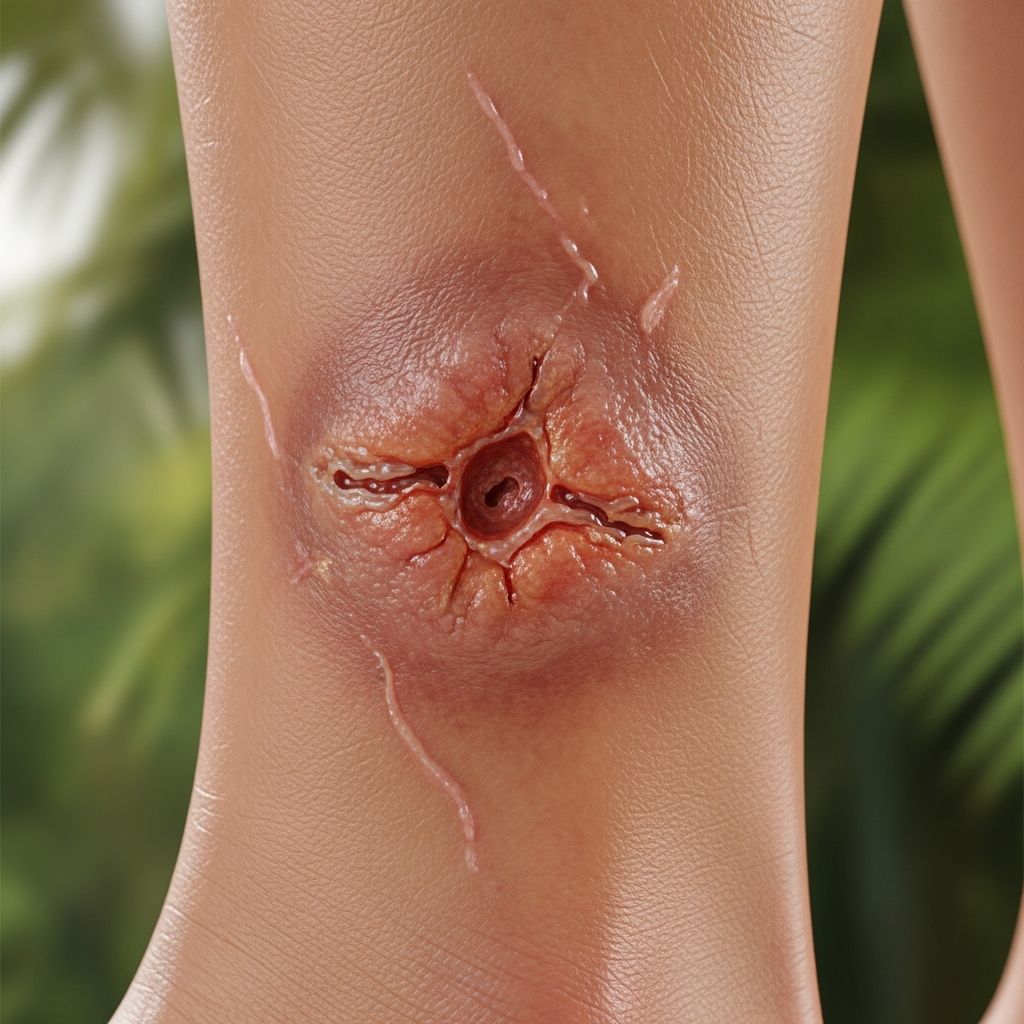
A tropical ulcer is a painful, rapidly enlarging skin ulceration caused by a mixed bacterial infection. This condition, also known as tropical phagedenic ulcer or jungle rot, is a synergistic bacterial infection primarily caused by Fusobacterium ulcerans, spirochaetes, and other bacteria working together. The disease typically affects individuals living in hot, humid tropical regions, with young children and older adults rarely experiencing this condition. The infection can develop from bacteria entering the body through minor wounds, cuts, insect bites, or other breaks in the skin.
Clinical Features and Presentation
Tropical ulcers present with distinctive clinical characteristics that aid in diagnosis. The ulcer initially appears as a circular, superficial lesion with purple edges that is extremely painful to the touch. The condition is marked by rapid enlargement across the skin surface, distinguishing it from other chronic ulcerations. Unlike buruli ulcers, tropical ulcers demonstrate minimal undermining of the surrounding tissue.
The key clinical features include:
- Rapid, aggressive enlargement of the ulcer
- Intense pain, particularly at the wound margins
- Purple or erythematous (red) edges surrounding the lesion
- Purulent drainage and exudation
- Superficial to moderately deep tissue involvement
- Predominantly affects the lower limbs
- Most common in children aged 5-15 years and young adults
Geographic Distribution and Risk Factors
Tropical ulcers occur primarily in individuals living in or recently returning from tropical and subtropical regions with high temperatures and humidity. The condition is endemic in parts of Africa, Southeast Asia, the Pacific Islands, Central America, and the Caribbean. Risk factors include poor hygiene, malnutrition, inadequate wound care, and living conditions with limited access to clean water and healthcare facilities.
Demographic patterns show that the disease affects older children and young adults most frequently, with children under five years and adults over 45 years rarely being affected. This age distribution suggests that acquired immunity may develop with age or prolonged exposure.
Diagnosis and Differential Diagnosis
Accurate diagnosis of tropical ulcers requires careful clinical assessment and appropriate investigations to differentiate from other causes of chronic leg ulceration. It is essential to rule out other conditions including cutaneous leishmaniasis, atypical mycobacteria, pyoderma gangrenosum, venous ulcers, syphilitic gumma, vasculitic ulcers, and neoplastic ulcers.
Diagnostic approaches include:
- Clinical examination: Assessment of ulcer characteristics, location, and surrounding tissue
- Bacterial swabs: Swabs taken from the base and edges of the ulcer to determine the type and sensitivity of bacteria present
- Skin biopsies: May be needed to exclude other causes of chronic ulceration
- Histological examination: Tissue samples sent in formalin for routine histology and special staining
- Bacterial and mycobacterial culture: Fresh tissue samples sent in saline-soaked gauze for culture and polymerase chain reaction (PCR) testing
- Laboratory investigations: To assess nutritional status and general health
The combination of clinical presentation with rapid, painful enlargement and positive bacterial cultures typically confirms the diagnosis of tropical ulcer.
First-Line Treatment
The cornerstone of tropical ulcer management involves a combined approach of antibiotic therapy, wound care, and supportive measures. First-line antibiotic treatment consists of a combination of penicillin and metronidazole.
The standard antibiotic regimen includes:
- Penicillin 500 mg orally every 6 hours for 1 week
- Metronidazole 250 mg orally every 8 hours for 10 days
This combination targets both aerobic and anaerobic bacteria involved in the synergistic infection. Treatment duration typically ranges from 7-10 days, though this may be extended based on clinical response. Antibiotic therapy should be combined with proper wound care, cleansing, immobilization, and nutritional support for optimal outcomes.
Related Stories



Alternative Antibiotic Options
For patients with penicillin allergies, alternative antibiotics can be used. Tetracyclines are recommended for penicillin-allergic patients, with options including:
- Minocycline 100 mg orally twice daily
- Doxycycline 100 mg orally twice daily
Other antibiotic options mentioned in clinical literature include erythromycin and fluoroquinolones, though these are typically considered second-line agents. The choice of antibiotic may be adjusted based on local susceptibility patterns and availability of medications.
Topical Wound Management
Proper wound care is crucial for successful treatment of tropical ulcers and often requires more intensive management than systemic antibiotics alone. The approach to topical treatment should be tailored based on the availability of resources and the stage of ulcer healing.
Initial Wound Cleansing
At the beginning of treatment, frequent dressing changes with appropriate cleansing solutions are recommended. Antibacterial rinse solutions should be used to irrigate the ulcers at each dressing change, allowing these substances to soak into the wound for approximately 15-20 minutes. Common cleansing solutions include:
- 2% vinegar solution
- Super-oxidized water
- 3% hydrogen peroxide
Early Dressing Strategies
Following initial cleansing, several dressing approaches can be employed. Gentian violet, a traditional antimicrobial agent, may be applied to the entire wound bed during the first two to three dressing changes, as it penetrates several millimeters into the wound surface and may accelerate bacterial eradication. However, its long-term safety is not fully established.
Cotton gauze dressings provide an economical option in resource-limited settings. To prevent dressings from sticking to the wound bed, a protective barrier layer consisting of a 50:50 mixture of zinc paste and petrolatum jelly can be applied over the entire wound surface before gauze placement.
Advanced Dressing Options
When resources permit, modern dressing materials offer advantages including:
- Silver-coated polyurethane foam dressings with antimicrobial properties
- Iodine-containing polyurethane dressings
- Sorbact gauze with antimicrobial properties
- Polymem dressings
These advanced dressings are particularly beneficial once the ulcer has stabilized and is no longer rapidly expanding.
Natural and Alternative Topical Treatments
In resource-limited settings, natural wound treatments have shown effectiveness. These include:
- Honey applied daily until necrotic tissue clears, then at longer intervals
- White granulated sugar applied similarly to honey
- Activated charcoal powder filling the wound cavity, or mixed with honey in a 50:50 ratio for drier wounds
Surgical Management
Large ulcers exceeding 5 centimeters in diameter typically require surgical intervention. Surgical management includes two primary approaches:
- Surgical debridement: Removal of dead, necrotic tissue to promote healing and eliminate bacterial reservoirs
- Skin grafting: Partial-thickness or full-thickness skin grafts can accelerate healing and improve cosmetic outcomes once the ulcer bed contains healthy granulation tissue
Simpler grafting techniques such as blister technique and punch-grafting methods may be used when advanced surgical facilities are unavailable. However, in many rural tropical regions where tropical ulcers are endemic, advanced surgical techniques are not accessible, and wounds are allowed to heal through secondary intention with supportive care.
Advanced Wound Healing Modalities
Once the ulcer bed is clean and demonstrates early granulation tissue formation, additional therapeutic options become available:
- Negative pressure wound therapy: Can be applied to accelerate granulation tissue formation and promote wound contraction
- Hyperbaric oxygen therapy: May enhance wound healing in selected cases
These advanced modalities are typically available only in well-resourced healthcare settings and major medical centers.
Supportive Care Measures
Beyond antimicrobial and surgical management, comprehensive supportive care is essential for optimal outcomes:
- Nutritional support: Adequate protein and calorie intake to support immune function and tissue repair
- Wound immobilization: Elevation and protection of the affected limb to reduce pain and promote healing
- Pain management: Analgesics as needed, particularly during dressing changes
- Infection prevention: Strict hygiene measures to prevent secondary bacterial superinfection
- Patient education: Training caregivers in proper dressing technique and wound care
Prognosis and Healing Timeline
The prognosis for tropical ulcers is generally favorable when appropriate treatment is initiated promptly. Healing timelines vary based on ulcer size, treatment intensity, and patient factors. Small ulcers may heal within several weeks of appropriate antibiotic therapy and wound care, while larger ulcers may require months of treatment, particularly if surgical intervention is necessary.
Poor prognostic factors include delayed diagnosis, malnutrition, inadequate antibiotic therapy, poor wound care, and limited access to healthcare. Complications such as secondary bacterial superinfection or osteomyelitis may occur if the condition is neglected.
Prevention and Public Health Considerations
Prevention of tropical ulcers focuses on reducing risk factors and promoting general health in endemic areas:
- Prompt treatment of minor skin injuries and wounds
- Maintenance of good personal hygiene
- Adequate nutrition and health status
- Access to clean water and sanitation
- Prompt medical attention for signs of infection
- Health education in endemic communities
Improving socioeconomic conditions and access to healthcare in tropical regions can significantly reduce the incidence and severity of tropical ulcers.
Frequently Asked Questions (FAQs)
Q: Is tropical ulcer contagious?
A: Tropical ulcers are not directly contagious from person to person. However, the bacteria present in the ulcer can potentially contaminate other wounds or breaks in skin if contact occurs, making careful hygiene important.
Q: Can tropical ulcer be cured?
A: Yes, tropical ulcers can be successfully treated and cured with appropriate antibiotic therapy, wound care, and supportive measures. Early diagnosis and treatment lead to better outcomes and faster healing.
Q: How long does treatment typically take?
A: Small tropical ulcers may heal within 2-4 weeks of appropriate treatment, while larger ulcers may require 2-3 months or longer, especially if surgical intervention is needed.
Q: What should I do if I have symptoms of a tropical ulcer?
A: Seek medical attention promptly. Early diagnosis and treatment significantly improve outcomes. Your healthcare provider can perform appropriate diagnostic tests and initiate treatment.
Q: Are there any long-term complications?
A: Most tropical ulcers heal completely with appropriate treatment. Scarring may occur, particularly with larger ulcers. Rarely, if untreated or severely neglected, complications such as osteomyelitis or sepsis can develop.
References
- Tropical and exotic dermatoses and ulcers — Royal Australian College of General Practitioners (RACGP). 2014. https://www.racgp.org.au/afp/2014/september/tropical-and-exotic-dermatoses-and-ulcers
- Tropical phagedenic ulcers: Comprehensive wound management guide — Wounds Africa. https://www.woundsafrica.com/tropical-phagedenic-ulcers
- Tropical Ulcer — DermNet New Zealand. https://dermnetnz.org/topics/tropical-ulcer
- Tropical Ulcer: Mixed bacterial infection of skin — Harper’s Textbook of Pediatric Dermatology, Wiley Online Library. https://onlinelibrary.wiley.com/doi/abs/10.1002/9781444345384.ch66
- Dermatologic Clues to Emerging Tropical Infections: A Narrative Review — PubMed Central. 2024. https://pmc.ncbi.nlm.nih.gov/articles/PMC12542232/
Similar Articles








Read full bio of Sneha Tete