Tuberculin Skin Test: Step-By-Step Guide And Results
Comprehensive guide to the tuberculin skin test for detecting TB infection, including procedure, interpretation, and follow-up care.
The tuberculin skin test, commonly known as the TB skin test or Mantoux test, serves as a vital tool for identifying latent tuberculosis (TB) infection by gauging the body’s immune response to injected proteins derived from the TB bacterium. This method helps in early detection, particularly among at-risk populations, enabling preventive measures before the infection progresses to active disease.
Understanding the Purpose and Mechanism
The primary goal of the tuberculin skin test is to detect exposure to Mycobacterium tuberculosis, the bacterium responsible for TB. It involves injecting a small amount of purified protein derivative (PPD), a standardized extract from killed TB bacteria, into the skin. In individuals previously exposed, the immune system recognizes these proteins and triggers a delayed hypersensitivity reaction, manifesting as localized swelling.
This reaction typically develops 2 to 8 weeks post-infection, as T-cells mount a response. The test does not distinguish between latent infection and active disease but indicates prior exposure. It remains a cornerstone of TB screening due to its simplicity and cost-effectiveness, especially in resource-limited settings.
Who Should Undergo Testing?
TB screening via skin test is recommended for high-risk groups to facilitate timely intervention. Key candidates include:
- Healthcare workers exposed to TB patients.
- Individuals with HIV or other immunosuppressive conditions.
- Recent contacts of active TB cases.
- People from TB-endemic regions.
- Children under 5 years and those with conditions like diabetes or kidney disease.
- Prisoners, homeless individuals, and residents of long-term care facilities.
For baseline testing in healthcare personnel, a two-step approach is advised to account for prior exposure that might cause a “boosted” reaction on retesting.
Step-by-Step Administration Process
Administering the test requires precision to ensure accuracy. It demands two visits: one for injection and another for reading results.
First Visit: Injection
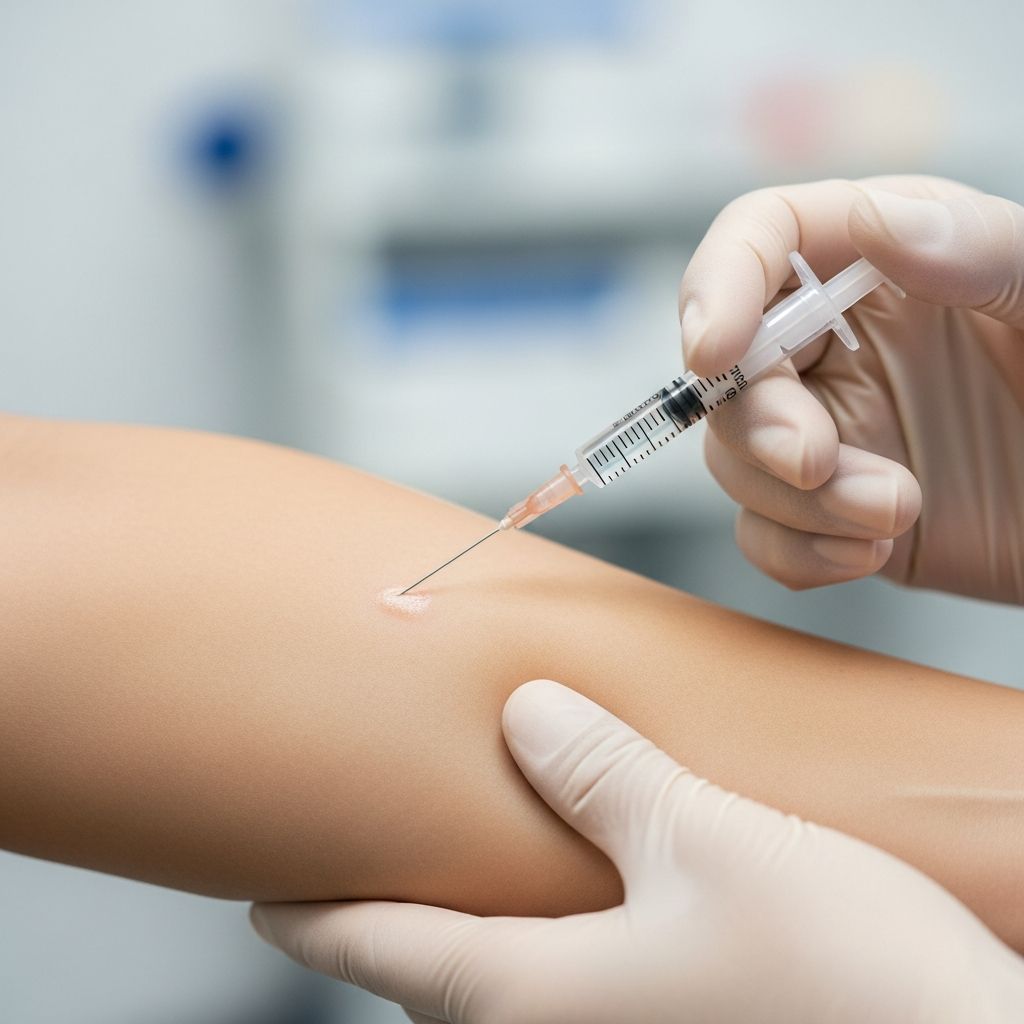
A trained healthcare provider cleans the inner forearm with alcohol and allows it to dry. Using a 27-gauge tuberculin syringe, 0.1 ml of PPD solution is injected intradermally, bevel up, creating a 6-10 mm wheal. The site must remain uncovered and undisturbed.
The procedure takes about 5 minutes. Patients should avoid scratching or applying lotions to the area.
Second Visit: Reading Results
Return 48-72 hours later for evaluation. Only trained personnel should measure the induration—the firm, raised area—transversely across the forearm, ignoring redness. Measurements outside this window invalidate results, necessitating a repeat test.
Interpreting Results by Risk Level
Positive thresholds vary by individual risk, balancing sensitivity and specificity. The table below summarizes criteria:
| Induration Size | Risk Group |
|---|---|
| ≥5 mm | HIV-positive, recent TB contacts, abnormal chest X-ray, organ transplant recipients, immunosuppressed (e.g., high-dose steroids), high-risk medical conditions (silicosis, diabetes, chronic kidney disease), low body weight, children <5 years. |
| ≥10 mm | Recent immigrants from high-prevalence areas, IV drug users, residents/employees of high-risk settings (prisons, shelters), certain medical conditions, children <4 years exposed to high-risk adults, mycobacteriology lab personnel. |
| ≥15 mm | No known risk factors. |
Related Stories



A positive result prompts further evaluation for active TB via chest X-ray and sputum analysis. Latent TB treatment, if confirmed, prevents progression in 90% of cases.
The Two-Step Testing Protocol
For ongoing screening, like in healthcare workers, two-step testing minimizes false conversions. If the first test is negative, administer a second 1-3 weeks later. A positive second result likely indicates past infection (boosted response), not new acquisition.
- First test negative → Second test 1-3 weeks later.
- Second test positive → Classify as previously infected; no conversion.
False Positives, False Negatives, and Limitations
While reliable, the test has caveats:
- False Positives: Prior BCG vaccination or exposure to non-TB mycobacteria can cause reactions.
- False Negatives: Occur in anergic states (e.g., HIV, overwhelming infection, recent live vaccines). Very young children or elderly may not react reliably.
- Limitations: Requires two visits; subjective reading; not ideal for immunocompromised patients where blood tests (IGRA) may be preferable.
Anergic individuals might need anergy testing or alternative diagnostics like interferon-gamma release assays (IGRAs).
Potential Side Effects and Precautions
The test is safe, with minimal risks. Common reactions include temporary itching, redness, or bruising at the site. Rarely, blistering or necrosis occurs—report severe symptoms promptly.
- Avoid if history of severe reaction to PPD.
- Inform provider of recent live vaccines or steroids.
- No impact on daily activities post-injection.
Follow-Up After Positive Results
A positive TST mandates:
- Symptom review (cough, fever, weight loss).
- Chest radiograph.
- Sputum tests if indicated.
For latent TB, options include isoniazid, rifampin, or shorter regimens like 3HP (isoniazid-rifapentine weekly for 12 weeks), highly effective in preventing active disease.
Comparing TST to Blood Tests
| Aspect | TST (Skin Test) | IGRA (Blood Test) |
|---|---|---|
| Visits Required | 2 | 1 |
| Affected by BCG | Yes | No |
| Best For | Children, low-resource settings | BCG-vaccinated, immunocompromised |
| Cost | Lower | Higher |
TST excels in accessibility, while IGRAs offer higher specificity.
Frequently Asked Questions (FAQs)
What if I miss the 48-72 hour reading window?
The test must be repeated, as reactions peak then and wane afterward.
Can I shower after the injection?
Yes, but avoid scrubbing the site vigorously.
Is the test painful?
A mild prick; the wheal may itch mildly.
What does a negative test mean?
No TB infection detected at testing time, but doesn’t rule out future exposure.
How often should I be tested?
Depends on risk; annually for high-risk occupations.
Global Context and Public Health Role
TB remains a global killer, with 10 million cases yearly. TST screening underpins control strategies in low-incidence countries, identifying latent cases for treatment to curb transmission. Integration with vaccination programs and contact tracing amplifies impact.
In high-burden areas, combining TST with IGRAs optimizes detection. Public health campaigns emphasize testing vulnerable groups to achieve WHO End TB goals.
References
- Clinical Testing Guidance for Tuberculosis: Tuberculin Skin Test — Centers for Disease Control and Prevention (CDC). 2023-10-01. https://www.cdc.gov/tb/hcp/testing-diagnosis/tuberculin-skin-test.html
- Tuberculin (intradermal route) — Mayo Clinic. 2024-05-15. https://www.mayoclinic.org/drugs-supplements/tuberculin-intradermal-route/description/drg-20066571
- Tuberculin (TB Skin Test) — Testing.com. 2024-02-20. https://www.testing.com/tests/tb-skin-test/
- What Is a TB (Tuberculosis) Test? — Cleveland Clinic. 2024-01-10. https://my.clevelandclinic.org/health/diagnostics/22751-tuberculosis-tb-test
- Testing for Tuberculosis: Skin Test — Centers for Disease Control and Prevention (CDC). 2023-11-05. https://www.cdc.gov/tb/testing/skin-test.html
Similar Articles








Read full bio of medha deb