Tuberculosis Screening: Essential Guide To Tests & Follow-Up
Essential guide to TB screening methods, indications, and interpretation for healthcare professionals and at-risk individuals.
Tuberculosis (TB) screening is crucial for detecting latent tuberculosis infection (LTBI) in at-risk populations to prevent progression to active disease. Primary methods include the tuberculin skin test (TST) and interferon-gamma release assays (IGRA), each with distinct advantages and limitations.
What is tuberculosis screening?
Tuberculosis screening identifies individuals infected with Mycobacterium tuberculosis who are asymptomatic, known as latent TB infection (LTBI). LTBI affects about one-quarter of the global population, with a 5-15% lifetime risk of progressing to active TB without treatment. Screening targets those at high risk for infection or progression, enabling preventive therapy to reduce active TB incidence.
Screening does not diagnose active TB but flags individuals needing further evaluation. Both TST and IGRA detect cell-mediated immune responses to TB antigens but cannot distinguish latent from active infection or recent from remote exposure.
Who should be screened for tuberculosis?
Screening is recommended for populations at increased risk of TB infection or progression to disease. Key groups include:
- Close contacts of active TB cases.
- Individuals from high TB-prevalence countries.
- Healthcare workers, prison staff, and homeless shelter employees with frequent exposure.
- Immunocompromised persons (e.g., HIV-positive, organ transplant recipients, those on immunosuppressive therapy).
- People with conditions like diabetes, chronic kidney disease, silicosis, or low body weight (<90% ideal).
- Children under 5 years, especially those exposed to high-risk adults.
- Residents and employees of high-risk congregate settings (e.g., correctional facilities, long-term care).
The U.S. Preventive Services Task Force (USPSTF) recommends screening adults at elevated risk, citing moderate net benefit from early detection and treatment.
Tuberculin skin test (TST)
How is the TST administered?
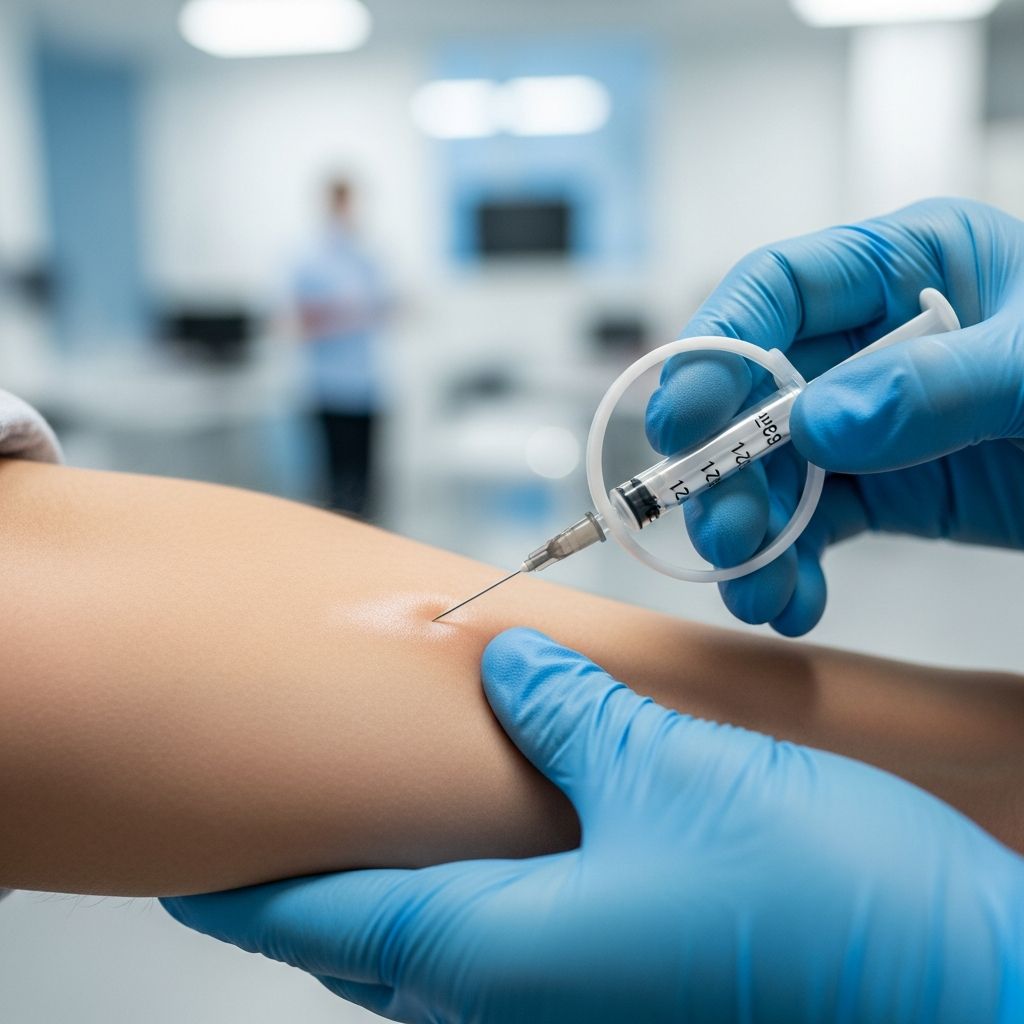
The TST, or Mantoux test, involves intradermal injection of 0.1 mL (5 tuberculin units) purified protein derivative (PPD) into the inner forearm using a 27-gauge tuberculin syringe, bevel up. A wheal of 6-10 mm should form. The reaction is read 48-72 hours later by measuring induration (firm swelling) perpendicular to the forearm axis, ignoring erythema.
A two-step approach may be used initially for high-risk occupations: if the first test is negative, a second is placed 1-3 weeks later to detect ‘boosted’ responses from prior sensitization.
How is the TST interpreted?
Interpretation depends on induration size and risk factors:
| Induration (mm) | High-risk groups (positive if ≥) |
|---|---|
| ≥5 | HIV-infected, recent contacts, organ transplant recipients, immunocompromised on steroids/anti-TNF. |
| ≥10 | Recent immigrants (<5 years) from high-prevalence countries, IV drug users, residents/employees of high-risk settings, children <4 years, those with medical risks (diabetes, kidney disease, etc.). |
| ≥15 | No known risk factors. |
Positive results warrant chest X-ray and symptom review. False positives occur with BCG vaccination or nontuberculous mycobacteria; false negatives in anergic states (e.g., HIV, young children).
Interferon-gamma release assays (IGRA)
How do IGRAs work?
IGRAs measure interferon-gamma release from T-cells sensitized to TB-specific antigens (ESAT-6, CFP-10, TB7.7). Two FDA-approved assays: QuantiFERON-TB Gold (measures IFN-γ in IU/mL via ELISA on whole blood) and T-SPOT.TB (ELISpot on peripheral blood mononuclear cells counting IFN-γ-producing cells).
Related Stories



Blood is drawn once, processed within 8-30 hours, unaffected by BCG or most nontuberculous mycobacteria.
Interpretation of IGRA
QuantiFERON-TB Gold: Positive if ≥0.35 IU/mL above nil (after conversion); negative <0.35 IU/mL; indeterminate if high background or low mitogen response. T-SPOT.TB: Positive ≥8 spots (ESAT-6 or CFP-10 minus nil); negative <5 spots; borderline 5-7 spots; invalid otherwise.
IGRAs are preferred in BCG-vaccinated individuals due to higher specificity.
TST versus IGRA
| Feature | TST | IGRA |
|---|---|---|
| Office visits | 2 (or 4 for two-step) | 1 |
| Turnaround time | 48-72 hours | 24 hours |
| Booster effect | Possible | No |
| BCG interference | Yes (false positive) | No |
| Reader bias | Subjective | Objective (lab) |
| Cost | Lower | Higher |
| Use in <5 years | Established | Limited data |
| HIV sensitivity | Lower | Lower |
TST has more long-term data but logistical challenges; IGRA offers convenience but higher cost and indeterminate rates in immunocompromised.
What to do with a positive screening test?
Positive TST or IGRA prompts:
- Symptom screen (cough, fever, weight loss, night sweats ≥1 month).
- Chest X-ray.
If symptomatic or abnormal X-ray: Collect 3 sputum specimens (8-24 hours apart, one morning) for AFB smear, culture, and NAAT if moderate-high risk.
No active TB: Treat LTBI based on risk (e.g., isoniazid 6-9 months, rifampin 4 months, or combination regimens).
False positive and false negative tests
- False positives (TST): BCG vaccination, environmental mycobacteria, improper storage/reading.
- False negatives: Anergy (HIV, malnutrition, immunosuppression), recent infection (<2-10 weeks), live vaccines, overwhelming active TB.
- IGRAs: Indeterminate in 5-15% (immunosuppression, technical issues).
Special situations
BCG vaccination
Prior BCG causes TST false positives (waning over time/decades); IGRA unaffected, preferred for BCG-vaccinated.
Immunocompromised patients
Lower test sensitivity; screen despite negatives if high suspicion. Use lowest induration cutoffs.
Healthcare workers
Annual/biennial screening; two-step initial TST; IGRA serial testing stable.
Children
TST standard (<5 years IGRA data limited); window period 2-12 weeks post-exposure.
Pregnancy
Screen if high risk; defer LTBI treatment until postpartum unless severe immunosuppression.
Serial testing
For ongoing exposure (e.g., HCWs): IGRA preferred (no boosting); TST boosting can mimic conversion. Significant change: TST ≥10 mm increase; IGRA per manufacturer (e.g., QuantiFERON ≥0.35 IU/mL increase and >25% prior value).
Recent contact investigations
Initial negative: Retest 8-10 weeks post-exposure. Treat window-period negatives in high-risk (e.g., children).
Frequently Asked Questions
What if I had BCG vaccine?
TST may be falsely positive; IGRA is more specific.
Can TB tests diagnose active TB?
No, they detect infection; chest X-ray/sputum needed for active disease.
How often should HCWs be screened?
Per institutional policy, often annually; IGRA avoids boosting.
What if TST is positive but IGRA negative?
Clinical correlation; consider exposure history, BCG. Discordance in 10-20%; evaluate as positive if high risk.
Is two-step TST always needed?
Only for baseline in serial testing to detect boosting.
References
- Comprehensive Tuberculosis Testing for the Dermatologist — PMC/NCBI. 2015-06-01. https://pmc.ncbi.nlm.nih.gov/articles/PMC4456800/
- Occupational Health Services – Tuberculosis Testing — US Drug Test Centers. 2023-01-01. https://www.usdrugtestcenters.com/occupational-health-services-tuberculosis-testing.html
- Clinical Testing Guidance for Tuberculosis: Tuberculin Skin Test — CDC. 2024-01-01. https://www.cdc.gov/tb/hcp/testing-diagnosis/tuberculin-skin-test.html
- Latent Tuberculosis Infection in Adults: Screening — USPSTF. 2023-10-17. https://www.uspreventiveservicestaskforce.org/uspstf/recommendation/latent-tuberculosis-infection-screening
- What Is a TB (Tuberculosis) Test? — Cleveland Clinic. 2023-01-01. https://my.clevelandclinic.org/health/diagnostics/22751-tuberculosis-tb-test
Similar Articles








Read full bio of medha deb