Tumor Necrosis Factor Inhibitors: 5 Biologics for Autoimmunity
Anti-TNFα drugs revolutionizing treatment for severe inflammatory skin diseases, psoriasis, and arthritis with targeted biologic therapy.
Updated 10 April 2024
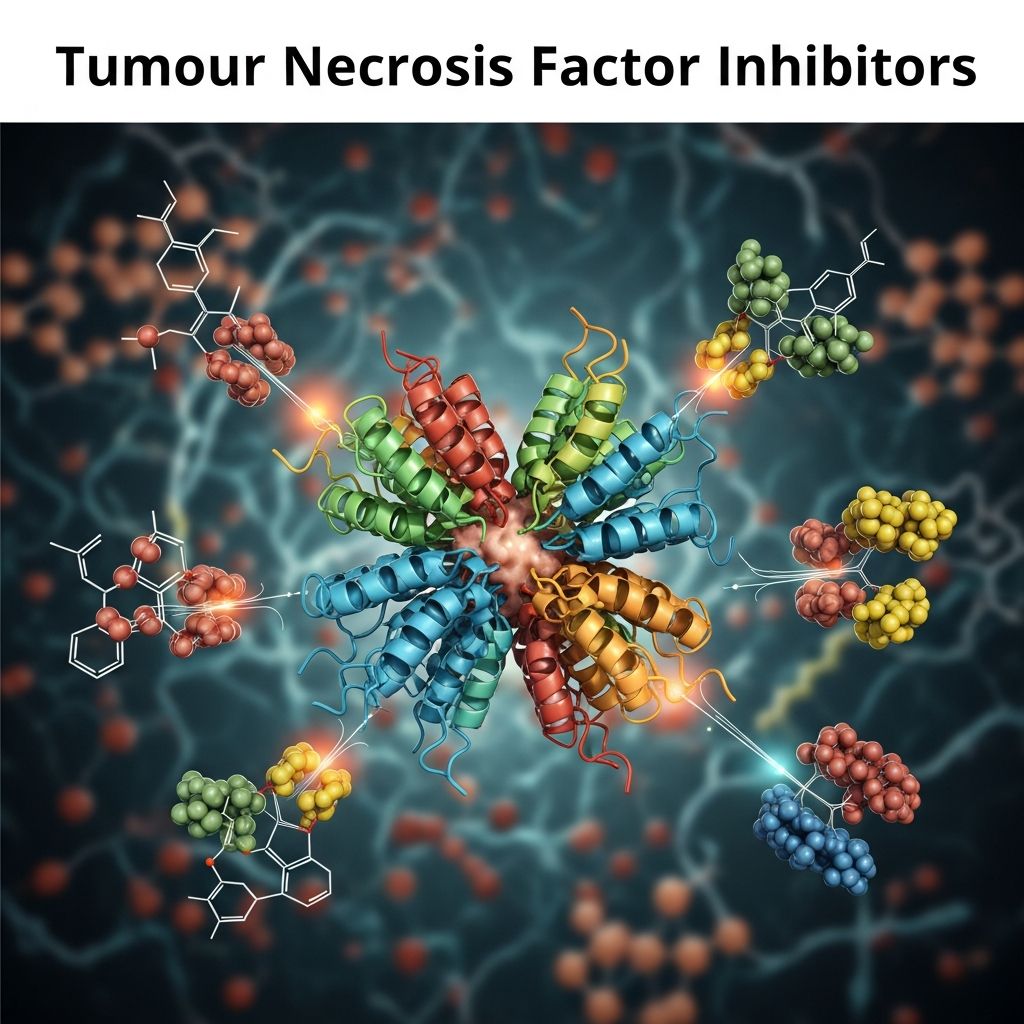
Tumour necrosis factor (TNF) inhibitors, also known as anti-TNF agents, are biologic drugs that target and neutralise TNF-alpha, a key proinflammatory cytokine driving inflammation in autoimmune and inflammatory conditions. These monoclonal antibodies were among the first biologics introduced to the market, primarily controlling inflammation in severe inflammatory skin diseases, arthritis, and bowel disorders.
What are tumour necrosis factor inhibitors?
The most potent TNF inhibitors are
monoclonal antibodies
specifically designed against TNF-alpha (TNFα). These engineered proteins bind to TNFα, preventing it from interacting with cell surface receptors and thus blocking downstream inflammatory cascades.Key anti-TNFα monoclonal antibodies include:
- Infliximab (Remicade®) – A chimeric (part mouse, part human) monoclonal antibody approved by the US FDA for psoriasis in 2006 and psoriatic arthritis in 2005.
- Adalimumab (Humira®) – A fully human monoclonal antibody approved for psoriatic arthritis in 2005 and later for plaque psoriasis.
- Golimumab (Simponi®) – A human monoclonal antibody used in rheumatologic conditions with emerging dermatologic applications.
- Certolizumab pegol (Cimzia®) – A PEGylated Fab’ fragment of a humanised anti-TNF monoclonal antibody, noted for efficacy in folliculitis decalvans.
Other agents with anti-TNF activity include:
- Etanercept (Enbrel®) – A soluble fusion protein comprising TNF receptor II linked to the Fc portion of human IgG1, FDA-approved for psoriasis in 2004 and psoriatic arthritis in 2002.
Natural compounds exhibiting TNF inhibition properties:
- Thalidomide and its analogues (e.g., lenalidomide)
- Curcumin (from turmeric)
- Resveratrol (found in grapes and red wine)
These biologics allow dermatologists to tailor therapy based on patient-specific needs, offering superior efficacy over traditional systemic therapies for moderate-to-severe cases.
What are tumour necrosis factor inhibitors used for?
Anti-TNF drugs are primarily indicated for
severe chronic plaque psoriasis
, particularly when conventional therapies like methotrexate, cyclosporine, or phototherapy fail. Clinical trials demonstrate significant improvements in Psoriasis Area and Severity Index (PASI) scores, often achieving PASI 75 (75% reduction) or higher, alongside enhancements in health-related quality of life (HRQoL).They are also employed off-label or in refractory cases for other severe inflammatory skin diseases, including:
- Hidradenitis suppurativa – Adalimumab is FDA-approved, reducing inflammatory nodules and abscesses.
- Pyoderma gangrenosum – Rapid lesion healing reported with infliximab infusions.
- Sapho syndrome – Effective for osteoarticular and skin manifestations.
- Behçet disease – Controls oral/genital ulcers and uveitis.
- Cicatricial alopecia variants like folliculitis decalvans (FD) and dissecting cellulitis of the scalp (DCS), where infliximab and etanercept halt hair loss and promote regrowth in some cases.
- Erosive pustular dermatosis of the scalp and acne keloidalis.
Beyond dermatology, TNF inhibitors treat psoriatic arthritis (ACR score improvements superior to DMARDs), rheumatoid arthritis, Crohn disease, ulcerative colitis, and ankylosing spondylitis.
How do tumour necrosis factor inhibitors work?
TNFα is a central mediator in inflammatory pathways, upregulated in psoriasis lesional skin and psoriatic arthritis synovium. It promotes keratinocyte hyperproliferation, angiogenesis, and recruitment of inflammatory cells. Anti-TNF agents neutralise soluble and membrane-bound TNFα, disrupting these processes and restoring immune homeostasis.
Distinct mechanisms:
- Monoclonal antibodies (infliximab, adalimumab) bind both soluble and transmembrane TNF.
- Etanercept primarily targets soluble TNF via its receptor fusion design.
This targeted action minimises off-target effects compared to broad immunosuppressants, though long-term data highlight risks like waning efficacy over time.
Related Stories



Clinical efficacy data
| Drug | Key Trials/Outcomes | PASI Response |
|---|---|---|
| Etanercept | Phase 4 study: 50mg SC twice weekly x12w, then weekly x12w | PASI 75 in >50% at 24w |
| Infliximab | Express study: 5mg/kg infusions | PASI 75: 80% at 10w |
| Adalimumab | CHAMPION trial | PASI 75: 71-79% at 16w |
In cicatricial alopecia, TNF inhibitors like infliximab induced rapid improvement in FD without recurrence in isolated cases, though challenge-rechallenge phenomena indicate dependency.
Administration
Anti-TNF biologics are administered parenterally:
- Infliximab: Intravenous infusion (e.g., 5 mg/kg at weeks 0, 2, 6, then every 8 weeks).
- Adalimumab: Subcutaneous injection (40 mg every 2 weeks).
- Etanercept: Subcutaneous (50 mg weekly).
- Golimumab/Certolizumab: Subcutaneous monthly or biweekly.
Dosing may be adjusted for induction or maintenance based on response.
What are the side effects of tumour necrosis factor inhibitors?
While generally well-tolerated with excellent initial efficacy, TNF inhibitors carry risks:
- Injection/infusion reactions: Local erythema, pain, or rare anaphylaxis (up to 20% incidence).
- Infections: Increased susceptibility to bacterial (TB screening mandatory), fungal, and opportunistic infections – black box warning.
- Malignancy: Lymphoma, non-melanoma skin cancer (sun protection advised).
- Autoimmune: Demyelinating disorders (MS), lupus-like syndrome, new-onset psoriasis.
- Cutaneous: Psoriasiform rashes, vasculitis, granuloma annulare.
- Other: Heart failure exacerbation, reversible alopecia.
In CA studies, adverse events were rare and mild (e.g., psoriasiform exanthema resolving on discontinuation).
Drug interactions
- Avoid live vaccines.
- Cautious co-use with other biologics or immunosuppressants increases infection risk.
- Monitor with abatacept or anakinra (contraindicated).
What monitoring is required?
Pre-treatment:
- TB screening (Quantiferon/chest X-ray).
- Hepatitis B/C serology.
- Baseline CBC, LFTs, lipids.
Ongoing:
- Monitor for infections, skin cancers.
- Annual TB re-screening.
- Discontinue if heart failure, MS symptoms emerge.
Are tumour necrosis factor inhibitors safe in pregnancy?
Limited data; category B/C drugs. Infliximab/adalimumab cross placenta – consider discontinuation in third trimester. Breastfeeding generally compatible post-clearance.
Frequently asked questions
Q. How quickly do TNF inhibitors work for psoriasis?
A: Rapid onset; PASI improvements seen within 2-4 weeks, peak at 10-12 weeks.
Q. Can TNF inhibitors cause cancer?
A: Increased risk of lymphoma and skin cancers; regular dermatologic exams recommended.
Q. Are they effective for hidradenitis suppurativa?
A: Yes, adalimumab is approved; reduces flare frequency and severity.
Q. What if I develop an infection on therapy?
A: Hold treatment and seek medical evaluation promptly.
Q. Do they work in psoriatic arthritis?
A: Superior ACR responses vs. DMARDs; joint and skin benefits.
References
- TNF-alpha inhibitors in dermatology — PubMed/NCBI. 2007-10-01. https://pubmed.ncbi.nlm.nih.gov/17940711/
- TNF-a Inhibitors in Dermatology — Skin Therapy Letter. 2024. https://www.skintherapyletter.com/psoriatic-arthritis/tnf-a-inhibitors/
- Tumor necrosis factor inhibitors and janus kinase inhibitors in the management of cicatricial alopecia — PLOS ONE. 2023-11-08. https://journals.plos.org/plosone/article?id=10.1371/journal.pone.0293433
- Tumor Necrosis Factor (TNF) Inhibitors — American College of Rheumatology. 2024. https://rheumatology.org/patients/tumor-necrosis-factor-tnf-inhibitors
- Tumor Necrosis Factor Inhibitors — StatPearls/NCBI Bookshelf. 2023-07-17. https://www.ncbi.nlm.nih.gov/books/NBK482425/
- Tumour necrosis factor inhibitors — DermNet NZ. 2024-04-10. https://dermnetnz.org/topics/tumour-necrosis-factor-inhibitors
Similar Articles








Read full bio of medha deb