Tumour of the Follicular Infundibulum Pathology
Detailed pathology of rare benign adnexal tumours resembling basal cell carcinoma on head and neck.
Tumours of the follicular infundibulum are rare benign adnexal neoplasms arising from the follicular infundibulum, the upper portion of the hair follicle. They typically present as solitary, asymptomatic, scaly papules or plaques on the head and neck in middle-aged adults, often clinically mimicking superficial basal cell carcinoma or seborrheic keratosis.
Introduction
The tumour of the follicular infundibulum (TFI), also known as infundibular tumour, is a uncommon cutaneous adnexal tumour derived from the acroinfundibulum of the hair follicle. First described in detail by Mehregan and others, it is characterized by its distinctive histopathological pattern rather than unique clinical features. While most cases are solitary, multiple or eruptive forms, termed infundibulomatosis, have been reported, particularly on the face, neck, and upper trunk. These lesions are benign but require histopathological confirmation for diagnosis due to overlapping appearances with malignant entities.
Clinically, TFI manifests as a flat, scaly papule or plaque, measuring 0.5-2 cm, often on sun-exposed areas like the face and neck. The surface may be slightly keratotic, and lesions are usually asymptomatic. In rare multiple cases, hypopigmented macules or papules appear symmetrically, becoming more prominent with sun exposure as surrounding skin tans. Histologically, it is a hallmark of plate-like, fenestrated proliferations of pale keratinocytes connected to the epidermis, distinguishing it from other follicular tumours.
Histology
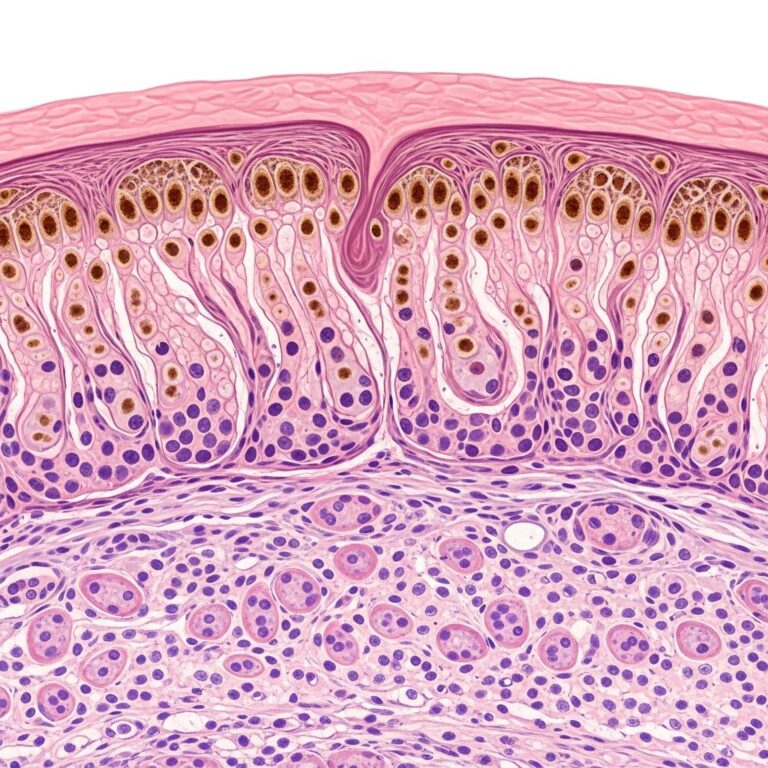
In sections of tumour of the follicular infundibulum, low-power examination reveals a well-circumscribed, symmetrical lesion forming a thin, plate-like plaque parallel to the epidermis. The tumour is composed of anastomosing narrow strands and cords of epithelial cells that connect multiple points of the overlying epidermis, creating a fenestrated or reticulated architecture. These strands extend into the superficial dermis without deep invasion.
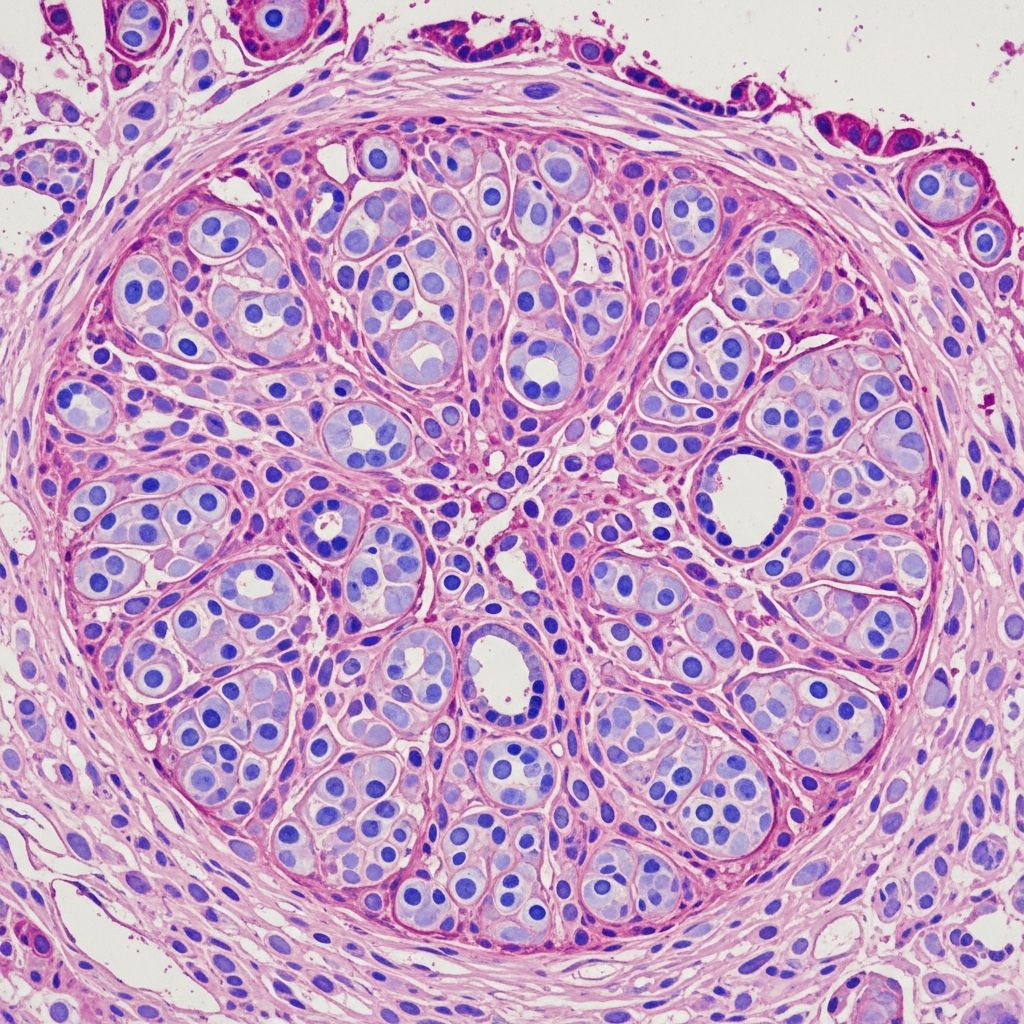
At higher magnification, the tumour cells are pale pink or clear keratinocytes with abundant glycogen-rich cytoplasm, giving a washed-out appearance. Nuclei are uniform, normochromatic, and lack atypia or mitoses. Peripheral palisading of basaloid cells lines the strands, a feature shared with basal cell carcinoma but distinguished by the pale, non-basaloid central cells. Connections to follicular infundibula are often evident, with strands arising from hair follicle openings.
- Epidermal connection: Multiple anastomotic bridges from epidermis and infundibula.
- Cell morphology: Pale/starry sky pattern due to glycogen (PAS-positive).
- Stroma: Thin, fibrillar collagen with increased elastic fibres at the base; vascular proliferation in some cases.
- Special stains: PAS highlights glycogen in cytoplasm; elastic stain shows surrounding fibres.
Ultrastructurally, cells resemble infundibular keratinocytes with abundant tonofilaments and glycogen granules. Rare variants show sebaceous differentiation, with lipid vacuoles in cells. Multiple lesions maintain similar histology but may appear more atrophic clinically.
Differential diagnosis
The clinical and histological overlap necessitates careful differentiation. Key entities include:
| Entity | Key Distinguishing Features |
|---|---|
| Basal cell carcinoma (BCC) | BCC shows uniform basaloid cells throughout (not pale/glycogenated centrally); retraction artefact, mucin, deeper invasion. Anastomosing strands parallel to epidermis are rare or focal in BCC. |
| Seborrheic keratosis (SK) | SK has exophytic growth, horn cysts, hyperkeratosis; lacks plate-like fenestration and infundibular connections. Cells are not uniformly pale. |
| Superficial epithelioma with sebaceous differentiation (SESD) | Similar plate-like growth but more sebaceous foci; lacks glycogen-rich pale cells. Hybrid forms reported. |
| Fibroepithelioma of Pinkus | Reticulated strands but thicker, more fibrotic stroma; basaloid cells predominate. |
| Tricholemmoma | Clear cells, palisading, but lobular growth from follicles; glycogen positive but peripheral location. |
| Clear cell acanthoma | Psoriasiform epidermal thickening; uniform clear cells throughout epidermis, not fenestrated. |
Related Stories



Immunohistochemistry is rarely needed but may show CK10 positivity (infundibular differentiation) and low Ki-67 proliferation index, supporting benignity.
Clinicopathologic variants
- Solitary TFI: Most common; head/neck in midlife women; papulonodular, scaly, <2cm.
- Multiple/infudibulomatosis: Younger patients; symmetric hypopigmented/erythematous macules/papules on face, neck, trunk; 20-100+ lesions. Rare lower limb cases with star-shaped atrophy reported.
- Sebaceous variant: Foci of sebaceous cells in plate-like strands; buttock plaque in elderly.
- Eruptive: Sudden multiple lesions, sun-accentuated hypopigmentation.
Associations: Rare in Cowden syndrome spectrum; monitor for BCC transformation in multiple cases.
Management
As benign lesions, no treatment is required unless symptomatic or cosmetic concern. Options include:
- Shave excision or curettage for solitary lesions.
- Cryotherapy for small papules.
- Observation for multiple asymptomatic cases.
Biopsy is essential for diagnosis, especially to exclude BCC. In multiple tumours, long-term follow-up advised due to rare malignant transformation risk.
Frequently Asked Questions
What is a tumour of the follicular infundibulum?
A rare benign hair follicle tumour presenting as scaly papules on head/neck, diagnosed histologically by fenestrated pale cell strands.
Is it cancerous?
No, it is benign, but mimics BCC clinically; biopsy confirms.
How is it treated?
Usually not needed; excision or cryotherapy for cosmetics.
Can it be multiple?
Yes, infundibulomatosis form with dozens of lesions on trunk/face.
What does histology show?
Plate-like anastomosing pale keratinocyte strands parallel to epidermis with palisading.
Further reading
- Adnexal tumours overview
- Hair follicle neoplasms
- Differential of superficial BCC
References
- Tumor of follicular infundibulum with unique features — Anais Brasileiros de Dermatologia (PMC). 2014. https://pmc.ncbi.nlm.nih.gov/articles/PMC4230666/
- Tumor of the follicular infundibulum with sebaceous differentiation — PubMed (American Journal of Dermatopathology). 2001-07-01. https://pubmed.ncbi.nlm.nih.gov/11401679/
- Tumour of the follicular infundibulum pathology — DermNet NZ. Recent access 2026. https://dermnetnz.org/topics/tumour-of-the-follicular-infundibulum-pathology
- Hair Follicle Neoplasms – Tumor of the Follicular Infundibulum — Perris Dermatology. Recent. https://perridermatology.com/dr-perris-blog/hair-follicle-neoplasms-tumor-of-the-follicular-infundibulum/
- Tumor of the follicular infundibulum (TFI) – dermpath in 5 minutes — YouTube (Jerad Gardner). 2023. https://www.youtube.com/watch?v=qJi9pqI1g5w
Similar Articles








Read full bio of Sneha Tete