Insulins For Type 1 Diabetes: 4 Types And Regimens
Comprehensive guide to insulin types, regimens, and management strategies for adults with type 1 diabetes to achieve optimal glycemic control.
People with
type 1 diabetes
require lifelong insulin replacement therapy because their pancreas produces little to no insulin. Insulin therapy mimics the body’s natural insulin release through basal (background) and bolus (mealtime) regimens, typically delivered via multiple daily injections (MDI) or continuous subcutaneous insulin infusion (CSII) using pumps. This approach aims to maintain blood glucose levels between 80-130 mg/dL before meals and under 180 mg/dL two hours post-meal, reducing complications like eye, kidney, and nerve damage.What are insulins?
Insulins are hormones that regulate blood glucose by facilitating its uptake into cells for energy. In type 1 diabetes, exogenous insulin is essential, provided as human insulins or analogues with modified structures for faster or longer action. Most adults use a basal-bolus regimen: long-acting basal insulin once or twice daily for steady coverage, and rapid-acting bolus insulin before meals to cover carbohydrates and correct highs.
Basal insulin analogues outperform human neutral protamine Hagedorn (NPH) insulin, offering better glycemic control, lower hypoglycemia risk, and reduced variability. Rapid-acting analogues are preferred over regular human insulin for equivalent or superior efficacy and safety.
Types of insulin
Insulins are categorized by onset, peak, and duration. Key types include:
- Long-acting basal insulins: Provide steady 24-hour coverage without pronounced peaks, minimizing nocturnal hypoglycemia. Examples: glargine (first- and second-generation), detemir, degludec. Second-generation analogues (e.g., glargine U300, degludec) match first-generation control but reduce hypoglycemia by up to 30-50%.
- Short-acting regular human insulin: Onset 30-60 minutes, peak 2-4 hours, duration 5-8 hours. Less favored due to higher hypoglycemia risk compared to analogues.
- Rapid-acting insulin analogues: Onset 15 minutes, peak 1 hour, duration 3-5 hours. Examples: aspart (standard and faster-acting), lispro, glulisine. Faster aspart offers post-meal benefits over standard aspart.
- Premixed insulins: Combine basal and bolus in one injection; less flexible for variable lifestyles, not ideal for intensive control.
| Type | Onset | Peak | Duration | Examples |
|---|---|---|---|---|
| Long-acting (basal) | 1-2 hours | Little/no peak | 20-24+ hours | Glargine U100/U300, detemir, degludec |
| Rapid-acting (bolus) | 15 minutes | 60 minutes | 3-5 hours | Aspart, lispro, glulisine |
| Short-acting | 30-60 min | 2-4 hours | 5-8 hours | Regular human |
Selection depends on lifestyle, hypoglycemia history, and dawn phenomenon (morning highs). Basal analogues reduce nocturnal lows versus NPH.
Insulin regimens
The standard is
basal-bolus therapy
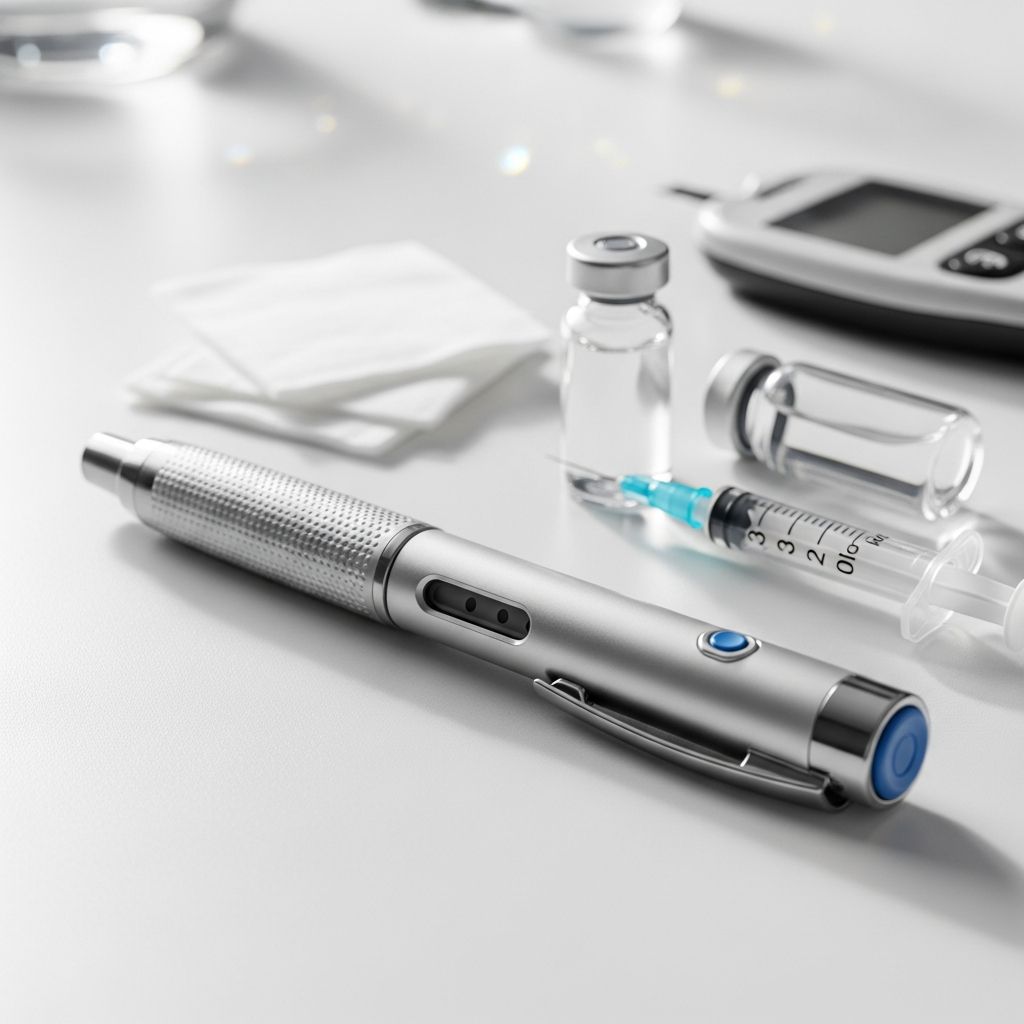
: 1-2 basal injections daily plus ≥3 bolus doses. This physiologic mimicry improves HbA1c below 7% while minimizing lows. Start with two injections daily, progressing to three or four for better control.- Multiple Daily Injections (MDI): Most common, accessible worldwide. Uses pens or syringes. Effective for most, but some need pumps for optimization.
- Continuous Subcutaneous Insulin Infusion (CSII)/Insulin Pump: Delivers basal via continuous infusion with bolus button boluses. Gold standard for dawn phenomenon, high variability, or hypoglycemia unawareness. Improves control and safety over MDI, though costlier.
Hybrid closed-loop systems (artificial pancreas) automate adjustments using CGM data, enhancing outcomes.
How do I inject insulin?
Injections use syringes, pens, or pumps. Rotate sites (abdomen, thighs, arms, buttocks) to prevent lipohypertrophy (fatty lumps impairing absorption). Inject at 90-degree angle; use new needles. For pumps, change cannula every 2-3 days.
- Prime devices to remove air.
- Subcutaneous injection; avoid muscles.
- Monitor for reactions like redness.
Storing insulin
Unopened vials/pens: Refrigerate at 2-8°C. In-use: Room temperature (up to 30°C) for 28-42 days, depending on type. Avoid heat, freezing, direct sun. Travel tips: Use cool packs, declare at security.
Starting insulin treatment
Diagnosis triggers immediate insulin, often basal-bolus from day one. Hospital initiation common for education. Titrate doses: Basal 40-50% total daily dose (TDD), bolus 50-60%. Adjust via self-monitoring or CGM.
Related Stories



Calculating insulin doses
Personalized via total daily dose (TDD), often 0.5-1 unit/kg body weight. Bolus = (carbs/insulin-to-carb ratio) + correction factor × (current glucose – target).
- Insulin-to-carb ratio: Starts 1:10-15g, adjusts per meal.
- Correction factor: 1:50-100 mg/dL per unit.
- Factors: Activity reduces needs; illness increases.
Educate on matching insulin to carbs, pre-meal glucose, activity.
Insulin dose adjustment
Review patterns via logs/CGM. Increase basal for fasting highs; bolus for post-meal spikes. Reduce for lows/exercise. Targets: HbA1c <7%, time-in-range >70% (70-180 mg/dL).
What if I take too much insulin?
Hypoglycemia (<70 mg/dL): Treat with 15g fast carbs (glucose tabs, juice), recheck 15 min. Severe: Glucagon injection or emergency help. Prevent via patterns, snacks.
What if I take too little insulin?
Hyperglycemia: Extra bolus correction. Ketones signal DKA risk—seek urgent care if persistent.
Can I take insulin if I’m ill?
“Sick day rules”: Monitor frequently, continue basal, bolus for carbs/ketones. Hydrate, adjust up 10-20% if highs. Consult healthcare team.
Exercise and insulin
Exercise lowers glucose; reduce bolus pre-activity, snack if needed. Basal cuts for prolonged sessions. CGM helps.
Alcohol and insulin
Alcohol risks nocturnal hypo; eat carbs first, limit intake, monitor overnight.
Adjunctive therapies
Pramlintide (amylin analogue) with mealtime insulin reduces post-meal spikes, aids weight loss in optimized patients.
Traveling with insulin
Carry supplies in hand luggage, extra doses, letters. Adjust for time zones (basal pumps programmable).
Pregnancy and insulin
Tight control vital; rapid-acting preferred, doses rise in later trimesters. Specialist oversight.
Hypoglycaemia unawareness
Scant symptoms from frequent lows; intensive therapy/CGM reverses it. Avoid overnight lows.
Frequently Asked Questions
What is the best insulin regimen for type 1 diabetes?
Basal-bolus MDI or pump therapy for most adults, aiming for HbA1c <7% with low hypoglycemia.
Are insulin pumps better than injections?
Pumps excel for variability or dawn phenomenon but cost more; MDI suffices for many.
How often should I monitor blood sugar?
4-10 times daily or continuous via CGM, especially around meals/activity.
Can I skip insulin doses?
No—risks DKA. Always dose appropriately.
What causes insulin resistance in T1D?
Illness, stress, hormones, inactivity; adjust doses accordingly.
References
- Insulin Therapy in Adults with Type 1 Diabetes Mellitus — Heinemann L, et al. 2020-02-21. https://pmc.ncbi.nlm.nih.gov/articles/PMC6995794/
- Type 1 Diabetes Treatment and Therapy — Breakthrough T1D. 2024. https://www.breakthrought1d.org/t1d-basics/treatments/
- Type 1 Diabetes – Diagnosis and Treatment — Mayo Clinic Staff. 2024-10-08. https://www.mayoclinic.org/diseases-conditions/type-1-diabetes/diagnosis-treatment/drc-20353017
- Insulin for Type 1 Diabetes — NHS. 2023-05-17. https://www.nhs.uk/medicines/insulin/insulin-for-type-1-diabetes/
- The Management of Type 1 Diabetes in Adults — Holt RIG, et al. 2021-10-06. https://diabetesjournals.org/care/article/44/11/2589/138492/The-Management-of-Type-1-Diabetes-in-Adults-A
- Insulin Routines — American Diabetes Association. 2024. https://diabetes.org/health-wellness/medication/insulin-routines
Similar Articles








Read full bio of medha deb