Types of Hearing Loss: Causes and Treatments
Understanding conductive, sensorineural, mixed, and central hearing loss types.
Understanding Types of Hearing Loss
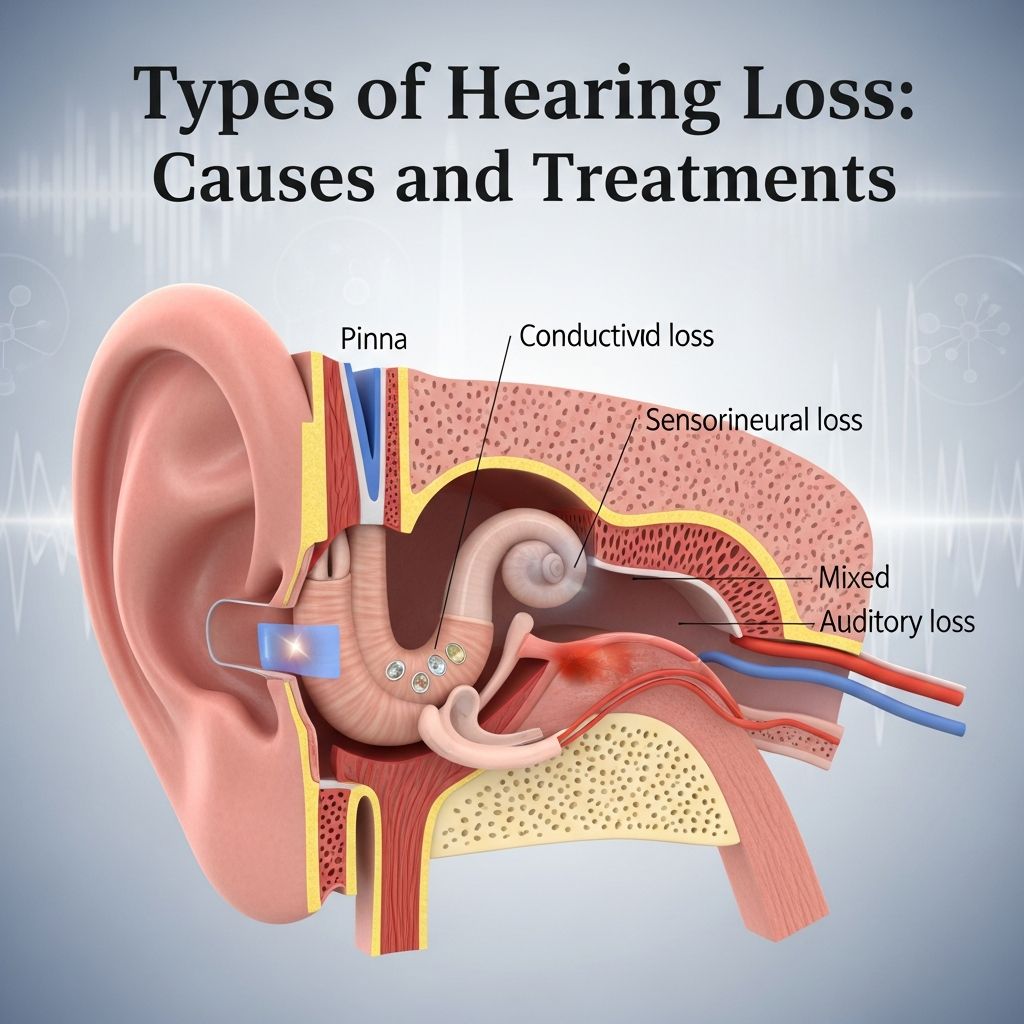
Hearing loss affects millions of people worldwide and can significantly impact quality of life, communication, and social interaction. More than 28 million Americans experience some degree of hearing impairment, making it one of the most common health conditions today. Understanding the different types of hearing loss is essential for proper diagnosis, treatment planning, and management strategies. Hearing loss is classified into several distinct categories based on where the problem occurs within the auditory system. The auditory system consists of the outer ear, middle ear, inner ear, and acoustic nerve pathways to the brain. When any of these components malfunction, hearing loss can occur. Each type of hearing loss presents different characteristics, causes, and treatment options.
Conductive Hearing Loss
Conductive hearing loss occurs when sound waves are blocked from passing through the outer ear, the middle ear, or both. This type of hearing loss results from a physical obstruction or structural problem that prevents sound from reaching the inner ear where it can be processed. In conductive hearing loss, the inner ear and auditory nerve are typically functioning normally; the problem lies in the conduction pathway.
Common Causes of Conductive Hearing Loss
Several conditions can cause conductive hearing loss. Cerumen impaction, or earwax buildup, is one of the most common causes and is often easily treatable. Otitis media, an infection or inflammation of the middle ear, frequently causes conductive hearing loss, particularly in children. Fluid accumulation in the middle ear, known as otitis media with effusion, can block sound transmission.
Structural abnormalities also contribute to conductive hearing loss. Exostoses and osteomas are benign bony growths of the external auditory canal that interfere with normal cerumen migration and can lead to canal occlusion. Patients with exostoses often report a history of cold-water swimming. Cholesteatoma, an accumulation of squamous epithelium within the middle ear, can develop following otitis media and may cause progressive conductive hearing loss. Damage to the tympanic membrane or the small bones of the middle ear (ossicles) from trauma, infection, or inflammation can also result in conductive hearing loss.
Treatment Options for Conductive Hearing Loss
The advantage of conductive hearing loss is that many cases are treatable or even reversible. Treatment options depend on the specific underlying cause. Cerumen impaction can be removed through irrigation or manual extraction. Infections and inflammation may respond to antibiotics or other medications. When structural damage is present, surgical intervention may be necessary. Surgical procedures can repair damaged tympanic membranes, replace damaged ossicles, or remove obstructions. In cases where surgery is not possible or effective, hearing aids, bone-anchored hearing aids (BAHA), or cochlear implants may be recommended to amplify sound or bypass the conductive pathway.
Sensorineural Hearing Loss
Sensorineural hearing loss occurs when there is damage to the inner ear (cochlea) or the neural pathways from the ear to the auditory cortex. This type of hearing loss involves problems with the sensory cells or nerve fibers responsible for converting sound vibrations into electrical signals that the brain can interpret. Sensorineural hearing loss is the most common type of hearing loss, accounting for the majority of cases in both adults and children.
Causes of Sensorineural Hearing Loss
Sensorineural hearing loss has numerous potential causes. Age-related hearing loss, known as presbycusis, is a symmetric, progressive deterioration of hearing in elderly patients caused by a combination of inherited and environmental factors, including lifetime noise exposure and tobacco use. Noise-induced hearing loss results from exposure to loud sounds and typically presents as bilateral, symmetric loss centered around 4,000 Hz.
Related Stories



Other significant causes include hereditary factors, with more than 100 congenital syndromes associated with sensorineural hearing loss. Ototoxic medications, including certain antibiotics, chemotherapy agents, and diuretics, can damage the inner ear. Infections such as meningitis, measles, mumps, and rubella can cause sensorineural hearing loss. Medical conditions like Meniere’s disease, which causes sudden hearing loss accompanied by vertigo and tinnitus, acoustic neuromas, and autoimmune hearing loss can all result in sensorineural damage. Head trauma, viral infections, and sudden unexplained sensorineural hearing loss represent additional causes that may require urgent evaluation.
Characteristics and Treatment
Unlike conductive hearing loss, sensorineural hearing loss is typically permanent because the damage to sensory cells or nerve fibers cannot be repaired. However, various management strategies can help. Hearing aids are the primary treatment option, amplifying sound to compensate for the damaged hair cells. Cochlear implants may be recommended for individuals with severe to profound hearing loss who receive limited benefit from conventional hearing aids. These devices bypass damaged portions of the inner ear and directly stimulate the auditory nerve. Audiology consultation is recommended for accurate testing and consideration of amplification options.
Mixed Hearing Loss
Mixed hearing loss occurs when a person experiences both conductive and sensorineural hearing loss simultaneously. This means there are problems in both the outer or middle ear and the inner ear or auditory nerve. Mixed hearing loss affects multiple components of the auditory system and can result in more profound hearing impairment than either type alone.
Causes and Characteristics
Mixed hearing loss can develop from various combinations of conditions. A person might have chronic otitis media (causing conductive loss) combined with age-related presbycusis (causing sensorineural loss). Alternatively, someone with noise-induced hearing loss might develop conductive hearing loss from an ear infection or trauma. The specific combination of causes in each case affects the treatment approach and prognosis.
Management Approaches
Treatment for mixed hearing loss addresses both components and varies depending on the severity of each type. Surgical procedures may be necessary to correct structural abnormalities or remove obstructions causing the conductive component. Simultaneously, hearing aids or cochlear implants may be needed to address the sensorineural component. In some cases, bone-anchored hearing aids prove particularly effective for mixed hearing loss because they can bypass conductive problems while amplifying sound for the sensorineural component. Comprehensive audiological evaluation is essential to determine the most appropriate treatment strategy.
Auditory Neuropathy Spectrum Disorder
Auditory neuropathy spectrum disorder (ANSD) represents a distinct category of hearing loss where sound enters the ear normally and reaches the acoustic nerve, but a problem occurs when the sound is transmitted to the brain. This condition involves dysfunction of the central auditory system, including the auditory nerve and related pathways in the brain. Central hearing loss, a related condition, results from neurological problems affecting sound processing in the brain and auditory pathways.
Clinical Features
ANSD presents unique diagnostic and management challenges because standard audiological testing may show normal outer and middle ear function, yet the patient experiences significant hearing difficulties. Central hearing loss may result from neurological conditions, brain tumors, or stroke affecting auditory processing areas. Symptoms can include difficulty understanding speech even when volume is adequate, problems localizing sound sources, and challenges in noisy environments.
Treatment Considerations
Management of ANSD and central hearing loss requires specialized evaluation and may involve multidisciplinary approaches including neurology and audiology. Treatment depends on identifying the underlying cause and may involve addressing the neurological condition. Hearing aids or cochlear implants may provide some benefit, though the effectiveness varies depending on the specific nature of the neural dysfunction. Communication strategies and rehabilitation techniques are often important components of management.
Degrees and Severity of Hearing Loss
Hearing loss severity is classified into categories based on the quietest sound a person can hear, measured in decibels of hearing level (dB HL). Understanding the degree of hearing loss helps guide treatment decisions and expectations for management outcomes.
Severity Classification:
- Normal hearing: –10 to 15 dB HL
- Slight impairment: 16 to 25 dB HL – Able to hear and repeat words spoken in normal voice at one meter
- Mild hearing loss: 26 to 40 dB HL – Difficulty hearing conversational speech, particularly in noisy environments
- Moderate hearing loss: 41 to 55 dB HL – Able to hear and repeat words spoken at raised voice at one meter
- Moderately severe hearing loss: 56 to 70 dB HL – Requires raised voice or hearing aids for conversation
- Severe hearing loss: 71 to 90 dB HL – Requires hearing aids or other amplification; lip-reading often necessary
- Profound hearing loss: Greater than 90 dB HL – May require cochlear implants or alternative communication methods
Diagnosis and Evaluation
Proper diagnosis of hearing loss type is essential for determining appropriate treatment. Audiological evaluation typically includes pure-tone audiometry, which measures hearing sensitivity across different frequencies. Tympanometry assesses middle ear function and can help differentiate conductive from sensorineural causes. Imaging studies such as MRI or CT scans may be recommended when acoustic neuromas or other structural abnormalities are suspected. A detailed history of symptom onset, progression, associated symptoms like tinnitus or vertigo, and medical conditions helps guide diagnostic evaluation.
Frequently Asked Questions
Q: Can hearing loss be reversed?
A: Some types of conductive hearing loss can be reversed through medical or surgical treatment, particularly when caused by infections, fluid accumulation, or removable obstructions. However, sensorineural hearing loss is typically permanent. Early identification and treatment of reversible causes can sometimes prevent permanent hearing damage.
Q: What is the difference between hearing loss and deafness?
A: Hearing loss refers to a reduction in the ability to hear sounds, ranging from mild to profound. Deafness typically refers to profound hearing loss or complete inability to hear. The terms are sometimes used differently within the deaf community, where deafness may represent cultural identity rather than solely an audiological condition.
Q: Are hearing aids effective for all types of hearing loss?
A: Hearing aids are most effective for conductive and sensorineural hearing loss. They amplify sound to compensate for hearing loss. However, effectiveness varies depending on the type, degree, and cause of hearing loss. Audiological evaluation helps determine the best hearing aid option for each individual’s specific needs.
Q: When should I seek medical evaluation for hearing loss?
A: If you experience sudden hearing loss, difficulty understanding speech, tinnitus, or progressive hearing difficulty, you should seek evaluation promptly. Sudden sensorineural hearing loss is a medical emergency requiring urgent evaluation to determine treatable causes.
Q: What is the prognosis for hearing loss?
A: Prognosis depends on the type and cause of hearing loss. Conductive hearing loss often has a good prognosis with appropriate treatment. Sensorineural hearing loss is usually permanent but manageable with hearing aids or cochlear implants. Early identification and intervention provide the best outcomes for all types of hearing loss.
References
- Differential Diagnosis and Treatment of Hearing Loss — American Academy of Family Physicians (AAFP). 2003-09-15. https://www.aafp.org/pubs/afp/issues/2003/0915/p1125.html
- The Four Types of Hearing Loss — CCHAT Sacramento. https://www.cchatsacramento.org/blog-and-events/the-four-types-of-hearing-loss
- Hearing Loss Types, Causes and Treatments — Hearing Loss Association of America. https://www.hearingloss.org/understanding-hearing-loss/types-causes-and-treatments/
- Hearing Loss Grades and the International Classification of Functioning, Disability and Health — National Center for Biotechnology Information (NCBI). 2019. https://pmc.ncbi.nlm.nih.gov/articles/PMC6796665/
- SNHL Most Common Category of Hearing Loss — UCLA Health. https://www.uclahealth.org/news/article/snhl-most-common-category-hearing-loss
- Degree of Hearing Loss — American Speech-Language-Hearing Association (ASHA). https://www.asha.org/public/hearing/degree-of-hearing-loss/
Similar Articles








Read full bio of Sneha Tete