Types of Scleroderma: Limited vs Diffuse
Understanding limited and diffuse scleroderma: symptoms, progression, and management.
Scleroderma is a chronic autoimmune disease that affects connective tissue throughout the body, causing hardening and thickening of the skin and potentially affecting internal organs. The name derives from Greek words meaning “hard skin,” which accurately describes the primary symptom experienced by those living with this condition. While scleroderma presents with similar core characteristics across patients, the disease manifests in distinctly different ways depending on the type. Understanding these differences is crucial for patients, caregivers, and healthcare providers in managing the condition effectively and predicting disease progression.
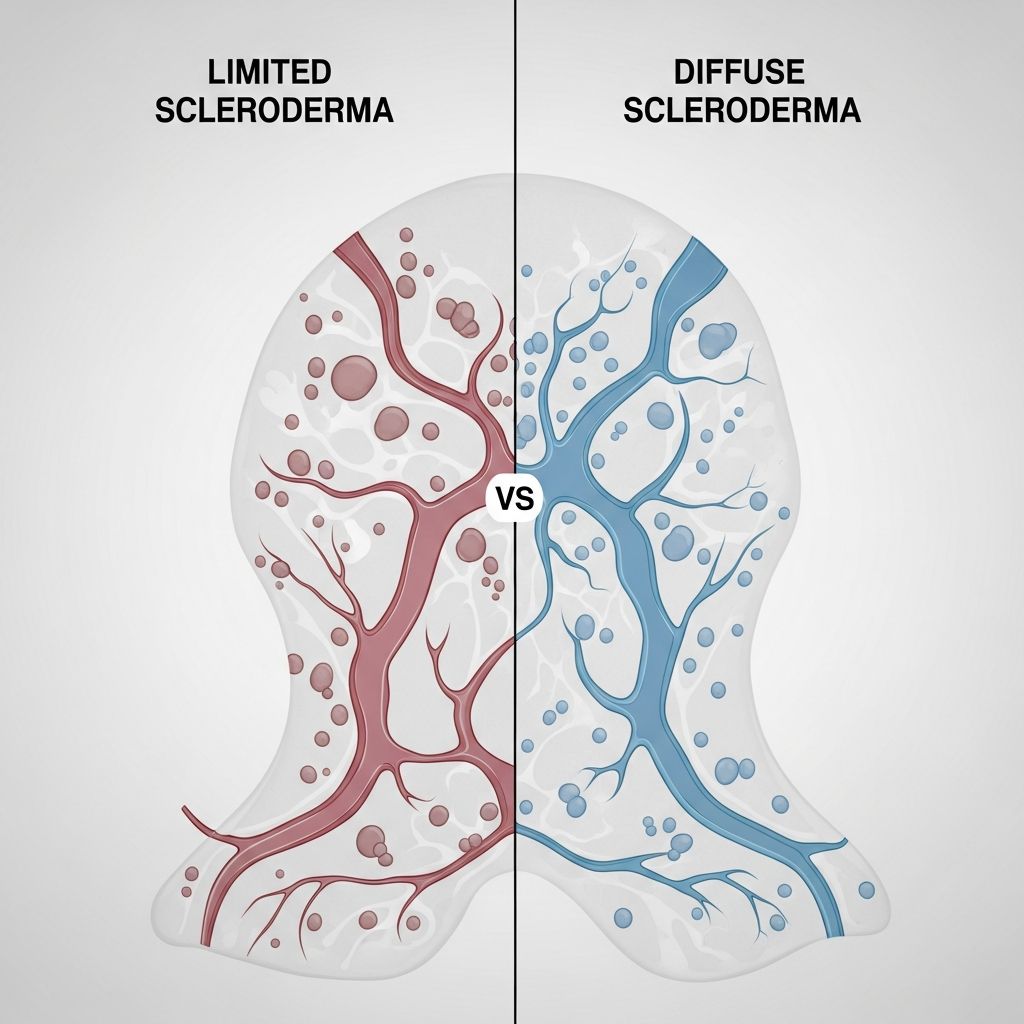
There are two main types of systemic scleroderma that can affect internal organs: limited cutaneous scleroderma and diffuse cutaneous scleroderma. These classifications are distinguished primarily by the extent and location of skin involvement, which correlates with the severity of internal organ involvement and overall disease prognosis. The distribution of skin thickening serves as a clinical marker that helps physicians predict disease progression and guide treatment decisions.
Limited Cutaneous Scleroderma
Limited cutaneous scleroderma represents the milder and more common form of the disease, particularly among Caucasian populations. This type accounts for the majority of scleroderma cases and generally carries a better prognosis compared to its diffuse counterpart. Patients with limited scleroderma typically experience slower disease progression and often maintain better functional capacity over time.
Skin Involvement Pattern
In limited cutaneous scleroderma, skin thickening is restricted to specific areas of the body. The characteristic distribution includes thickening below the elbows, below the knees, and on the face. This limited pattern of involvement distinguishes it from diffuse disease and typically indicates a less aggressive disease course. Many patients with limited scleroderma have only mild thickening confined to the fingers, with little to no involvement of other body areas.
CREST Syndrome
Limited scleroderma was historically known as CREST syndrome, an acronym that describes the primary clinical manifestations commonly observed in this form of the disease. Each letter represents a specific symptom or finding:
- C – Calcium Deposits: Small calcium deposits that accumulate in body tissues, particularly in the fingers, bursa over the elbows, and rarely over the kneecaps or other pressure areas. These deposits may occasionally become infected if they rupture.
- R – Raynaud’s Phenomenon: One of the earliest and most common symptoms, characterized by fingers becoming extremely sensitive to cold or emotional stress and changing color in response to these triggers.
- E – Esophageal Reflux: Commonly referred to as heartburn or gastroesophageal reflux disease (GERD), this occurs due to involvement of the esophagus and digestive tract.
- S – Sclerodactyly: Thickening and tightening of skin on the fingers, causing them to become stiff and potentially develop flexion contractures.
- T – Telangiectasias: Enlarged blood vessels appearing as small red spots on the face and other areas of the body, which are not painful but may be a cosmetic concern for some patients.
It is important to note that not every patient with limited scleroderma will develop all five CREST components. Each individual presents with a unique pattern of symptoms, and the progression varies significantly from person to person.
Clinical Characteristics of Limited Scleroderma
Patients with limited cutaneous scleroderma typically have internal organ involvement that is less severe than in diffuse disease. While these patients may experience esophageal problems and occasionally pulmonary complications, the frequency and severity of multi-organ involvement is generally lower. The disease often remains stable for extended periods, with some patients experiencing minimal progression over many years.
The skin manifestations in limited scleroderma, while less extensive than in diffuse disease, can still significantly impact quality of life. Patients may experience difficulties with dexterity and hand function due to finger tightness, though the involvement of larger body areas is uncommon.
Related Stories



Diffuse Cutaneous Scleroderma
Diffuse cutaneous scleroderma represents the more severe form of the disease and involves more extensive areas of skin thickening and greater internal organ involvement. This form carries a higher risk of serious complications and generally requires more aggressive monitoring and treatment strategies. Diffuse scleroderma is more commonly observed in African Americans and Native Americans, who tend to experience more severe disease manifestations.
Extensive Skin Involvement
In diffuse cutaneous scleroderma, skin thickening extends to proximal areas of the body, including the chest, abdomen, upper arms, and thighs. Beyond these proximal areas, patients may also experience thickening in the same locations affected in limited disease, such as below the elbows, below the knees, and on the face. This widespread distribution of skin involvement is the hallmark feature distinguishing diffuse from limited scleroderma.
The progression of skin thickening in diffuse scleroderma typically begins on the fingers and gradually extends to other body areas over time. The extent of skin involvement tends to correlate with internal organ involvement and overall disease severity. Areas affected may include the back of the hands, forearms, upper arms, face, neck, trunk, legs, and feet.
Internal Organ Involvement
Patients with diffuse cutaneous scleroderma face significantly greater risk of internal organ complications compared to those with limited disease. Major organs that may be affected include:
- Lungs: Pulmonary fibrosis or stiffening of the lungs can develop, potentially interfering with breathing and causing progressive respiratory compromise.
- Heart: Cardiac involvement may occur, ranging from mild pericarditis to more serious myocardial fibrosis.
- Kidneys: Renal involvement can lead to scleroderma renal crisis, a medical emergency requiring immediate intervention.
- Gastrointestinal Tract: More severe involvement than in limited disease, potentially affecting nutrient absorption and overall nutritional status.
- Skin: Fibrosis and excess collagen accumulation in internal organs mirrors the process occurring in the skin.
Physical and Functional Impact
The extensive skin involvement in diffuse scleroderma creates significant functional limitations for patients. Tightened skin makes movement of joints difficult, and patients frequently experience trouble bending fingers, hands, and larger joints. Many patients develop a smaller mouth opening caused by tightness of facial skin, making it difficult to open the mouth wide or close it completely over the teeth. This can complicate dental care and eating.
Patients with diffuse disease often experience more severe flexion contractures of the fingers, where the fingertips bend permanently toward the palm. Additional facial changes may include small vertical lines around the lips and alterations in facial appearance. The combination of extensive skin tightening and potential internal organ involvement requires more intensive medical management and closer monitoring.
Common Features Across Both Types
Raynaud’s Phenomenon
Raynaud’s phenomenon represents one of the earliest and most common manifestations across both types of scleroderma. This condition involves changes in the fingers triggered by cold exposure or emotional stress, caused by excess collagen that narrows blood vessels and reduces blood flow to body tissues and organs. Fingers typically become very sensitive to temperature changes and may change color—often turning white, then blue, then red—in response to cold or stress.
Almost everyone with scleroderma experiences Raynaud’s phenomenon, making it a key diagnostic indicator. The sensitivity and color changes are caused by spasm and narrowing of blood vessels due to collagen accumulation and overreaction of skin blood vessels to temperature and emotional triggers.
Skin Changes and Appearance
Beyond thickening, patients with both types of scleroderma may experience significant changes in skin appearance and pigmentation. Some areas of skin may become darker (hyperpigmentation), while other areas may develop patchy loss of color (hypopigmentation). Large patches of pigment loss can also occur. These pigment changes typically improve over time, with skin tone usually returning to normal appearance after several years.
Thickened skin often appears shiny and scaly due to dryness. Patients may also develop telangiectasias—small red spots caused by widening of small blood vessels in the skin surface—which are not painful but may be cosmetic concerns. Additionally, patients may experience hair loss on the arms and legs, decreased sweating, and the development of skin sores where the skin has been injured by trauma.
Digital Ulcers
Digital ulcers represent a serious complication that can occur in both types of scleroderma. These painful sores develop when excess collagen collects on the inside of blood vessels, causing them to narrow and restrict blood flow. They occur most frequently on fingertips but can develop anywhere on fingers or toes when skin is stretched too tight. Sores may also appear at pressure points, such as elbows.
Digital ulcers can be extremely painful and may significantly impair hand function and daily activities. They require careful medical management to prevent infection and promote healing.
Calcium Deposits
Small calcium deposits (calcinosis) may develop in the tissues of the fingers, bursa over elbows, and rarely over kneecaps or other pressure areas in both types of scleroderma. If these deposits rupture, they may become infected, requiring immediate medical attention and treatment.
Disease Progression and Severity Variation
Scleroderma progression varies dramatically from patient to patient, even within the same disease classification. Most patients experience tight and swollen fingers initially and likely develop Raynaud’s phenomenon. After these early manifestations, it may take months to years for the full extent of the disease to develop. In many patients, the disease remains mild and does not progress significantly beyond initial presentations.
A general principle in scleroderma management is that the greater the extent of skin involvement, the more severe the case tends to be. However, skin involvement alone does not completely predict internal organ involvement or disease trajectory. Some patients with limited skin involvement may experience significant internal organ complications, while others with more extensive skin involvement may have minimal organ involvement.
Autoantibody Markers and Prognosis
Increasingly, physicians use blood markers called autoantibodies to help determine disease course and overall prognosis. While not every patient produces autoantibodies, three common ones include centromere antibody, topoisomerase (Scl-70) antibody, and RNA polymerase 3 antibody. These markers can provide prognostic information and help guide treatment decisions.
Frequently Asked Questions
What is the difference between limited and diffuse scleroderma?
The primary difference lies in the extent of skin involvement. Limited scleroderma affects skin below the elbows, below the knees, and on the face, while diffuse scleroderma involves these areas plus proximal areas including the chest, abdomen, upper arms, and thighs. Diffuse disease also carries higher risk of internal organ involvement and generally more severe disease manifestations.
Is limited scleroderma less serious than diffuse?
Generally, limited scleroderma carries a better prognosis with slower disease progression and less frequent internal organ involvement. However, individual cases vary significantly, and some patients with limited scleroderma may experience serious complications. Conversely, some patients with diffuse disease may have relatively mild internal organ involvement.
Can limited scleroderma progress to diffuse?
Once diagnosed, the classification typically remains consistent. A patient diagnosed with limited scleroderma will not progress to diffuse scleroderma. However, within each category, disease severity may increase or remain stable over time.
Are there other types of scleroderma beyond limited and diffuse?
The two main systemic forms affecting internal organs are limited and diffuse cutaneous scleroderma. However, localized scleroderma (morphea and linear scleroderma) are separate entities that do not typically affect internal organs. Your physician can determine which type you have based on clinical evaluation and testing.
How is the type of scleroderma determined?
Classification is based on the distribution and extent of skin thickening, combined with clinical examination by a rheumatologist. Blood tests for autoantibodies and imaging studies may provide additional prognostic information but are not required to determine type classification.
Does ethnicity affect which type of scleroderma someone develops?
While both types occur across all ethnic groups, African Americans and Native Americans tend to develop more severe scleroderma overall. Limited scleroderma is more common among Caucasian populations. These observations suggest a hereditary or genetic component to scleroderma susceptibility and severity.
References
- About Scleroderma — Johns Hopkins Scleroderma Center. 2024. https://www.hopkinsscleroderma.org/patients/about-scleroderma/
- What is Scleroderma? — Johns Hopkins Scleroderma Center. 2024. https://www.hopkinsscleroderma.org/scleroderma/
- Scleroderma – Disease Introduction — Johns Hopkins Medicine. 2024. https://www.youtube.com/watch?v=86ZlRWV8NiY
- Scleroderma Associated Myopathy – Overview — Johns Hopkins Rheumatology. 2024. https://www.youtube.com/watch?v=98_4T6m5wvk
- Diagnosing Scleroderma — Johns Hopkins Medicine. 2024. https://www.youtube.com/watch?v=L3pEIbSlzzk
Similar Articles








Read full bio of medha deb