Ultrasound: What It Is, Purpose, Procedure & Results
Complete guide to ultrasound imaging: non-invasive diagnostic tool using sound waves for medical evaluation.
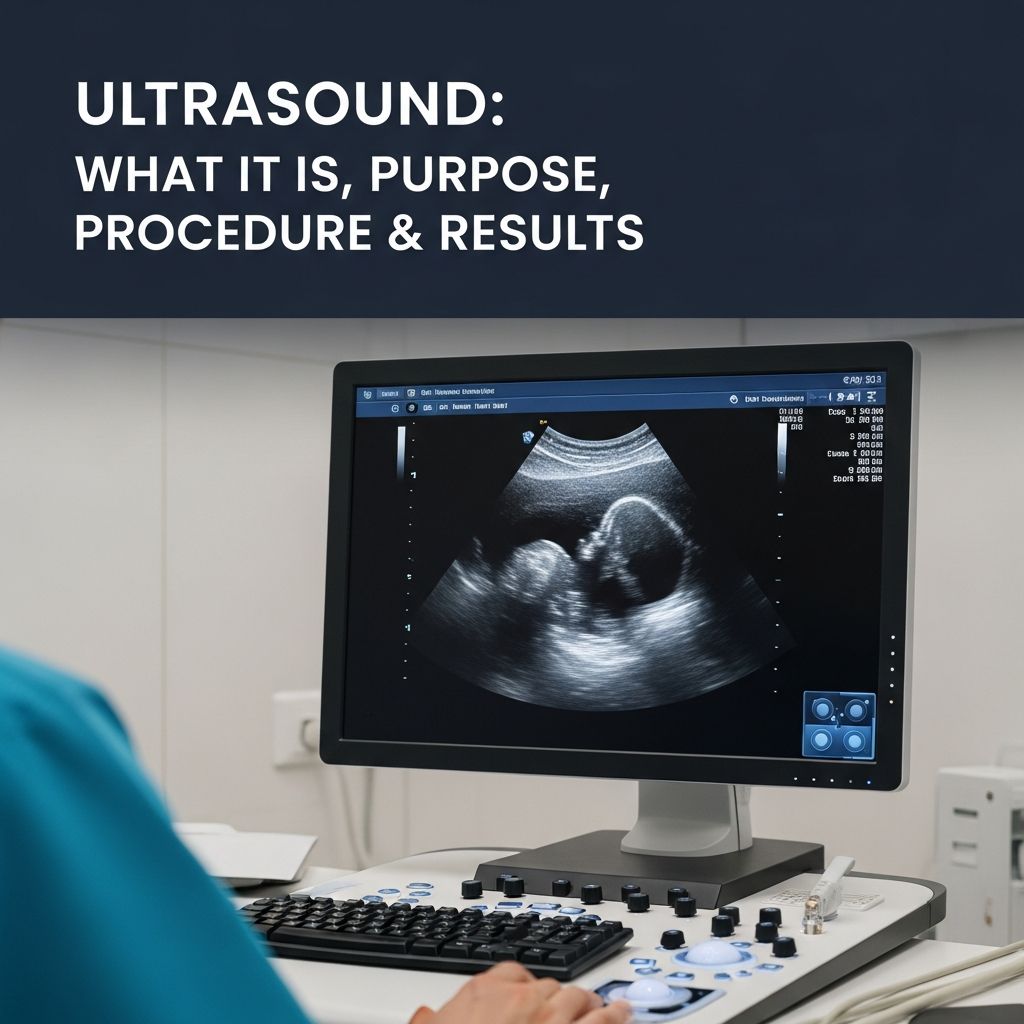
Ultrasound is a noninvasive imaging test that shows structures inside your body using high-intensity sound waves. An ultrasound picture is called a sonogram, and the process itself is often referred to as sonography. Healthcare providers use ultrasound exams for several important purposes, including during pregnancy to monitor fetal development, for diagnosing various conditions affecting internal organs and tissues, and for image guidance during certain medical procedures. Unlike X-rays or CT scans, ultrasound does not use radiation, making it a safe imaging option for patients of all ages.
What Is Ultrasound?
Ultrasound is a medical imaging technique that utilizes high-frequency sound waves to create detailed pictures of the structures within your body. The technology works by sending sound waves through body tissues and capturing the echoes that bounce back to create visual images on a screen. These sound waves are at frequencies far too high for the human ear to hear, typically ranging from 2 to 18 megahertz in diagnostic applications.
The fundamental principle behind ultrasound imaging involves the transmission of sound waves through tissues of varying densities. Different tissues reflect sound waves differently based on their composition and density. A transducer, also called a probe or sonographic probe, serves as both the transmitter and receiver of these sound waves. When placed against the skin, the transducer sends small pulses of sound waves into the body and then records the echoing waves that return. A computer processes these returning signals based on their loudness (amplitude), pitch (frequency), and the time it takes for the signal to return to the transducer. The computer also considers the type of body structure and tissue the sound is traveling through to construct a detailed image.
How Ultrasound Works
The process of ultrasound imaging begins with the application of a small amount of gel to the area being examined. This gel is crucial because it allows sound waves to travel efficiently back and forth between the transducer and the area of examination. Without this conductive medium, the ultrasound waves would be reflected away by air between the probe and skin, resulting in poor image quality.
Once the transducer is placed against the skin over the gel, it sends short pulses of inaudible, high-frequency sound waves into the body. These waves penetrate through various layers of tissue and organs. When the sound waves encounter different tissue interfaces, some waves are reflected back to the transducer while others continue deeper into the body. The reflected waves are received by the transducer and converted into electrical signals that are processed by a computer. The ultrasound image appears immediately on a video display screen that resembles a computer monitor, allowing the technician and physician to observe the structures in real-time.
Doppler ultrasound represents a special variation of standard ultrasound technology. This advanced technique evaluates the movement of materials within the body, particularly the flow of blood through arteries and veins. Doppler ultrasound allows physicians to assess blood flow patterns and detect any abnormalities in circulation. This capability makes it especially useful for evaluating vascular conditions and ensuring proper blood supply to organs.
Purpose of Ultrasound Exams
Healthcare providers utilize ultrasound for multiple clinical purposes, making it one of the most versatile diagnostic tools in modern medicine.
Diagnostic Ultrasounds
Providers use diagnostic ultrasounds to view internal parts of your body to determine if something is wrong or not working properly. Diagnostic ultrasound exams can help your provider learn more about what’s causing a wide range of symptoms, such as unexplained pain, masses (lumps), or what may be causing abnormal blood test results. These exams can evaluate virtually any part of the body visible to ultrasound, including the abdomen, pelvis, heart, blood vessels, thyroid, and soft tissues.
Related Stories



Examples of diagnostic ultrasounds include:
- Abdominal ultrasound to examine organs like the liver, kidneys, pancreas, and gallbladder
- Pelvic ultrasound to visualize the uterus, ovaries, and reproductive structures
- Thyroid ultrasound to assess thyroid gland size and structure
- Vascular ultrasound to evaluate blood vessels for blockages or disease
- Breast ultrasound to examine breast tissue and characterize masses
- Cardiac ultrasound (echocardiogram) to assess heart structure and function
Ultrasound for Procedure Guidance
Providers sometimes use ultrasound to perform certain procedures with precision and accuracy. Real-time ultrasound guidance allows physicians to visualize the exact location of needles and instruments during invasive procedures, significantly improving accuracy and reducing complications. A common use of ultrasound is to guide needle placement to sample fluid or tissue from specific areas of the body. This technique is called ultrasound-guided biopsy or aspiration.
Examples of procedures that may require ultrasound guidance include:
- Fine needle aspiration of thyroid nodules or lymph nodes
- Paracentesis (fluid removal from the abdomen)
- Thoracentesis (fluid removal from around the lungs)
- Amniocentesis during pregnancy
- Chorionic villus sampling (CVS) during pregnancy
- Cyst aspiration and tissue biopsy
- Joint injections and soft tissue injections
- Central venous catheter placement
Ultrasound in Pregnancy
One of the most well-known applications of ultrasound is in obstetrics. For ultrasounds during pregnancy, the traditional ultrasound is a two-dimensional (2D) image of the fetus. Two-dimensional ultrasound produces outlines and flat-looking images, which allows your healthcare provider to see the fetus’s internal organs and structures. A prenatal ultrasound, also called a sonogram, is a test during pregnancy that checks on the health and development of your baby.
Ultrasound is an important tool for healthcare providers to screen for congenital conditions, which are conditions your baby is born with. A screening is a type of test that determines if your baby is more likely to have a specific health condition. Your provider also uses ultrasound to guide the needle during certain diagnostic procedures in pregnancy, such as amniocentesis or chorionic villus sampling (CVS).
What Areas of the Body Can Ultrasound Examine?
Ultrasound can create images of soft tissue structures and organs throughout the body. The versatility of ultrasound makes it applicable to nearly every body system when ultrasound-visible structures are the target of evaluation. Areas commonly examined with ultrasound include:
- Blood vessels and vascular structures
- Uterus and female reproductive organs
- Ovaries
- Kidneys and urinary system
- Glands including thyroid and parathyroid
- Liver and biliary system
- Pancreas
- Heart and cardiac structures
- Breast tissue
- Muscles, tendons, and ligaments
- Soft tissue masses and cysts
- Fetus and pregnancy-related structures
The Ultrasound Procedure
Preparation
Preparation for your ultrasound examination depends on which type of ultrasound you are having. For most diagnostic ultrasound exams, minimal or no preparation is required. However, some specific ultrasound types may require special preparation. Your healthcare provider will give you specific instructions regarding any necessary preparation for your particular ultrasound examination.
During the Examination
During a typical ultrasound examination, you will lie on an examination table in a comfortable position. The technologist will apply a small amount of clear gel to the area of your body being examined. This gel allows the ultrasound probe to make proper contact with your skin and enables the sound waves to travel effectively. The gel is typically warm and water-based, causing no discomfort.
The technologist then places the transducer on your skin over the area being examined and moves it around to obtain different views and angles. You may feel mild pressure as the transducer is moved across your skin, but the procedure should not cause pain. Real-time images appear on a video display screen, allowing the technologist to capture the necessary measurements and images for diagnostic purposes. The technologist may ask you to hold your breath, change positions, or move in certain ways to obtain optimal images.
Transducer Placement
For most diagnostic ultrasound exams, the technician places the transducer (probe) on your skin. In some cases, they may need to place the probe inside your body, such as in your vagina during gynecologic ultrasounds or in your rectum during certain urologic procedures. This type of ultrasound is called transesophageal or transvaginal ultrasound, depending on the placement, and allows for more detailed imaging of structures that are difficult to visualize from external scanning.
Understanding Your Ultrasound Results
Normal Results
A normal ultrasound result means that the sonographer and physician did not find any problems with the structures examined. Normal results indicate that the organs, tissues, and structures visualized appear to be functioning properly and show no signs of abnormality. In the context of pregnancy ultrasounds, a normal result means your pregnancy care provider didn’t find any problems and that your baby is growing and developing normally.
Abnormal Results
An abnormal result means your provider noticed something irregular during the ultrasound examination. If the physician identifies an abnormality, your provider may order additional ultrasounds or diagnostic tests to determine the nature and significance of the finding. This might include follow-up imaging studies, laboratory tests, or other diagnostic procedures to establish a definitive diagnosis.
Incomplete Ultrasound Results
Occasionally, the ultrasound is incomplete if there’s difficulty seeing all the structures needed for that particular ultrasound examination. Your baby’s position or movement sometimes makes it difficult to see everything your provider needs to see. In prenatal ultrasounds, if the fetus is in an unfavorable position or is moving excessively, the sonographer may not be able to obtain all necessary images. In such cases, you’ll need a repeat ultrasound and they’ll try again. Similarly, in other ultrasound exams, patient factors such as body habitus, bowel gas, or equipment limitations may necessitate a follow-up study.
Advantages of Ultrasound Imaging
Ultrasound offers numerous advantages over other imaging modalities, making it a preferred choice for many diagnostic situations. First and foremost, ultrasound does not use radiation, eliminating the risks associated with ionizing radiation exposure. This makes ultrasound particularly safe for use in pregnant patients and pediatric populations. Additionally, ultrasound provides real-time imaging, allowing visualization of organ movement and blood flow. The procedure is noninvasive, relatively quick, and can be performed in various clinical settings. Ultrasound is also generally less expensive than other advanced imaging modalities like CT or MRI, making it accessible to more patients.
Limitations and Considerations
Acoustic Limitations
Standard diagnostic ultrasound has no known harmful effects on humans when used appropriately for medical purposes. However, ultrasound does have certain technical limitations. Ultrasound waves are disrupted by air or gas, which means ultrasound is not an ideal imaging technique for air-filled structures like the bowel. Ultrasound is not as useful for imaging air-filled lungs, but it may be used to detect fluid around or within the lungs. Similarly, ultrasound cannot penetrate bone, but may be used for imaging bone fractures or for detecting infection surrounding a bone.
Patient-Related Limitations
Large patients are more difficult to image by ultrasound because greater amounts of tissue attenuate (weaken) the sound waves as they pass deeper into the body and need to be returned to the transducer for analysis. This technical limitation may result in degraded image quality in obese patients, sometimes necessitating alternative imaging modalities.
Types of Ultrasound Specialists
Various specialists perform ultrasound examinations with expertise in specific body systems and imaging techniques. A breast sonographer specializes in taking images of breast tissue and looks for and confirms the presence of tumors or cysts. A neurosonographer specializes in taking images of the brain and nervous system using specialized equipment called a transcranial Doppler. A cardiac sonographer, or echocardiographer, specializes in taking images of the heart, examining the heart’s vessels, chambers, and valves. A musculoskeletal sonographer specializes in taking images of muscles, joints, tendons, and ligaments and may help with ultrasound guidance during surgical treatments or injections. A pediatric sonographer specializes in taking images of babies and children, frequently taking images associated with premature births or birth defects.
Frequently Asked Questions
Q: Is ultrasound safe during pregnancy?
A: Yes, ultrasound is considered very safe during pregnancy. It does not use radiation and has no known harmful effects on the developing fetus when used for medical purposes by trained professionals.
Q: How long does an ultrasound examination take?
A: Most ultrasound examinations take 20 to 30 minutes, although this can vary depending on the complexity of the examination and the structures being evaluated.
Q: Do I need to fast before an ultrasound?
A: Requirements vary depending on the type of ultrasound. For abdominal ultrasounds, fasting may be recommended. Your healthcare provider will give you specific preparation instructions for your particular ultrasound.
Q: Can ultrasound detect all abnormalities?
A: While ultrasound is highly effective for many conditions, it does have limitations. Some conditions may require additional imaging modalities like CT or MRI for complete evaluation.
Q: Will I receive results immediately?
A: The images are captured during the examination, but formal interpretation by a radiologist typically takes 24 to 48 hours. Your healthcare provider will discuss results with you according to their standard protocol.
Q: Is ultrasound painful?
A: Standard ultrasound is painless. You may feel mild pressure from the transducer, but it should not cause discomfort. If you experience pain, inform the technologist immediately.
References
- Ultrasound: What It Is, Purpose, Procedure & Results — Cleveland Clinic. 2025. https://my.clevelandclinic.org/health/diagnostics/4995-ultrasound
- Ultrasound In Pregnancy: What To Expect, Purpose & Results — Cleveland Clinic. 2025. https://my.clevelandclinic.org/health/diagnostics/9704-ultrasound-in-pregnancy
- Ultrasound Technologist & Diagnostic Medical Sonographer — Cleveland Clinic. 2025. https://my.clevelandclinic.org/health/articles/24877-ultrasound-technician-diagnostic-medical-sonographer
- Ultrasound Imaging — Cleveland Clinic Abu Dhabi. 2024. https://www.clevelandclinicabudhabi.ae/en/health-hub/health-resource/diagnostics-and-testing/ultrasound
- Your Ultrasound Test — Cleveland Clinic Abu Dhabi. 2024. https://www.clevelandclinicabudhabi.ae/en/health-hub/health-resource/diagnostics-and-testing/your-ultrasound-test
- Private Imaging Services — Cleveland Clinic London. 2024. https://clevelandcliniclondon.uk/clinical-institutes/hospital-services/imaging
Similar Articles








Read full bio of medha deb