20/20 Vision: 6 Things It Doesn’t Tell You
Discover what 20/20 vision truly signifies, its limitations, and how it fits into overall eye health for better daily vision care.
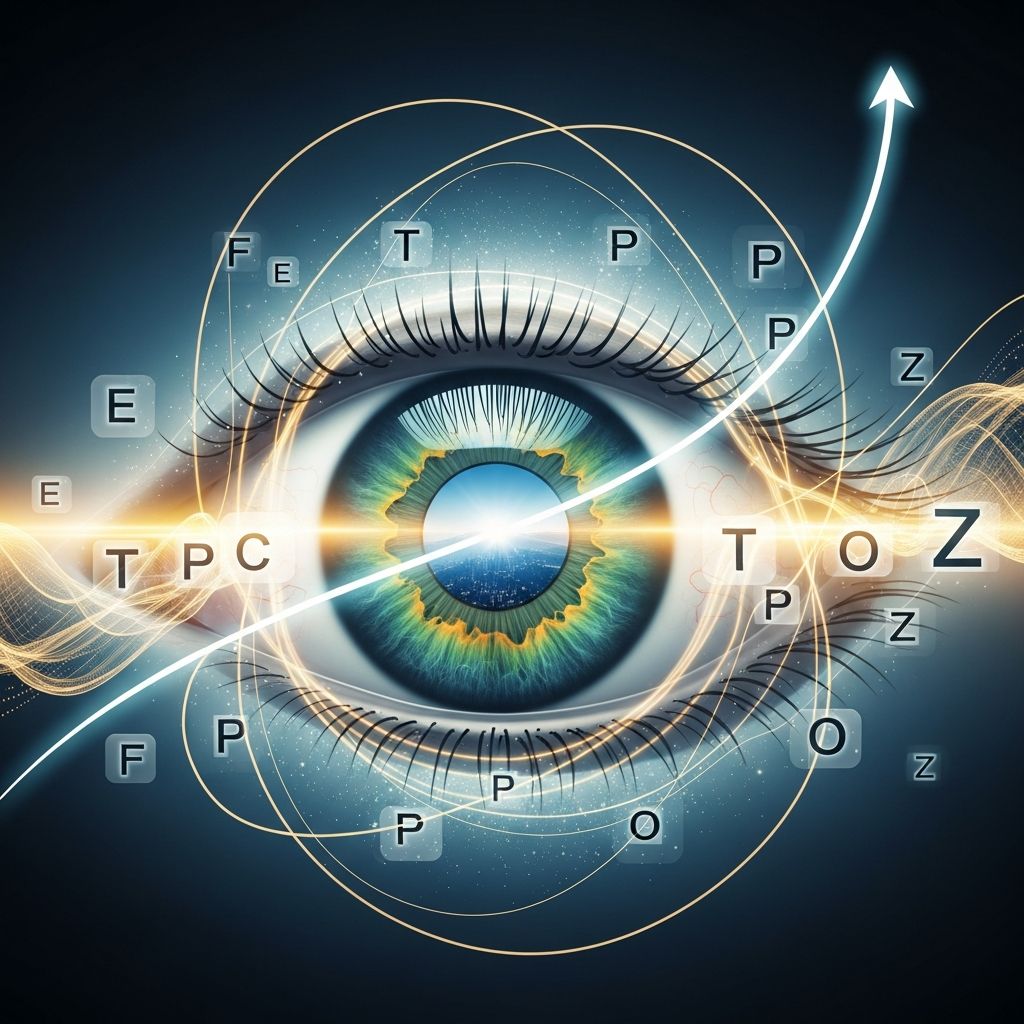
Visual acuity measurements like 20/20 provide a standardized way to assess how sharply someone sees at a distance, but they represent only one aspect of eye health. This guide delves into the science, testing, interpretations, and broader implications of these scores to help you grasp what they mean for your vision.
The Fundamentals of Visual Acuity
Visual acuity describes the clarity and sharpness of vision, particularly for distant objects. The 20/20 benchmark originates from testing protocols where a person stands 20 feet from a chart and identifies letters that an individual with typical sight can discern at the same distance. This metric emerged from standardized eye charts developed in the 19th century, now universally used in clinics worldwide.
At its core, 20/20 indicates average performance: from 20 feet, you resolve details equivalent to what most people achieve unaided at that range. It does not imply flawless eyesight across all conditions or distances. Factors like lighting, contrast, and individual eye anatomy influence results.
How Eye Charts Measure Your Vision
The Snellen chart, featuring progressively smaller letters or symbols from largest at the top to tiniest at the bottom, is the gold standard for acuity testing. Patients read aloud the smallest line they can clearly identify while positioned 20 feet away—often simulated in smaller rooms via mirrors.
- Top line: Large letters visible to nearly everyone, even with significant impairment.
- Middle lines: Represent average to good vision thresholds.
- Bottom lines: Challenge those with exceptional acuity.
Results are recorded as fractions: the first number is the testing distance (20 feet), the second is the distance at which a person with normal vision could read the same line. Thus, 20/20 equals normal; 20/40 means you see at 20 feet what normals see at 40 feet (poorer acuity).
Decoding Common Vision Scores
Vision notations vary widely, each signaling different levels of clarity. Here’s a breakdown:
| Vision Score | Meaning | Implications |
|---|---|---|
| 20/10 | Sees at 20 feet what normal sees at 10 feet | Superior acuity, often in young adults or athletes |
| 20/15 | Sees at 20 feet what normal sees at 15 feet | Better than average, common benchmark for pilots |
| 20/20 | Matches normal vision at 20 feet | Standard for driving without correction in most areas |
| 20/40 | Sees at 20 feet what normal sees at 40 feet | May require correction for sharp distance vision |
| 20/100 | Sees at 20 feet what normal sees at 100 feet | Significant impairment, impacts daily activities |
| 20/200 | Sees at 20 feet what normal sees at 200 feet | Legal blindness threshold in the US with correction |
These scores highlight relative performance against population norms. Superior vision like 20/10 occurs in a small percentage, often linked to keen corneal focusing or larger pupil sizes allowing more light intake.
Why 20/20 Doesn’t Equal Perfect Eyesight
A common misconception portrays 20/20 as ultimate visual prowess, yet it solely gauges central distance acuity. It overlooks numerous eye functions essential for comprehensive sight.
- Near vision issues: Farsightedness (hyperopia) allows clear distance but blurs close objects; presbyopia, age-related focusing decline after 40, demands reading glasses despite 20/20 distance scores.
- Astigmatism: Irregular corneal shape distorts images, requiring correction even with good acuity lines.
- Peripheral vision: Side awareness, crucial for safety, isn’t tested.
- Depth perception: Binocular coordination for 3D judgment.
- Color discrimination: Identifying hues, vital for signals or art.
- Eye teaming: Smooth movement and alignment.
Related Stories



Thus, someone with 20/20 might still wear glasses for these reasons. Only about 35% achieve natural 20/20 globally; others rely on lenses or surgery.
Visual Impairment Categories and Legal Standards
Beyond everyday scores, classifications define impairment levels. The World Health Organization outlines:
- Mild: 20/30 to 20/60 – noticeable but manageable.
- Moderate: 20/70 to 20/160 – requires aids for most tasks.
- Severe: 20/200 or worse – profound daily challenges.
- Profound: 20/500 to 20/1000 – near-total loss.
In the US, legal blindness is uncorrectable vision worse than 20/200 or severely limited visual field. Driving standards often mandate at least 20/40 corrected.
Factors Affecting Your Acuity Score
Scores fluctuate due to multiple influences. Age alters lens flexibility, reducing near focus post-40. Health conditions like diabetes impact retinal vessels; medications dilate pupils unevenly. Environmental factors—fatigue, dry eyes, poor lighting—temporarily degrade performance.
Testing accuracy demands optimal conditions: corrected prior prescriptions, dilated pupils if needed, and rested eyes. Annual exams track changes early.
Achieving and Maintaining Optimal Vision
While genetics set baselines, lifestyle bolsters eye health. Corrective options include glasses, contacts, LASIK for refractive errors. Nutrition rich in lutein, zeaxanthin (leafy greens), omega-3s supports retinas. UV-protective sunglasses prevent cataracts. Regular 20-20-20 breaks curb digital strain.
Comprehensive exams evaluate beyond acuity: pressure for glaucoma, fundus for retina health, refraction for prescriptions.
FAQs on 20/20 Vision
Is 20/20 vision rare?
About one-third of Americans have it naturally; globally lower without correction.
Can you have 20/20 but need glasses?
Yes, for near work, astigmatism, or other deficits.
What’s better than 20/20?
20/15 or 20/10 denotes sharper distance clarity.
Does 20/20 change with age?
Distance often stable, but near vision declines.
How often should I get eye exams?
Adults: every 1-2 years; more if risks present.
Key Takeaways for Everyday Eye Care
Grasping 20/20 demystifies reports and underscores holistic assessments. Prioritize full evaluations for lasting clarity. Early intervention preserves function amid natural declines.
References
- What Does It Mean to Have 20/20 Vision? — Good Eyes. 2023. https://www.goodeyes.com/eye-health/what-does-it-mean-to-have-20-20-vision/
- What Does It Mean to Have 20/20 Vision? — The EyeDoctors. 2024. https://www.theeyedoctors.net/eye-care-resources/what-does-it-mean-to-have-20-20-vision
- 20/20 Vision: What It Means, Tests & Corrective Methods — Cleveland Clinic. 2023-10-26. https://my.clevelandclinic.org/health/articles/2020-vision
- What Does It Mean to Have 20/20 Vision? — EyeCare Associates. 2024. https://www.webeca.com/eye-care-resources/what-does-it-mean-to-have-20-20-vision
- 20/20 Vision. 20/10 Vision. 20/40 Vision. What do all these numbers actually mean? — Commonwealth Eyes. 2012-02-27. https://commonwealtheyes.com/2020-vision-2010-vision-2040-vision-what-do-all-these-numbers-actually-mean/
Similar Articles








Read full bio of Sneha Tete