Understanding the Autorefractor Eye Exam
Discover how autorefractors revolutionize eye exams by providing precise, objective measurements of vision errors in seconds.
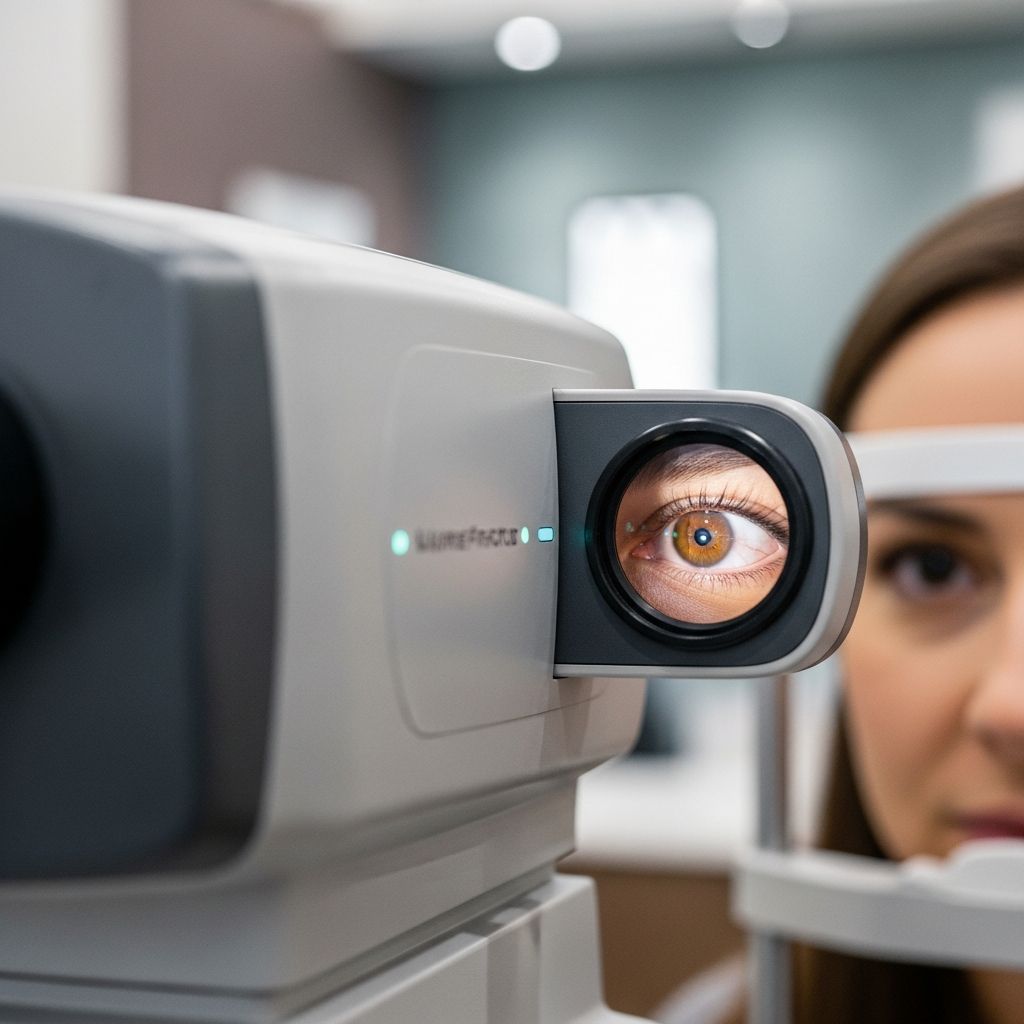
The autorefractor represents a cornerstone of contemporary optometric practice, delivering swift and reliable data on how light bends within the eye to form images on the retina. This device automates the initial assessment of refractive errors, setting the stage for personalized vision correction.
The Science Behind Refractive Errors
Refractive errors occur when the eye fails to properly focus light, leading to blurred vision at various distances. Common types include myopia, where distant objects appear unclear due to light focusing in front of the retina; hyperopia, causing near vision challenges as light focuses behind the retina; astigmatism, resulting from irregular corneal curvature that distorts light rays; and presbyopia, an age-related loss of near focusing ability.
These conditions affect millions worldwide, often progressing silently until detected during routine exams. Early identification via tools like the autorefractor prevents complications such as eye strain, headaches, and reduced quality of life.
How Autorefractors Function: A Step-by-Step Breakdown
At its core, an autorefractor uses infrared light to probe the eye’s optical system without requiring patient feedback, making it ideal for all ages.
- Patient Positioning: The individual rests their chin on a support and forehead against a pad, aligning the eye with the device’s aperture. A joystick ensures precise centering on the pupil.
- Light Projection: An invisible near-infrared beam enters the eye, passes through the cornea and lens, reflects off the retina, and returns to sensors.
- Reflection Analysis: Sensors detect wavefront distortions in the returning light, calculating sphere (nearsightedness/farsightedness), cylinder (astigmatism power), and axis (astigmatism orientation).
- Data Computation: Algorithms process multiple readings across meridians, averaging results for accuracy in seconds.
This objective process yields a baseline prescription, refined later subjectively.
Key Components of Modern Autorefractors
Advanced models integrate sophisticated hardware for precision.
| Component | Function | Benefit |
|---|---|---|
| Light Source (IR LED/Laser) | Emits non-visible beam | Patient comfort, no distraction |
| Optical Sensors | Detect reflected light | High-resolution error mapping |
| Computing Unit | Processes data into Rx values | Wavefront analysis for custom fits |
| Chinrest & Joystick | Stabilizes and aligns | Repeatable, accurate measurements |
| Display Interface | Shows real-time results | Seamless EHR integration |
Integration into the Full Refraction Process
The autorefractor initiates but doesn’t complete refraction. It precedes subjective tests using a phoropter, where patients compare lens choices while reading charts.
- Objective Baseline: Autorefractor or retinoscopy provides starting data.
- Subjective Refinement: Phoropter flips lenses for ‘better or worse’ feedback.
- Near Vision Assessment: Tests reading lenses via intermediate charts.
- Astigmatism Verification: Specialized charts confirm cylinder and axis.
- Final Validation: Trial frames with physical lenses confirm comfort and clarity.
For pediatrics or non-verbal patients, autorefraction dominates due to its feedback-free nature.
Advantages Over Traditional Methods
- Speed: Results in under 10 seconds per eye.
- Objectivity: Unaffected by patient responses, reducing errors.
- Versatility: Effective for children, elderly, or those with cognitive challenges.
- Precision: Detects subtle errors missed by manual techniques.
- Consistency: Repeatable across visits for tracking changes.
Studies affirm autorefractors enhance accuracy, especially in high-volume clinics.
Preparing for Your Autorefractor Test
Minimal preparation is needed, but optimal conditions improve outcomes.
- Remove contacts 24-48 hours prior if instructed.
- Avoid eye makeup or lotions near the device.
- Relax and blink naturally during measurement.
- Follow fixation target without over-focusing.
The test feels like staring into a dimly lit picture that shifts focus automatically.
Safety, Maintenance, and Limitations
Safety features include auto-shutoff for misalignment and low-intensity light to prevent discomfort. Clinics clean contact points between patients and calibrate devices regularly.
Limitations: Cannot assess binocular vision, accommodation, or non-refractive issues like cataracts. Results serve as a starting point, not final prescription.
Role in Detecting Common Vision Issues
Autorefractors excel at quantifying:
- Myopia: Elongated eyeball shifts focus forward.
- Hyperopia: Short eyeball delays focus.
- Astigmatism: Multi-meridian measurements pinpoint irregularity.
- Presbyopia Indicators: Combined with near tests.
Technological Evolution and Future Trends
From basic optometers to wavefront-enabled systems, autorefractors now map higher-order aberrations for custom lenses and refractive surgery planning. Integration with AI promises even faster, predictive analytics.
Frequently Asked Questions (FAQs)
Does the autorefractor hurt?
No, it’s painless and uses invisible light.
How long does it take?
A few seconds per eye.
Can children use it?
Yes, ideal for non-verbal patients.
Is it 100% accurate?
Provides objective baseline; subjective refinement ensures precision.
Do I need dilated pupils?
Usually not; undilated pupils suffice.
What if results seem off?
Eye doctors cross-verify with multiple methods.
Why Regular Eye Exams Matter
Incorporating autorefraction into annual checkups enables early intervention for refractive errors, preventing progression and associated risks like retinal strain. Consult your optometrist for personalized screening.
References
- How Are Refractive Errors Diagnosed? — Optometrists.org. Accessed 2026. https://www.optometrists.org/general-practice-optometry/guide-to-eye-exams/eye-exams/how-are-refractive-errors-diagnosed/
- What is an automated refraction eye test? — Specsavers UK. Accessed 2026. https://www.specsavers.co.uk/eye-test/automated-refraction-eye-tests
- Autorefractor Explained: Best Eye Exam Machines — OPTIUSA. Accessed 2026. https://optiusa.com/blogs/blog/what-is-autorefractor
- Autorefractor — Newcomer Eye Associates. Accessed 2026. https://www.brodskyeye.com/your-eye-health__trashed/eye-exams__trashed/common-tests/autorefractor/
- Understanding the Refraction Process — True Focus Eye Care. Accessed 2026. https://truefocuseyecare.com/blog/understanding-the-refraction-process-demystifying-your-eye-exam/
- Autorefractor – Shining a Light on Your Vision Prescription — OE Berlin. Accessed 2026. https://www.oeberlin.com/blog/autorefractor-prescription-tool.html
- Autorefractors — NCBI Bookshelf (StatPearls). 2023-10-01. https://www.ncbi.nlm.nih.gov/books/NBK580520/
Similar Articles








Read full bio of medha deb