Understanding Your Heart Rate: A Guide to Pulse Assessment
Learn how to accurately measure and interpret your pulse for better health monitoring
What Your Pulse Tells You About Your Health
Your pulse represents the number of times your heart beats in one minute, and it serves as a fundamental indicator of cardiovascular function. When you feel your pulse, you’re detecting the force of blood traveling through an artery located close to your skin’s surface with each heartbeat. This simple measurement provides valuable insights into your overall health status and can help you monitor changes in your physical condition over time.
Understanding your pulse is more than just a medical practice—it’s a practical skill that empowers you to take an active role in managing your health. Whether you’re recovering from illness, training for athletic performance, or simply maintaining wellness, knowing how to measure and interpret your pulse correctly is essential. Healthcare providers frequently assess pulse during routine checkups, after injuries, and when monitoring chronic conditions.
Where to Find Your Pulse on Your Body
The pulse can be measured at multiple locations throughout your body where arteries lie close enough to the skin’s surface to be compressed against bone. This accessibility makes pulse checking a convenient self-care technique that doesn’t require any special equipment.
The most commonly used locations for pulse measurement include:
- Radial artery (wrist): Located on the thumb side of your wrist between the wrist bone and tendon, this is the easiest and most accessible location for routine pulse checks
- Carotid artery (neck): Found alongside your windpipe, this artery provides an alternative measurement point, though it requires careful technique
- Additional locations: Your pulse can also be detected at the elbow, behind the knee, and on the top of your foot, though these are less commonly used for routine monitoring
Step-by-Step Guide to Measuring Your Radial Pulse
The radial pulse at your wrist is the preferred location for most people because it’s easily accessible and straightforward to locate. Following the correct technique ensures accurate measurements and consistent results.
Preparation Phase
Before attempting to measure your pulse, take a moment to prepare yourself and gather necessary materials. Wash your hands thoroughly to maintain hygiene, and if possible, sit or lie down for several minutes to achieve a resting state. This baseline measurement is particularly important if you’re monitoring your resting heart rate for health assessment purposes.
Location and Positioning
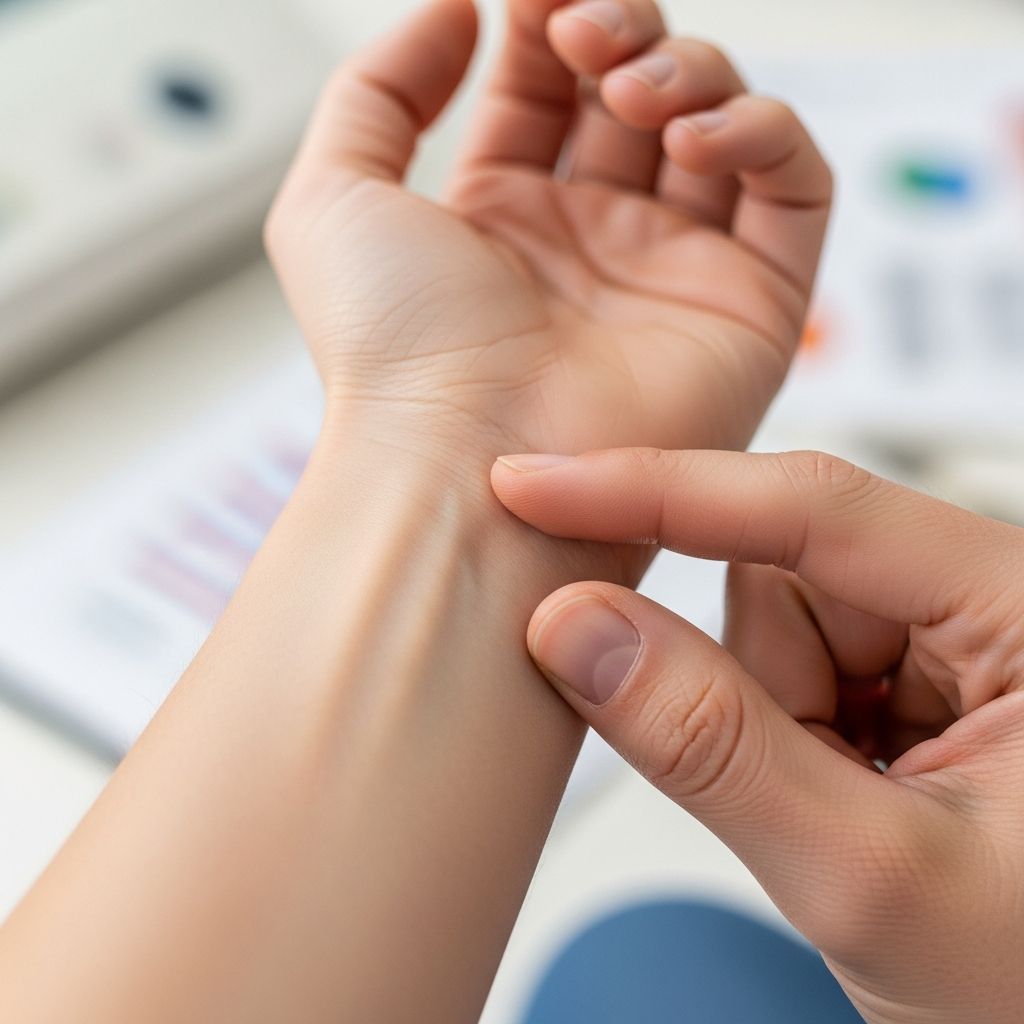
Position the hand you want to check with your palm facing upward. Look at the area between your wrist bone and the tendon visible on the thumb side of your wrist. This groove-like area is where the radial artery runs closest to the surface, making it the optimal location for pulse detection.
Finger Placement Technique
Using your opposite hand, place the tips of your index and middle finger (second and third fingers) in the groove on the thumb side of your wrist. Avoid using your thumb, as it has its own pulse that can interfere with accurate measurement. Apply gentle, steady pressure until you feel the pulse beneath your fingers.
Pressure control is critical during this step. Press firmly enough to feel each heartbeat clearly, but not so hard that you compress the artery and block blood flow. Finding this balance typically requires practice, and your ability to detect the pulse easily will improve with repetition.
Related Stories



Counting and Recording
Once you’ve located your pulse, watch the second hand on your watch or clock. Several timing approaches work effectively:
- Count beats for a full 60 seconds and record the total—this is the most straightforward method
- Count beats for 30 seconds and multiply by two
- Count beats for 15 seconds and multiply by four
- Count beats for 10 seconds and multiply by six
- Count beats for 6 seconds and multiply by ten for quick assessment
Shorter counting intervals can be helpful if you find it difficult to maintain focus or accurately track beats over a full minute. Write down your measurement immediately to ensure you don’t forget the number.
Measuring Pulse at Your Neck
The carotid artery in your neck provides an alternative pulse measurement location. While slightly more sensitive than the wrist location, the neck pulse can be useful in certain situations.
Proper Technique for Carotid Pulse
Locate the artery on one side of your neck in the groove alongside your windpipe, just below your jaw. Place the tips of your index and middle finger gently in this groove and apply light pressure until you feel the pulse.
Critical safety consideration: Never press on both sides of your neck simultaneously, as this can restrict blood flow to your brain and cause dizziness, lightheadedness, or fainting. Always check one side at a time, and if you have been diagnosed with plaques in your neck arteries, avoid this measurement location entirely.
What Normal Heart Rate Ranges Mean
Understanding what constitutes a normal heart rate helps you interpret your measurements correctly. Heart rates vary significantly from person to person based on age, fitness level, and overall health status.
For most adults at rest, a normal pulse falls between 50 and 90 beats per minute. However, athletes and individuals with high cardiovascular fitness may have resting heart rates as low as 40 to 60 beats per minute. Conversely, sedentary individuals might naturally fall at the higher end of the normal range.
During physical activity, your pulse rate should elevate to between 50% to 70% of your maximum heart rate. You can calculate your predicted maximum heart rate by subtracting your age from 220. For example, a 30-year-old would have a predicted maximum heart rate of 190 beats per minute (220 – 30 = 190), meaning their exercise heart rate should fall between 95 and 133 beats per minute during moderate activity.
Assessing Pulse Strength and Rhythm
Beyond simply counting beats, healthcare providers and informed individuals also evaluate two important characteristics of the pulse: its strength and its regularity. These qualities provide additional information about cardiovascular health.
Understanding Pulse Strength
Pulse strength describes how forcefully blood is being pumped through the artery. As you feel the pulse, notice whether each beat feels strong and robust or weak and faint. Experienced practitioners compare pulse strength to what they’ve observed in previous measurements, noting whether the force feels consistent across multiple beats.
Evaluating Rhythm and Regularity
A regular pulse means each beat occurs consistently at predictable intervals, like a steady rhythm. As you count, listen and feel for any interruptions or variations in this pattern. An irregular heartbeat may present as a skipped beat, a sudden change in rate, or an unpredictable pattern without apparent rhythm.
Irregularities can be classified in two ways: regularly irregular (where skipped beats occur in a predictable pattern) or irregularly irregular (where no pattern exists). If you notice any rhythm irregularities that are new or unexpected, inform your healthcare provider.
Importance of Regular Pulse Monitoring
Establishing your personal baseline heart rate through regular measurement allows you to recognize when changes occur. As you track your pulse consistently over weeks and months, you’ll develop familiarity with what’s normal for your body.
Monitoring your pulse becomes especially valuable when you notice changes that warrant further investigation. Contact your primary care provider if you observe:
- A significant increase in your resting heart rate compared to your established baseline
- A decrease in your resting heart rate that seems unusual for you
- New irregularities in your heart rhythm or pulse strength
- Dizziness, shortness of breath, or chest discomfort accompanying pulse changes
- Persistent elevation in pulse rate without a clear cause like exercise or stress
Using Technology for Heart Rate Measurement
While manual pulse checking remains a valuable skill, modern devices have made heart rate monitoring increasingly accessible and convenient. Smartwatches, fitness trackers, and smartphone applications can automatically measure your heart rate using various technologies.
The advantages of electronic devices include automatic timing, elimination of counting errors, and the ability to track changes and trends over extended periods. Many of these devices are becoming increasingly accurate, though none are perfect.
If you’re uncertain about the accuracy of a device, you can verify its readings by simultaneously taking your pulse manually and comparing the numbers. This dual-measurement approach provides confidence in either method and helps identify any consistent discrepancies in device performance.
Clinical Applications and When to Seek Help
Healthcare providers assess pulse as part of routine patient evaluation because irregularities can indicate underlying heart problems that require investigation. Taking the pulse provides essential information about patient suitability for procedures and helps establish baseline measurements for comparison during follow-up visits.
Certain pulse abnormalities warrant medical attention more urgently than others. While a single elevated pulse reading during stress or excitement is normal, persistent changes in your resting heart rate pattern deserve evaluation by a healthcare professional. Similarly, any newly discovered irregularities in rhythm or strength should be reported to your doctor.
Practical Tips for Successful Pulse Measurement
- Practice regularly to develop the sensitivity needed to locate and feel the pulse quickly
- Keep written records of your pulse measurements to identify trends and patterns
- Measure your resting pulse at the same time each day for consistent baseline data
- Avoid caffeine, nicotine, and strenuous activity for 30 minutes before measuring resting heart rate
- Be patient with yourself if you initially struggle to locate or count your pulse—skill improves with practice
- Compare manual measurements with device readings to verify accuracy and build confidence
- Communicate any concerning changes to your healthcare provider promptly
Frequently Asked Questions About Pulse Measurement
What’s the difference between pulse and heart rate?
The terms are essentially synonymous—pulse is the physical sensation you feel when blood is pumped through arteries, while heart rate is the measurement of how many times per minute this occurs.
Can pulse measurement be taken through clothing?
For the wrist, you may feel the pulse through thin clothing, but bare skin provides the clearest sensation. For the neck, avoiding heavy clothing or tight collars improves accuracy.
How often should I check my pulse?
This depends on your individual health situation. Healthy individuals may check occasionally for self-awareness, while those with cardiac conditions may need daily or more frequent measurements as directed by their healthcare provider.
Why might my pulse feel irregular?
Various factors can cause temporary irregularities, including stress, caffeine, exercise, or underlying cardiac conditions. Persistent irregularities require medical evaluation.
Is a lower resting pulse rate always better?
While trained athletes often have lower resting heart rates reflecting cardiovascular efficiency, a sudden decrease in your established baseline can indicate a problem and should be evaluated medically.
References
- How to measure the pulse — National Institutes of Health, National Center for Biotechnology Information. 2013. https://pmc.ncbi.nlm.nih.gov/articles/PMC3756652/
- How to Check Your Heart Rate (Manually and Using a Device) — Massachusetts General Hospital. 2024. https://www.massgeneralbrigham.org/en/about/newsroom/articles/how-to-check-your-heart-rate
- How to take your pulse — Mayo Clinic. 2024-04-16. https://www.mayoclinic.org/healthy-lifestyle/adult-health/in-depth/how-to-take-pulse/art-20482581
- How to measure someone’s heart rate — NHS/Public Health England. https://www.youtube.com/watch?v=em9poqLcJRw
- How To Check Your Pulse — Cleveland Clinic. 2024. https://my.clevelandclinic.org/health/articles/23918-how-to-take-your-pulse
- How to check your pulse — British Heart Foundation. https://www.bhf.org.uk/informationsupport/tests/checking-your-pulse
Similar Articles








Read full bio of medha deb